The Security Service of Ukraine (SBU) recently published a bold video compilation of drone attacks on parked Russian fighter jets, once again demonstrating the asymmetric warfare unleashed on multi-million dollar warplanes using cheap one-way attack drones that sometimes cost as low as $10,000.
The SBU announced that its elite “Alpha Group,” also known as “A” Special Operations Centre, targeted five Russian military airfields and damaged about 15 Russian aircraft in a string of long-range drone attacks throughout 2025.
“The enemy had become used to feeling safe in the rear. But for the special forces of the SBU’s ‘Alpha’ unit, distance is no longer an issue,” the SBU said in a statement on January 28, 2026.
The videos, evidently recorded from the drone cameras, show several Russian aircraft being targeted in different attacks. The SBU claimed that the strikes destroyed 15 Russian military aircraft, along with associated ammunition and fuel depots, inflicting an estimated $1 billion in total damage.
The SBU did not say how it arrived at the $1 billion mark. However, to put the figure in perspective, the SBU claims to have destroyed: Eleven fixed-wing aircraft, including the Su-30SM, Su-34, Su-27, Su-24, and MiG-31; three helicopters, including the Mi-28, Mi-26, and Mi-8; and one An-26 transport aircraft.
5 аеродромів, мінус 15 авіабортів та $1 млрд: далекобійна «математика» від «Альфи» СБУ
На унікальних кадрах підтверджені ураження:
▪️ Су-30СМ, Су-34, Су-27, Су-24, МіГ-31
▪️ Мі-28, Мі-26, Мі-8
▪️ Ан-26Разом із технікою на аеродромах згоріли склади з боєприпасами та пальним. pic.twitter.com/lr3cJdRgUO
— СБ України (@ServiceSsu) January 28, 2026
The SBU did not mention the location of these strikes. However, open-source intelligence (OSINT) analysts and reports in local media suggest that the Su-30SM fighter jet and Su-24 bombers were likely struck in January at the Saky airfield in Crimea. The other targeted bases include Kirovskoye, Simferopol, and Belbek—all of which are in Crimea.
These strikes are, therefore, separate from the deep-strike offensive launched by Ukraine in June 2025 as part of “Operation Spiderweb.”
While the SBU did not specify which drones were used in the strikes, we understand that Ukraine has developed a diverse fleet of cheap, one-way, long-range attack drones, often costing under $10,000 each.
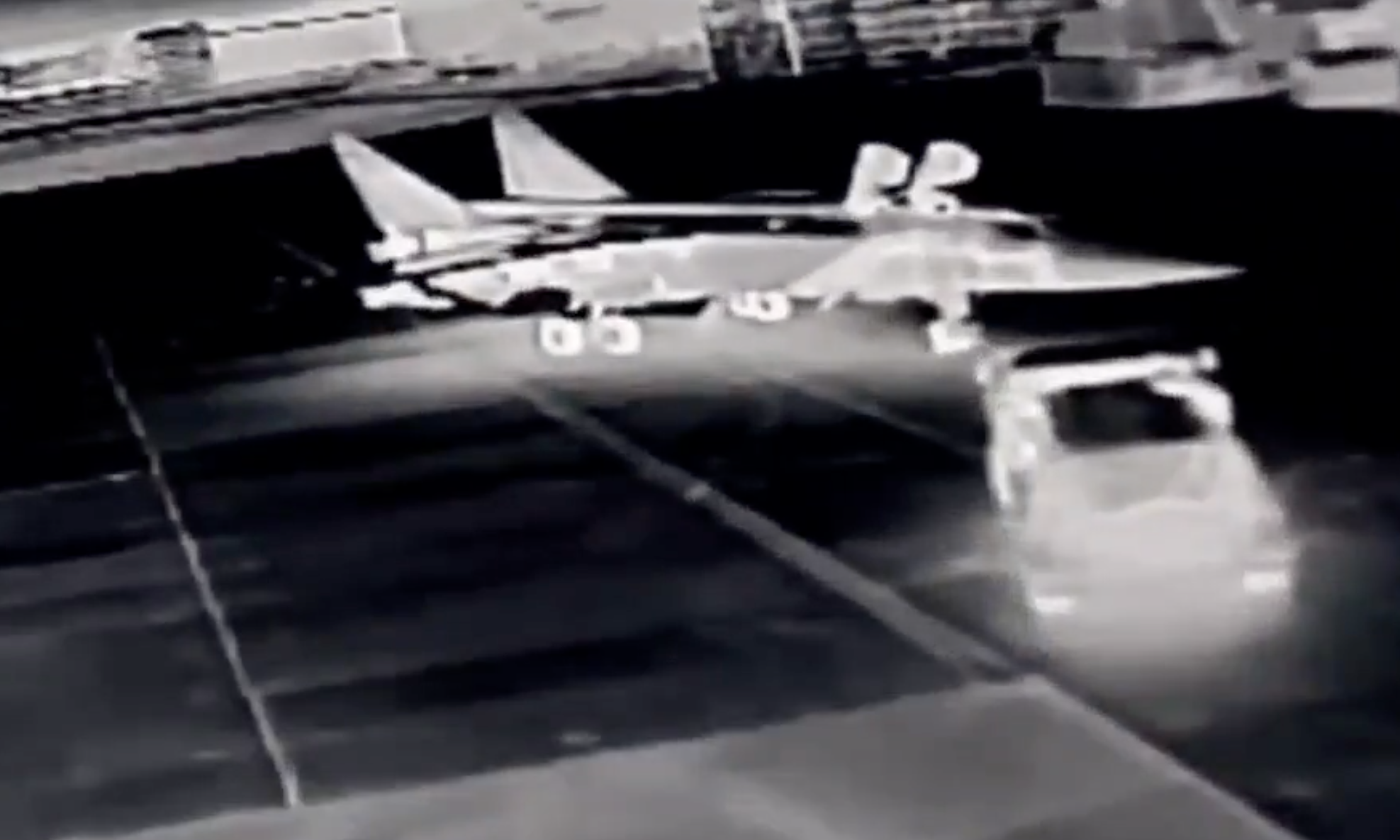
Interestingly, Ukrainian drones were able to get past advanced Russian air defences to conduct “long-range” surprise attacks. However, the precise Russian losses claimed by SBU have not been publicly acknowledged or denied by Moscow.
Ukraine’s Attack On Parked Russian Aircraft
Initially, when Ukrainian drones struck Russian airfields and damaged crucial assets, Moscow’s response was to leverage the strategic depth of the large Russian landmass and redeploy the jets deeper inside Russia, where the Ukrainian drones could not possibly reach.
However, that has rapidly changed with the emergence of Ukraine’s long-range drones that regularly attack targets deep inside Russian territory. These attacks started as early as 2022 when Ukraine first started repurposing its Soviet-era unmanned aerial vehicles (UAVs) to strike Russian airfields.
On the morning of December 5, 2022, Ukraine attacked two air bases in Russia using Soviet-made UAVs – Dyagilevo in the Ryazan region (approximately 285 miles from Ukrainian territory) and Engels in the Saratov region (approximately 315 miles from Ukrainian territory) in an effort to disable Russian long-range aircraft.
At the time, unconfirmed reports claimed that the Ukrainian drones managed to damage two Tu-95, a Tu-22M3, and an Il-78. This was followed by a similar targeting of the Engels-2 airbase again in the next 20 days, which allegedly damaged Tu-95 bombers.
In August 2023, Russia was hit by what it described as the biggest attack on its soil (by that time). The drones travelled about 600 kilometres from the Ukrainian border and destroyed about four Il-76 military transport aircraft in Russia’s Pskov Oblast.
In April 2024, dozens of Ukrainian drones attacked locations in western Russia and other areas, including an airport housing a squadron of Sukhoi jet planes. The drones reportedly attacked the military airfield in Morozovsk in the Rostov region that hosted Su-24, Su-24M, and Su-34 bombers.
Not just that, the Ukrainian Defence Intelligence Agency (GUR) announced in June 2024 that the Sukhoi Su-57 stealth fighter was struck by a drone on the tarmac of an airbase in the Astrakhan region, almost 600 kilometres behind the front lines.
The agency also posted satellite images to back its claims, saying, “The images show that on June 7, Su-57 was still intact, but on June 8, craters from the explosion and distinctive fire spots emerged near it as a result of the fire damage.”
However, Ukraine’s most audacious mission, named “Operation Spiderweb”, was launched on June 1, 2025, and changed the rules of this war forever.
“$7 billion: This is the estimated cost of the enemy’s strategic aviation, which was hit today as a result of the SBU’s special operation,” the SBU said in a social media post at the time.
As part of this operation, about 117 short-range First-Person-View (FPV) quadcopter drones were flown into Russia and concealed inside prefabricated modular structures, like wooden sheds, mounted on truck trailers. The drones were then transported throughout the nation by unwitting Russian truck drivers.
The retractable roofs were remotely opened at pre-designated times when the trucks were parked at designated locations. This allowed the drones to be launched from very close range, to bypass most of Russia’s electronic warfare and air defence detection systems.
This strategy maximised damage to vulnerable aircraft parked on the ground, and was described by analysts as the most humiliating offensive launched by Ukraine.
The strikes hit four Russian airbases housing Long-Range Aviation assets, including Belaya in Irkutsk Oblast, Siberia; Olenya in Murmansk Oblast; Dyagilevo in Ryazan Oblast; and Ivanovo Severny in Ivanovo Oblast.
The operation was apparently planned over 18 months, as disclosed by Ukrainian President Volodymyr Zelenskyy, who personally oversaw it.
Ukraine’s SBU and officials claimed that about 41 Russian military aircraft were either damaged or destroyed, such as the Tu-95MS and Tu-22M3, as well as an A-50 airborne early warning aircraft.
However, subsequent reports and expert opinions rejected the claims, arguing that the number of aircraft lost was most likely in single digits. Nonetheless, the operation prompted dispersion of remaining strategic bombers farther east, temporarily constraining long-range missile strikes on Ukraine.
Operation Spiderweb demonstrated Ukraine’s creative use of asymmetric, low-cost drone warfare to target valuable objects located far behind lines. And, it may have become a template for future attacks, signalling to Russia that its aircraft are never safe, no distance.
However, unlike the Operation Spiderweb, the attacks shown in the latest video are all concentrated in the Crimean Peninsula, which once belonged to Ukraine.
Russian aviation has suffered terrible attrition as a result of Ukraine’s 2025 drone campaign, including the Operation Spiderweb. It is estimated that 10–20 airframes may have been severely damaged or written off.
- Contact the author at sakshi.tiwari13 (at) outlook.com
- Follow EurAsian Times on Google News