Between August 2024 and February 2026, unexplained and suspicious Uninhabited Aerial Vehicles (UAVs) were sighted over sensitive NATO military bases all over Europe, including nuclear-sharing sites hosting American B61-12 gravity bombs and France’s ballistic-missile submarine base at Île Longue, forcing repeated closures of major commercial aviation hubs, disrupting military operations and spreading panic.
Now, after a detailed study, the International Institute for Strategic Studies (IISS) has assessed that the strategic drone campaign over sensitive military sites in Europe was conducted by Russia as part of its unconventional warfare in Europe.
It found that “it is highly likely that the Kremlin conducted a UAV campaign over Europe,” which began in August 2024 and continued unabated in 2025 and even in 2026.
However, it must be noted that, so far, no European government has formally blamed Russia for these drone sightings.
Additionally, the report is based on circumstantial evidence and open-source information.
The report concludes that Russia probably used its shadow fleet to launch drones from international waters.
“We assess it is likely that Russian-linked vessels and the ‘shadow fleet’ were used as launch/recovery platforms for UAVs as part of the Kremlin’s wider unconventional war on Europe.”
Since 2022, Russian oil exports have increasingly relied on a fleet of aging, re-flagged tankers acquired through multi-layered holding structures in jurisdictions including the Marshall Islands, Panama, and Sierra Leone.
Ironically, the sanctions imposed by Western countries and Russia’s reliance on this shadow fleet for oil exports have helped the Kremlin in launching a systematic drone campaign over Europe.
According to estimates, Russia has more than 1,300 tankers in its shadow fleet.
“While the aim is to frustrate sanctions enforcement and complicate port state control, it has the secondary effect of obstructing any intelligence attribution of hybrid activities conducted from those vessels,” it said.
To launch UAVs, the most relevant technique is ‘dark sailing,’ sailing close enough to a target coastline to bring embarked UAVs within range.
“It is plausible that a Russian-linked vessel and/or shadow fleet tanker approaches the operating area, switches off its AIS transponder while a launch or recovery of a UAV takes place, and resumes normal transmission once clear of the area,” it said.
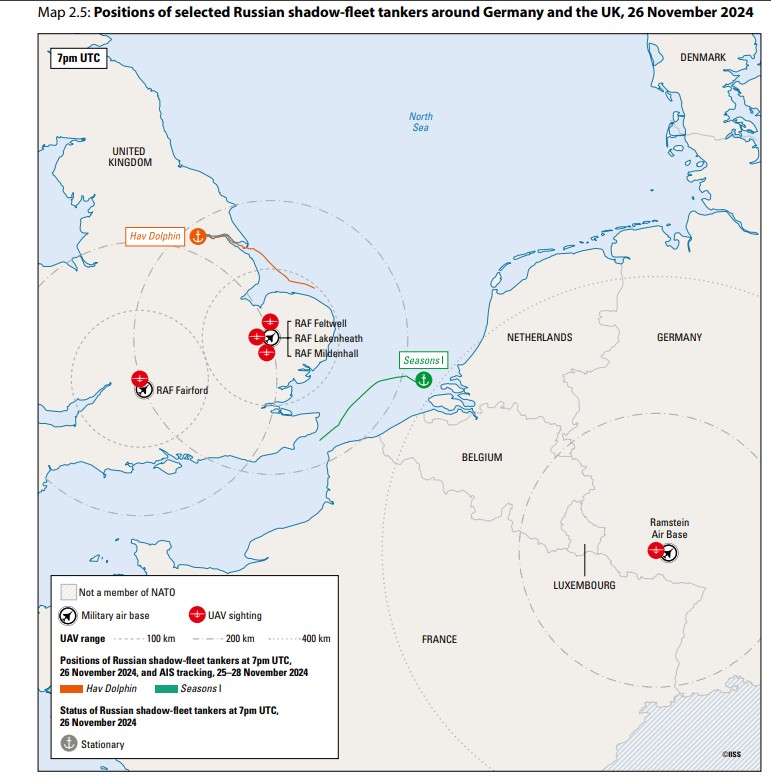
The IISS report specifically mentions ‘Hav Dolphin,’ a vessel later linked to 2025 drone incidents in Germany and the Netherlands, which happened to be docked in the UK during drone incursions over the RAF bases.
The systematic drone campaign over military sites all across Europe represents, the report warns, both a series of “tactical successes for the Kremlin and a strategic failure of allied air defense.”
These drones were sighted at Ramstein Air Base in Germany, RAF Lakenheath, and then over RAF Fairford, RAF Feltwell, and RAF Mildenhall, among other military sites in Europe.
The report also explains how Russia was able to execute systematic drone incursions all over Europe for nearly two years. “The Kremlin’s success rests on a basic strategic insight: Europe’s air-defense architecture was designed to detect and defeat conventional air threats operating in a recognizable battlespace.”
“It was not built for, by comparison, relatively low-cost UAVs and deniable incursions with the aim of exposing gaps in detection, decision-making and legal authority – all while remaining below the threshold of a collective allied response,” it said.
The report also highlights a crucial lacuna in the European response.
While Russia targeted military sites all over Europe, the response it received was fragmented.
“The relevant governments focused on the national response rather than connecting the dots across Europe,” it said.
“Open-source reporting of each incident in the IISS dataset suggests the Kremlin’s campaign exposed political fractures within the Alliance, as well as exploiting the gap between what European militaries could do and what their governments were prepared to authorize,” it added.
Russia’s Objectives
Russia’s systematic drone campaign over military sites in Europe had multiple objectives, among them:
- Probing the response times and decision-making thresholds of allied air defense and civil-military command structures;
- Mapping vulnerabilities around critical infrastructure, including dual-use civilian hubs, military logistics nodes supporting Ukraine, and facilities associated with allied nuclear deterrence;
- Imposing economic and psychological costs on European societies through the disruption of civilian aviation and public confidence in airspace security; and
- Normalizing low-level airspace violations below the threshold of a direct allied military response.
The campaign is likely to have generated operational value to Russian planners: radar exposure, reaction times, interception corridors, rules-of-engagement thresholds, and the geography of NATO’s reinforcement routes across Europe and to Ukraine, it said.
European Response
Notably, many European governments reformed their archaic legislation after repeated UAV incursions.
For instance, in Germany, the Bundeswehr was only legally authorized to shoot down UAVs if they were flying directly over military installations, leaving the protection of airspace strictly to law enforcement.
Following numerous incidents, the authorities approved an amendment explicitly allowing the police to shoot down UAVs.
Germany also established a national UAV defense center (Drohnenabwehrzentrum) designed to bring together the competencies of the federal police, state authorities, and Bundeswehr.
The Netherlands hosted a drone and counter-drone exercise in May 2026.
Lithuania explicitly authorized the peacetime shootdown of drones crossing its borders.
Romania also established specific legal frameworks that grant its military explicit authorization to intercept and destroy hostile drones.
Similarly, an EU Counter-drone Center of Excellence is planned for Geel, Belgium, by early 2027.
The UAV incursion into Polish airspace in September 2025 prompted Warsaw to invoke Article 4 (Members will consult together whenever territorial integrity is threatened) for the eighth time in NATO’s history.
Yet crucial gaps remain in Europe’s collective response and air defense architecture, which Russia might be exploiting.
The maritime dimension is the most important unresolved vulnerability, it warns.
“If Russian-linked vessels can launch, support or relay UAV operations from international waters or European EEZs, they can complicate attribution, exploit commercial cover and avoid the warning indicators associated with land-border incursions.”
However, Russia’s reliance on UAVs also reveals the limits of its intelligence-collection options.
Why is Russia Using UAVs for Intelligence Gathering?
The Kremlin has been forced to find a series of workarounds since large numbers of Russian intelligence officers were expelled from European capitals in 2022, it said.
The UAV campaign also exposed gaps in Russia’s Earth imaging and reconnaissance capacity, especially when Russia’s UAV Campaign Over Europe is compared with the combined military and commercial space support available to Ukraine and NATO states, it added.
The report concludes that the European response is fragmented, incomplete, and not strong enough to discourage Russia from continuing its UAV operations over sensitive European sites.
“The first point to note is that as long as the rules of engagement remain fragmented across national jurisdictions, the Kremlin will continue to exploit them,” it said.
Further, no UAVs were recovered intact at the nuclear sites they flew over, and no operatives were apprehended launching UAVs from shadow-fleet vessels.
The report notes that apart from the Charles de Gaulle incident, no other incident has been publicly attributed to Russia.
Furthermore, there is still no clarity as to what will constitute a hostile act and when a drone incursion should merit a military response.
The report also brings attention to the maritime dimension of these drone incursions.
“As long as Russian-linked vessels and the shadow fleet can loiter in international waters or European EEZs and launch UAVs with effective impunity, the campaign’s primary enabling mechanism remains intact,” it warns.
The report underscores the urgent need for Europe to formulate a clear, legally sound, strong, and coordinated response to Russia’s unconventional and hybrid warfare against Europe involving drone incursions launched from a shadow fleet loitering in international waters.
- Sumit Ahlawat has over a decade of experience in news media. He has worked with Press Trust of India, Times Now, Zee News, Economic Times, and Microsoft News. He holds a Master’s Degree in International Media and Modern History from the University of Sheffield, UK.
- He can be reached at ahlawat.sumit85 (at) gmail.com