Amidst mounting protests in Pakistan-occupied Kashmir, Pakistan is once again under the spotlight for all the wrong reasons.
Reports indicate that more than 45 people have been killed and over 200 have been injured amid the ongoing unrest. The people are not protesting merely over basic issues such as flour, healthcare, electricity, and other essential facilities. This is a systemic and structural issue whose roots go back to 1947, when the region was seized by Pakistan.
The people of PoK (called Azad Kashmir in Pakistan and Pakistan-occupied Kashmir in India) have, only on paper, their own Prime Minister, cabinet, President, Legislative Assembly, and other institutions. Linguistically and through official narratives, they are “Azad” (free), but in reality, they are directly controlled and administered from Rawalpindi and Islamabad.
For more than 78 years, they have been denied meaningful political representation, participation, and basic civil liberties.
A Human Rights Watch report exposed the extent of these restrictions and the hypocrisy of the Pakistani state, noting that “No person or political party … shall be permitted to propagate against … the ideology of the State’s accession to Pakistan.”
The report argued that this provision under the Azad Jammu and Kashmir Interim Constitution Order, 1974, effectively bars advocates of independence or alternative political futures from fully participating in the political process. It also noted that, as per these legislative measures, those seeking public office in PoK, judicial positions, or government employment are required to take an oath of allegiance to Pakistan and to the cause of Kashmir’s accession to Pakistan, thereby restricting independent voices, political pluralism, and genuine political freedoms and civil liberties.
Enforced disappearances, arbitrary detentions, and intimidation of dissenting voices have been repeatedly reported. In PoK, nobody can dare to question the Pakistani state or army without facing serious consequences; those who do risk being picked up, detained, or disappeared, often being held incommunicado without disclosure of their location or access to legal safeguards.
Today’s ongoing uprising against the Pakistani state should therefore not merely be seen as a law-and-order or administrative issue, as it is often portrayed. If it were simply a governance issue, then why did protests erupt again after Pakistan claimed to have accepted most of the 38 demands raised by the JAAC following last year’s protests?
In fact, Pakistan reportedly accepted 36 of the 38 demands, including many of the economic demands. Yet protests erupted again because the key demands relating to civil and political rights remained unaddressed, particularly the abolition of the 12 refugee seats. The reason is clear: Rawalpindi knows that if these seats are abolished, it would lose a crucial instrument of control over PoK and its assembly.
These seats are used for political engineering and to influence decisions and outcomes within the PoK Assembly. Pakistan argues that these seats cannot be abolished because the Kashmir issue remains unresolved, and it does not want to alter the legal status of the dispute, and that these seats represent the people living in Indian Kashmir.
However, this narrative is misleading. The seats are largely occupied by individuals settled in Pakistan’s provinces rather than by those who actually crossed over from Indian Kashmir. Those who actually deserve them remain denied these rights.
By contrast, India has 24 seats reserved in the Jammu and Kashmir Legislative Assembly for areas of the erstwhile state under Pakistan’s occupation, but these seats remain vacant and are not filled through elections.
At the same time, this argument of maintaining the “disputed status” stands in contradiction to the broader political and legal framework in PoK itself and the changes it has brought over these years, which include constitutional provisions that restrict political options by effectively prioritising accession or merger narratives, while pro-independence voices have long faced suppression, and political space has been shaped in a way that limits alternatives outside a pro-merger narrative.
Pakistan has also effectively extended restrictions on literature and political expression supporting independence, including the 2016 ban on 16 books and booklets, among them works such as Who Am I? and The Story of Escape from Srinagar Prison, which are associated with figures like Maqbool Bhat.
The people of PoK have endured this situation because Pakistan has long conditioned them to believe that whenever they raise their demands, the “Kashmir cause” will suffer and “India will take advantage” of it. This psychological warfare, propaganda, and narrative-building have been used since 1947 to keep the population under control. However, the limits have now been crossed. Conditions have deteriorated significantly, and people have begun resisting the Pakistani state.
Moreover, whenever Pakistan raises the Kashmir issue at the global stage against India, it projects itself as if everything is perfectly fine in PoJK, as if it has granted complete freedom to the people there, including all political, civil, and economic rights, and as if the people are entirely satisfied and happy there.
In reality, Pakistan has brutally suppressed dissenting voices and deprived them of their basic rights in PoJK for decades, and has effectively used cognitive warfare not only to control PoJK but also to conceal the region’s real problems from the international community. In many ways, it has effectively employed what Plato described as the “noble lie” to maintain control.
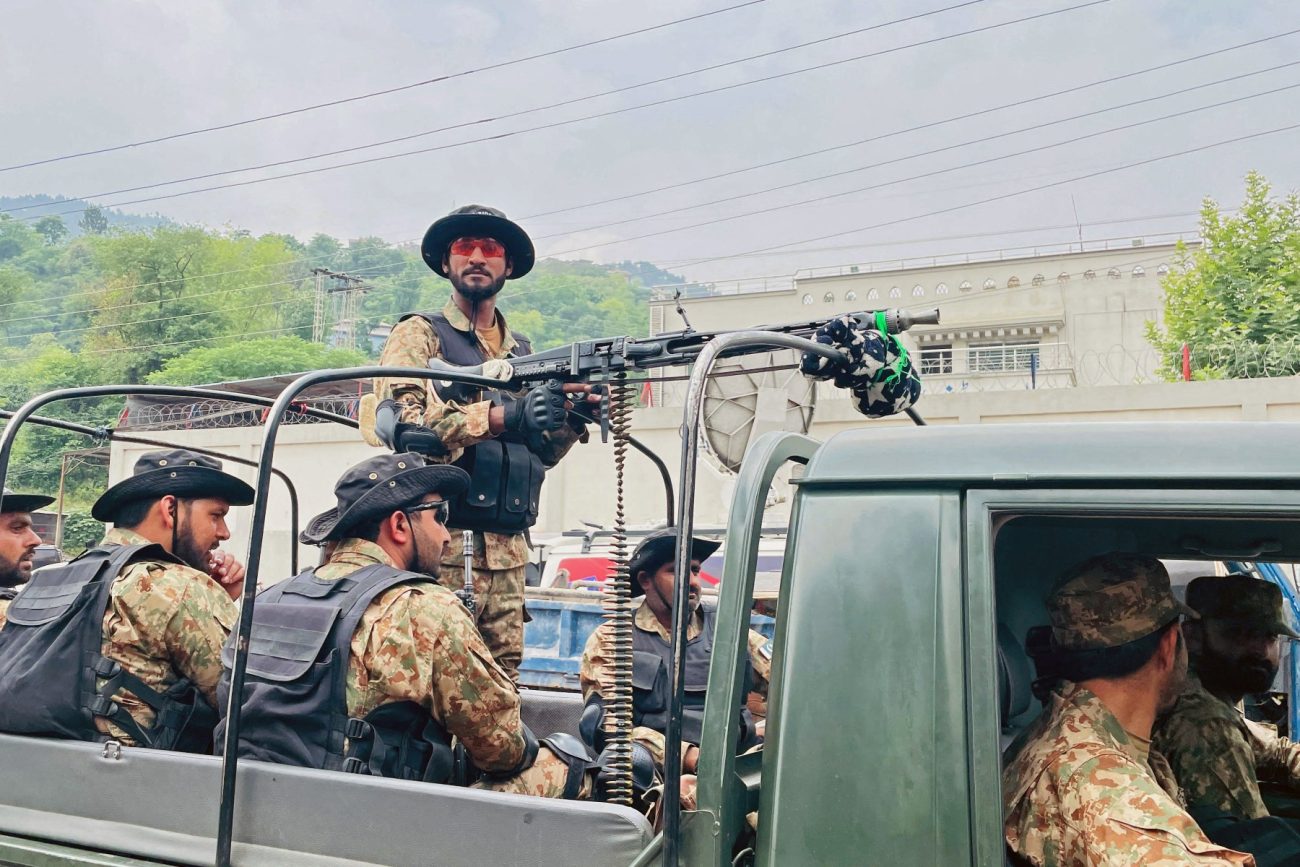
Collapse of Pakistan’s Narrative on Kashmir
These existing developments have significantly exposed Pakistan internationally. For years, it has accused India of human rights violations and restrictions on civil liberties. But today, Pakistan itself has been exposed over the continued oppression and suppression in PoK, with international observers, rights organizations, and political activists weighing in.
One can see how things have changed now: the Kashmiri diaspora that Pakistan once actively mobilized to protest against India, in places like the United Kingdom and elsewhere, is now protesting against Pakistan itself. The tables have turned, and the same diaspora that Pakistan promoted for decades is now questioning its policies.
The situation surrounding the JAAC further highlights these contradictions. It has been declared a terrorist organization, and its members, who had been in negotiations with the Pakistani government, are now being labeled as terrorists, with rewards announced for information leading to their arrest. Authorities have announced a reward of Rs 10 million (Rs 1 crore) for information leading to the arrest of four JAAC core leaders, including Shoukat Nawaz Mir, Umar Nazir Kashmiri, Khawaja Mehran Arshad, and Sardar Aman Khan. Until recently, Pakistan was negotiating with them; today, they are being labeled as terrorists. This raises serious questions about civil liberties and political freedoms in the region and further undermines Pakistan’s long-standing narrative against India.
Amnesty International has described the designation of the Joint Awami Action Committee (JAAC) as a proscribed organization under anti-terror laws as “disproportionate, unlawful and a violation of the right to freedom of association,” further highlighting what it termed an “alarming deterioration of human rights” in the region.
Today, Pakistan stands exposed on the global stage. Its narratives and propaganda have increasingly come under scrutiny. The world is witnessing realities today that were long concealed. International organizations, including human rights groups, have condemned the killings and the use of force on protesters.
In fact Pakistan has long used the Kashmir issue – not only against India but also as a means of controlling PoJK and for maintaining the dominance of the military establishment. Anyone who demanded rights or questioned the state was accused of damaging the ‘Kashmir cause’ or ‘helping India’. In these accounts, genuine demands were often suppressed.
Ultimately, the recent killings of protesters will prove to be a turning point. The deaths of innocent people demanding basic rights and facilities are likely to sow the seeds of greater public resentment and generate potent symbols around which future resistance will mobilize.
There, people have found heroes and events to look up to and romanticize, and these developments are likely to become lasting symbols that will be remembered by people and passed on over time through socialization. These will remain etched in the collective memory, reinforcing resolve and making it difficult for Pakistan to perpetuate its traditional narratives and propaganda on Kashmir and India.
- The author, a Kashmir-based journalist, has requested anonymity due to security concerns.
- THIS IS AN OPINION ARTICLE. VIEWS PERSONAL OF THE AUTHOR.