The Pakistan Air Force (PAF) has published a detailed video offering a sneak peek at its “Chinese weapon inventory,” and potentially confirming the acquisition of the HQ-17A air defense system.
On September 7, 2026, the Directorate General Public Relations of the Pakistan Air Force released a promotional video on its official X account, likely to mark Air Force Day.
The video, almost 5 minutes and 20 seconds long, is an animated propaganda video featuring multi-domain integrated air defense diagrams, cockpit and pilot scenes, ground and flight shots of fighter jets and early warning aircraft, night-operations footage, and conceptual graphics on “multi-domain” forces, among other things.
The video shows the destruction of what appears to be an Indian fighter jet with an air-to-air missile and claims that it destroyed 4 Indian Air Force Rafales, one Su-30MKI, one MiG-29, a Mirage 2000, and a Heron UAV in their latest combat with India last year.
Additionally, it features an animated strike on an Indian air defense system, along with claims of having destroyed two S-400 systems operated by India.
The video also shows a map graphic claiming impact on Indian cyber infrastructure, and claims it targeted 32 Indian airbases during the four-day conflict in 2025. Not just that, it carries claims about jamming Indian military satellites and shows a simulated strike on an Indian aircraft carrier, likely INS Vikrant.
Pakistan ISPR Releases:-
The PAF released a documentary claiming the following:
• Attacks on 32 Indian Air Force bases
• Attacks with two S400 missiles
• Destabilization of the Indian national grid
• Power outages on the Indian grid
• Disruption of the fuel supply chain
•… pic.twitter.com/4I2GVQOOtn— Team Charlie Intel 卐 (@AHIRSTAN) September 7, 2026
It is worth noting that these claims are unverified and not supported by definitive evidence.
India, on its part, has debunked many of these claims in the past through official channels.
Military analysts, particularly those based in India, were quick to dismiss the video as an exaggerated and fabricated propaganda attempt.
Nonetheless, the video provided a glimpse into the PAF’s arms inventory, shining the spotlight on Pakistan’s Chinese-origin weapons. Interestingly, China Military Bugle, the official press account of China’s armed forces, amplified the video on X with the caption “Powered by China’s Defense Industry,” underscoring Beijing’s interest in promoting the combat experience of its system
Pakistan Flaunts Chinese Weapons
Among a host of other weapons, the PAF may have showcased the Chinese-made CASIC HQ-17AE in this footage, officially unveiling it to the public. The footage shows a six-wheeled vehicle with a large rectangular radar array at around the 28-second mark.
Although the video does not identify the system, analysts have noted that it closely resembles the HQ-17A short-range surface-to-air missile system.
If confirmed as an in-service platform, this would represent a notable expansion of Pakistan’s layered air defenses and China’s first widely reported export of the system. The Pakistani military already operates export variants of the HQ-9, HQ-7, and HQ-16 families.
Developed by the Second Academy of state-owned China Aerospace Science and Industry Corporation (CASIC), the HQ-17AE is a mobile short-range air defense system designed to protect frontline and mechanized units, key facilities, and higher-tier air defense assets. The system emphasizes performance against modern threats, including drones, cruise missiles, precision-guided munitions, helicopters, and fixed-wing aircraft.

It can travel at up to 90 km/h on roads and search, track, and engage targets while moving at about 25 km/h. The system is manned by three personnel, and dedicated transporter-loader vehicles equipped with cranes support reloading.
The HQ-17AE’s radar suite includes a phased-array search radar with detection ranges cited around 45 km in related systems, along with an advanced guidance radar.
It can monitor dozens of targets, track multiple simultaneously, and guide up to four missiles against four targets at once.
Analysts surmised that the HQ-17AE will strengthen Pakistan’s air defense primarily by filling a critical short-range, low-to-medium-altitude gap in its increasingly layered, integrated air defense system. They said that while Pakistan’s existing air defense systems are effective against higher-flying aircraft and some standoff threats, they are less optimally suited for dense, low-altitude, or saturation attacks involving drones, loitering munitions, cruise missiles, guided bombs, and helicopters that approach at low levels.
With an engagement envelope of roughly 1.5–15/20 km in range and up to 10 km in altitude, the HQ-17A is designed precisely for this inner layer. As a highly mobile 6×6 wheeled system capable of searching, tracking, and firing while on the move, it can provide continuous protection for mechanized formations, air bases, command centers, radar sites, logistics nodes, and other high-value assets.
However, neither Pakistan nor Beijing has formally acknowledged such an acquisition at the time of writing the report. In fact, Islamabad may be interested in the system but hasn’t signed a formal deal for it yet.
The other major weapon systems featured in the video include two Chinese-origin fighter jets: the JF-17 Thunder and the J-10C Vigorous Dragon.
Produced jointly by China’s AVIC Chengdu Corporation and Pakistan’s Pakistan Aeronautical Complex, the JF-17 Thunder is a single-engine, lightweight, multi-role combat aircraft powered by a single Russian-designed RD-93 turbofan engine. The aircraft has been upgraded to the Block 2 and Block 3 variants, both of which are promoted for export.
Meanwhile, the J-10C is arguably the most advanced fighter jet operated by the PAF. It is a 4.5th-generation, single-engine, multi-role fighter jet powered by a Chinese WS-10B turbofan engine. It uses a fly-by-wire flight control system, features an Active Electronically Scanned Array (AESA) radar, and is compatible with a range of weapons, including PL-10 and PL-15.
Beijing has projected the aircraft as a more cost-effective alternative to the Rafale, Eurofighter Typhoon, and F-16 Viper.
The video prominently featured the PL-15E air-to-air missile, said to have a range of about 140-150 kilometers. The missile purportedly arms both the J-10C and the JF-17 and was used in the aerial duel with Indian jets in May 2025.
Additionally, the video showed the CM-400AKG anti-ship missile, which has a range of 100-250 kilometers, and was alleged to have been used to destroy the Indian S-400, as the EurAsian Times reported earlier. India outright rejected the Pakistani claim.
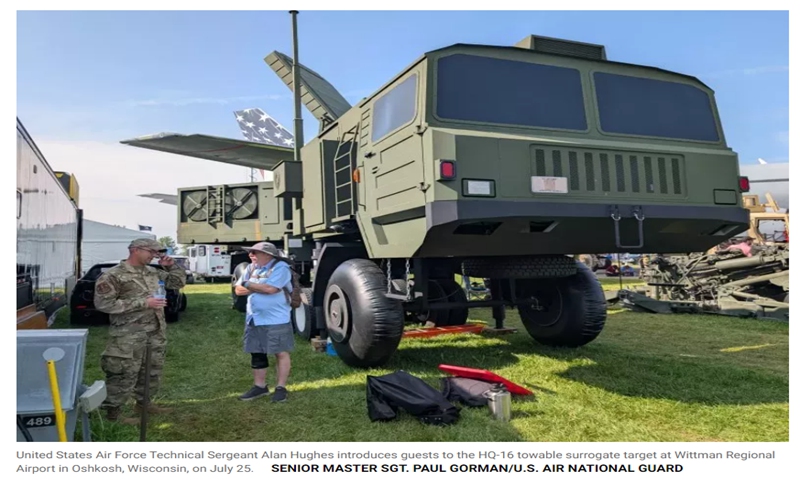
In addition, it showcased two of its air defense systems—the HQ-9BE and the HQ-16FE—both of which have been acquired from China.
The HQ-9BE is a Chinese-origin long-range, surface-to-air missile (SAM) system that draws on technology influenced by the Russian S-300 series, with Chinese upgrades to its radars, seekers, and electronics. It reportedly has a range of up to 260 kilometers. On the other hand, the HQ-16FE is an enhanced export variant of China’s HQ-16 family of medium-to-long-range surface-to-air missiles (SAMs), with a range of up to 160 kilometers.
In the last few minutes of the video, a bright silhouette of a fighter jet closely resembling the J-35A, a Chinese fifth-generation fighter that Pakistan has been rumored to buy, makes a rather unexpected appearance. However, the EurAsian Times could not verify the exact aircraft type in the video.
It is worth emphasizing that these are just a few Chinese-sourced weapon systems flaunted by Pakistan, and you can read a detailed EurAsian Times report on these acquisitions here.
For Pakistan, China has become a reliable source of arms supplies in recent years. It is the world’s fifth-largest importer of weaponry, with over 80% of its purchases coming from China, according to a SIPRI (Stockholm International Peace Research Institute) fact sheet. In fact, Pakistan receives 61% of all Chinese weapons exports, making the Islamabad-Beijing axis one of the world’s most exclusive and well-organized military supply networks.
For China, this is part of a two-pronged strategy. It helps keep India—with which China has an active border dispute along the LAC (Line of Actual Control)—in check and allows China to test its weapons in combat, as Pakistan and India continue to engage in sporadic, limited conflicts along their border.
In fact, China is now promoting its weapons, such as the J-10C fighter jet, in the export market by leveraging its combat performance in the May 2025 Indo-Pakistan conflict.
Having said that, the footage also features some weapons of Turkish origin, including the Korkut anti-aircraft guns and certain drones, consistent with Pakistan’s deepening defense relationship with its Middle Eastern ally.
Overall, the video serves as a capability showcase, a morale booster, and a strategic signaling tool by mixing real footage and animation, and making maximalist claims to project military superiority vis-à-vis India. While the Chinese systems shown are real, the specific combat-victory narrative is heavily contested and dismissed as propaganda.
- Contact the author at sakshi.tiwari13 (at) outlook.com
- Follow EurAsian Times on Google News