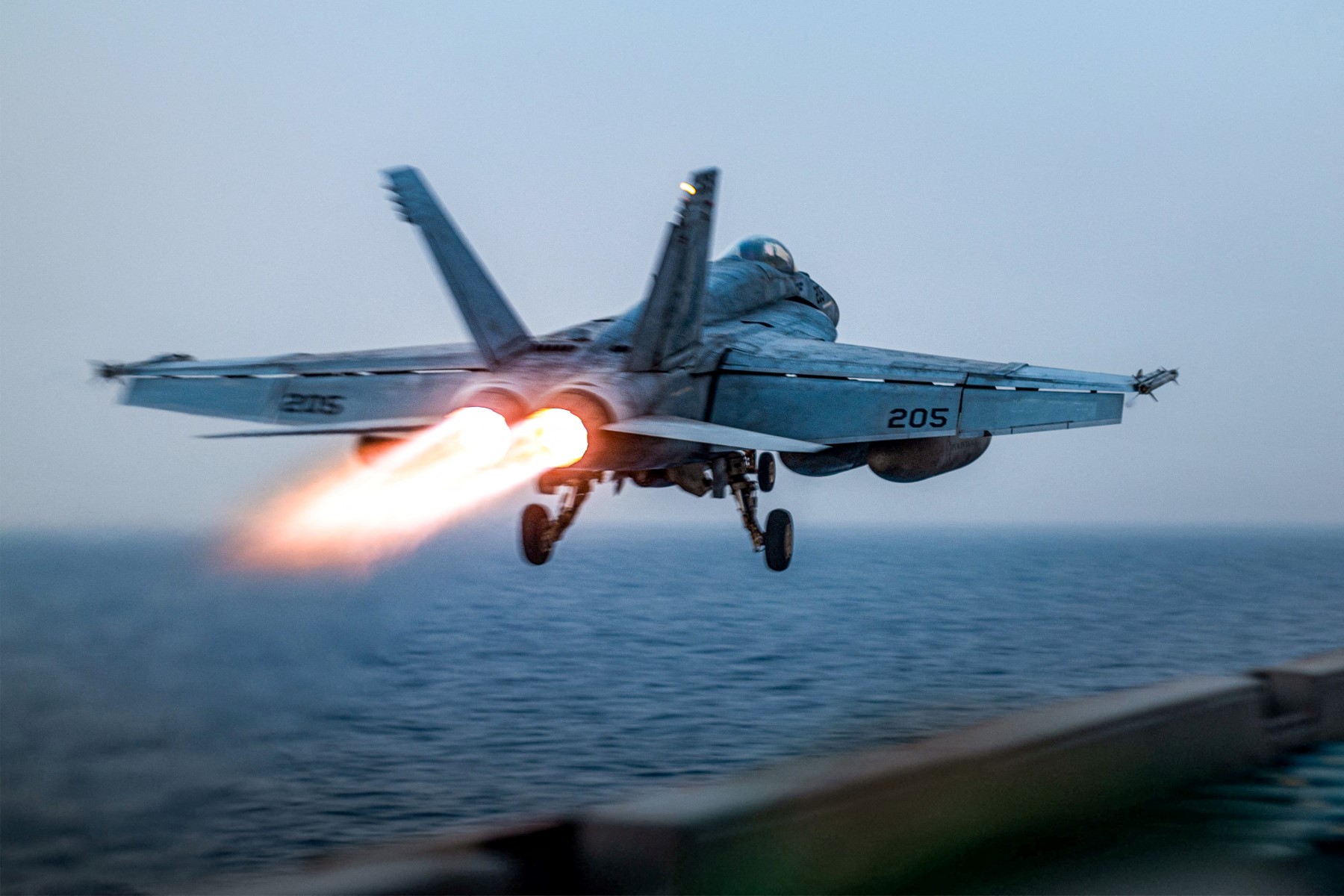
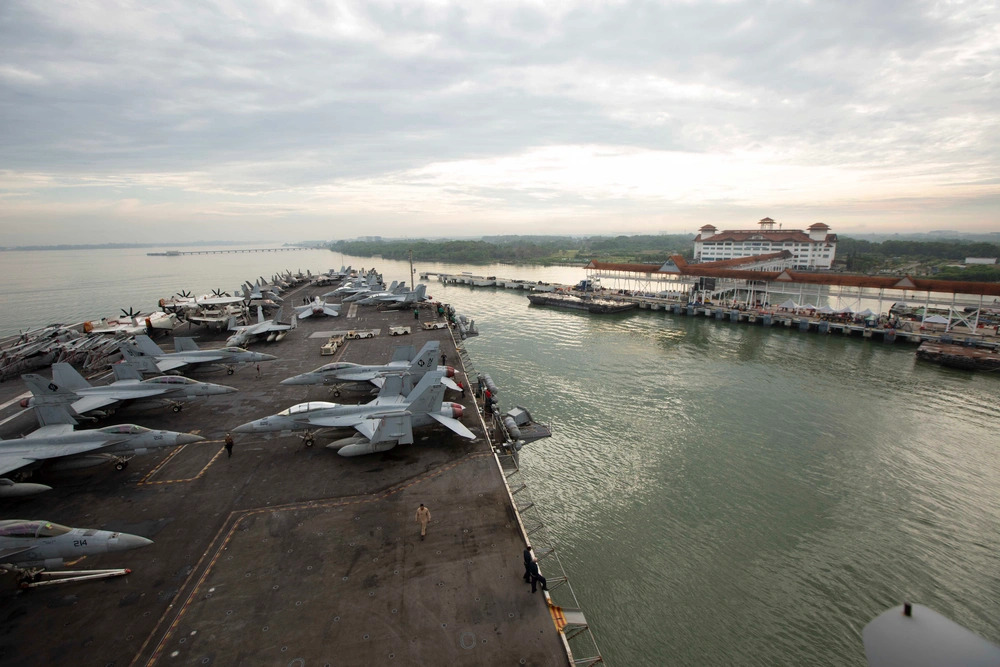
After a record uninterrupted 286 days at sea, sailors from the USS Abraham Lincoln spent five days in Thailand’s Pattaya before beginning their onward journey to the US.
On September 6, the carrier with nearly 5,000 US sailors departed Thailand. The carrier has earlier generated controversy for its unusually long deployment at sea amid the U.S. war with Iran.
“This port visit to Pattaya was a tremendous opportunity for this crew to recharge and a highlight for the strike group,” U.S. Navy Capt. Dan Keeler, Abraham Lincoln’s commanding officer, said in a statement.
Rarely in recent memory has a five-day port call by a US carrier made such global news and controversy.
Even before Lincoln docked in Thailand, authorities in Pattaya, also known as Thailand’s ‘Sin City‘ for its sprawling sex industry, had started rounding up sex workers.
Ahead of Lincoln’s arrival, Thai police conducted a late-night sweep targeting public prostitution along the city’s main promenade, Thai media outlets reported. However, the crackdown was largely symbolic.
In fact, Pattaya’s growth was fuelled in part by US servicemen seeking shore leave during the Vietnam War (1955-1975).
Now many in the city believe that the five-day halt by nearly 5,000 US soldiers will help revive the city’s sluggish economy.
“Each US military personnel could spend 1,000 to 3,000 baht ($30–$90 at current exchange rates) per day, depending on how long they stay ashore and whether they stay overnight,” Thai news outlet The Bangkok Post reported, quoting Pattaya Mayor Poramase Ngampiches.
As soon as Lincoln arrived, videos of US soldiers walking Pattaya’s red-light district flooded social media.
US Marines were also seen dancing half-naked in bars with local Thai girls. The Eurasian Times can not verify the authenticity of these videos.
🚨𝗖𝗥𝗘𝗪 𝗢𝗙 𝗨𝗦𝗦 𝗔𝗕𝗥𝗔𝗛𝗔𝗠 𝗟𝗜𝗡𝗖𝗢𝗟𝗡 𝗪𝗜𝗡𝗗 𝗨𝗣 𝗜𝗡 𝗔 𝗣𝗔𝗧𝗧𝗔𝗬𝗔 𝗦𝗔𝗨𝗦𝗔𝗚𝗘 𝗙𝗘𝗦𝗧! pic.twitter.com/ToErXtxlvG pic.twitter.com/W1ZBPbqaC1 https://t.co/Liv0FpKhNV
🚨Around 5,000 sailors and Marines from the USS Abraham Lincoln arrived in #Pattaya,…— ⚡️🌎 World News 🌐⚡️ (@ferozwala) September 6, 2026
On social media, many commented that the choice of Pattaya seemed deliberate so that US soldiers could avail themselves of the services of Thai sex workers.
In fact, prostitution has been deeply embedded in US military bases abroad, from Germany to South Korea and Japan to the Philippines.
Military and Prostitution
For as long as militaries have fought, prostitution has thrived around them.
Much before women joined armies and appeared on the battlefield, they were a regular part of military camps, where they performed various duties, including laundry, medical services, and also worked as sex workers.
In 18th-century India, sex camps flourished alongside the port towns developed by the East India Company, such as Calcutta, Bombay, and Madras.
However, as racial prejudices solidified, the colonial government also felt the need to regulate sex work.
In India, the Cantonment Act of 1864 structured and regulated prostitution in British military bases, providing for compulsory registration and health checks for women who served British soldiers. The act’s scope was limited to a four-mile radius around cantonment areas.
Scholars such as Stephen Legg have shown that urban brothels in India emerged primarily to serve army cantonments.
In the twentieth century, the Imperial Japanese Army established the concept of ‘comfort women,‘ a euphemism for sexual slavery. These ‘comfort women‘ were central to the Japanese war machine.
During its conquest of territory across East Asia, the Japanese military forced hundreds of thousands of women from Korea, China, Okinawa, and rural Japan, and other parts of Asia into sexual slavery, providing soldiers with “royal gifts” from the emperor.
However, as Japan was defeated in the Second World War, many of the Japanese military camps in South Korea were taken over by the US military.
In many cases, the ‘comfort women‘ of Japanese military camps were forced to become prostitutes, who, at least theoretically, did this work with their consent.
With the assistance of Korean officials, U.S. authorities continued the system absent formal slavery, but under conditions of exceedingly limited choice for the women involved.
US Military Bases and Prostitution
Commercial sex zones have thrived in tandem with many U.S. bases around the world, from Baumholder in Germany to Fort Bragg in North Carolina.
However, nowhere is this association more stark than in Asia, particularly in South Korea.
In South Korea, the “camptowns” that surround U.S. bases have become deeply entrenched in the country’s economy, politics, and culture.
According to David Vine, associate professor of anthropology at American University in Washington, DC, and author of the book ‘Base Nation: How U.S. Military Bases Abroad Harm America and the World,’ describes how these camptowns have been at the center of an exploitative and profoundly disturbing sex industry—one that both displays and reinforces the military’s attitudes about men, women, power and dominance.
In fact, these sex-zone camptowns started flourishing around US military bases in South Korea as early as 1945.
However, just like the British colonial state in India, the US military leadership was also concerned about the spread of Sexually Transmitted Diseases (STDs) in soldiers.
In 1868, the British passed the Contagious Diseases Act in India, which was aimed at checking the spread of venereal disease, especially among British troops, by registering sex workers, examining them, and locking diseased women in certified hospitals.
The act made registration of prostitutes and their regular examination compulsory. Any sex worker found to be suffering from a disease was evicted from registered brothels and was confined to certified hospitals.
Similarly, in post-war Korea, the US military government created a VD Control Section that instituted regular inspections and treatment for “entertaining girls.” This category included licensed prostitutes, dancers, “bar girls,” and waitresses. Between May 1947 and July 1948, medical personnel examined almost 15,000 women.
In fact, while Japanese forced Korean women into sexual slavery, in post-war Korea, the Korean government itself facilitated the creation of ‘comfort stations’ for US troops to strengthen the military alliance with the US and earn dollars.
In September 2022, more than 100 such women won a landmark victory when the South Korean Supreme Court ordered compensation for the sexual trauma they endured. It found the government guilty of “justifying and encouraging” prostitution in camp towns to help South Korea maintain its military alliance with the United States and earn American dollars.
In fact, many sex workers have recalled how they were termed “patriots” for offering sex to US soldiers and earning dollars for the local economy.
It also blamed the government for the “systematic and violent” way it detained the women and forced them to receive treatment for sexually transmitted diseases.
A South Korean government document from 1961 estimated that there were nearly 10,000 ‘comfort women’ in Seoul to cater to 50,000 US troops.
The sex trade was an important part of the South Korean economy.
For instance, in 1969, South Korean exports were US$835 million, and it earned US$160 million by offering various services to US troops based in the country, including the sex trade.
US soldiers were often also accused of violent sexual crimes against these ‘comfort women.’
For instance, between 1960 and 2004, American soldiers were found guilty of killing 11 sex workers in South Korea, according to a list compiled by the advocacy group Saewoomtuh.
South Koreans began to pay more attention to the issue of sexual exploitation in camp towns after a woman named Yun Geum-i was brutally sexually assaulted and viciously murdered by an American soldier in 1992.
It was among the first cases in which a U.S. soldier was handed over to a South Korean court for a crime against a Korean woman. The case produced demonstrations and unrest near Camp Casey, public outrage, and the formation of groups tracking U.S. military crime.
There were more protests in 2011 after a slew of rapes and violent crimes by US soldiers in South Korea.
Similar camptowns offering sex trade have also flourished around US military bases in other countries as well.
For instance, many strip clubs have mushroomed near the Kadena Air Base in Japan and areas around Futenma.
While initially, local Korean and Japanese women serviced US soldiers in these camp towns, as their economies became stronger, Filipina women started replacing them.
In the Philippines, before the 1992 withdrawal, Olongapo City next to Subic Bay Naval Base and Angeles City next to Clark Air Base hosted large-scale sex industries. Tens of thousands of women worked in bars and clubs along streets such as Magsaysay Drive and Fields Avenue.
Pattaya’s modern sex industry itself developed and became entrenched during the Vietnam War when it served as a major “rest and recreation” (R&R) destination for U.S. military personnel.
Similar camp towns also emerged near Cold War U.S. military bases, such as Baumholder in Germany.
These districts are not unique to U.S. forces; military garrisons of many countries have produced similar economies of sex, alcohol, and nightclubs.
However, what makes the US example unique is the scale and duration of US overseas basing—tens of thousands of soldiers deployed in a foreign country for years away from their families.
In this context, there is nothing unusual about US soldiers roaming the red-light district of Pattaya. This fits in the pattern of the sex trade mushrooming next to cantonments and military bases.
- Sumit Ahlawat has over a decade of experience in news media. He has worked with Press Trust of India, Times Now, Zee News, Economic Times, and Microsoft News. He holds a Master’s Degree in International Media and Modern History from the University of Sheffield, UK.
- He can be reached at ahlawat.sumit85 (at) gmail.com