Is there a link between US President Donald Trump’s diplomatic mission to Moscow and Kyiv and the simultaneous electoral victory of the Alternative for Germany (AfD) in Saxony-Anhalt?
After all, both events occurred over the same weekend – September 5–6, 2026.
Trump had dispatched his special envoy Steve Witkoff and his son-in-law Jared Kushner to meet with Russian President Vladimir Putin in Moscow before traveling to Kyiv to meet President Volodymyr Zelensky. The mission supposedly carried a peace proposal to end the war.
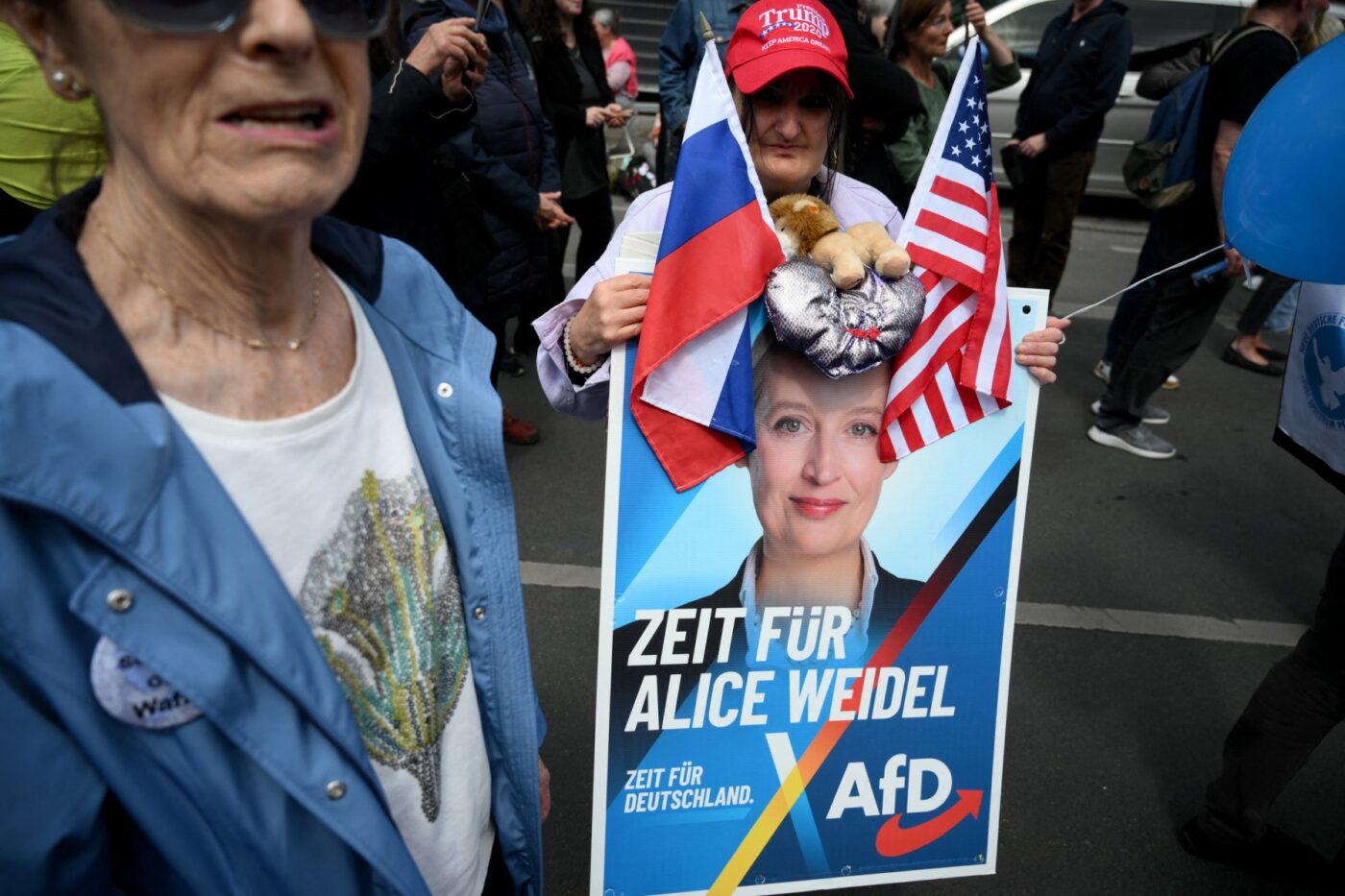
Concurrently, the far-right AfD achieved its largest-ever election victory, capturing a projected 44% of the vote in Saxony-Anhalt with 39 of 83 seats, more than double its 2021 result and double the vote of Chancellor Friedrich Merz’s conservative CDU (Christian Democratic Union).
At first glance, a link between the two events may not be that apparent, as the dominant Western media mainly highlight that the issues that affected the elections pertained to public opinion against immigration, wind farms, and rainbow flags (Clean energy companies in Germany use rainbow flags and rainbow colors to promote diversity, equity, and inclusion in the workplace and green technology sectors).
However, on closer scrutiny, a deeper geopolitical factor also seems to have played a role.
The AfD is the only major German party that openly says what German businessmen whisper in Magdeburg and Duisburg: stable relations between Germany and Russia are a must for European peace, and the war in Ukraine is the result of breaking that stability.
For thirty years, Germany’s prosperity rested on two pillars — American security and cheap Russian energy and raw materials. It was the “Ostpolitik” consensus from Willy Brandt to Helmut Kohl to Gerhard Schröder: trade, pipelines, dialogue with Moscow as the anchor of continental peace.
As the EurAsian Times had highlighted in the past, US President Biden and the European elites — in Berlin, Paris, London and Brussels — deliberately broke that anchor through Ukraine to humiliate Moscow.
When the Cold War ended, Russia did not lose a hot war. It withdrew voluntarily from Central Europe, expecting a new security architecture. What it got was NATO expansion, EU expansion, missile defense in Poland and Romania, and seemingly a Western consensus among the elites that since the West “won” the Cold War, it must dictate terms to a “defeated” Russia.
As was pointed out in the EurAsian Times, for the Western elites, support for Ukraine has been based on the premise that, more than defending or protecting Ukraine, the war should lead not only to the downfall of Russian President Vladimir Putin but also the disintegration of Russia, leading to “the total victory of democracy over authoritarianism.”
They remain deeply committed to what they call their “triple package of policies” — NATO enlargement, EU expansion, and democracy promotion. For them, Ukraine’s choice to join Europe will accelerate “the demise of the ideology of Russian imperialism that Putin represents.”
This is the mindset that led to the 2008 Bucharest declaration that Ukraine and Georgia will join NATO, to the EU Association Agreement in 2013 that forced Kyiv to choose between Brussels and Moscow, and finally to the systematic arming of Ukraine after 2014 while Kyiv never implemented the Minsk agreements (the first agreement, signed on September 5, 2014, by Ukraine, Russia, and separatist leaders, sought an immediate ceasefire and decentralization of power in Donbas; the second agreement, signed on February 12, 2015, talked of constitutional reform in Ukraine to grant a special self-governing status to parts of Donetsk and Luhansk, and restoration of full control over the state border to the Ukrainian government, tied to political changes).
The EurAsian Times also pointed out that the UK, France, and Germany would always create obstacles to Trump’s peace plan for Ukraine. They have literally kept Zelensky a prisoner of thought—even if he wants a deal, London, Paris, and Berlin would not allow him to have one.
The evidence is in plain sight.
In April 2022, a draft peace agreement in Istanbul was ready, with Ukrainian neutrality in exchange for security guarantees. Then UK Prime Minister Boris Johnson flew to Kyiv and told Zelensky to fight on. Since then, every time Washington has signaled flexibility — from Trump’s peace plan in 2025 to the latest push for territorial compromise — it is London and Paris and Berlin that have flown to Kyiv, that have announced new weapons packages, that have spoken of “no negotiations about Ukraine without Ukraine” while meaning no negotiations at all.
Zelensky, whatever his personal instincts, seems to be trapped. He cannot make a deal because his army, his budget, his intelligence, and his media cover are now entirely influenced by the UK, France, and Germany. Even if Trump in Washington says to make a deal, the Europeans have created a veto by keeping the war alive with their own money and weapons and by threatening to isolate any Ukrainian leader who compromises.
That explains how, the day Witkoff and Kushner landed in Kyiv (September 6), the national security advisers of the “European Three” (Germany, France, and the United Kingdom) unexpectedly arrived in the Ukrainian capital. Rather than allowing a single US-led track, they positioned themselves to be main participants in the peace process.
Against this background, the AfD’s program, which calls for “sensible diplomacy” with both Russia and the United States, for restoring ties with Russia, cutting support to Ukraine, and quitting the sanctions regime that has deindustrialized Germany, may not be termed pro-Russian. German voters now seem to agree that it is pro-German and pro-European.
AfD recognizes the elementary geographical fact that Russia cannot be moved off the map of Europe, that 40% of European gas before 2022 came from Russia, and that no lasting peace in Europe is possible without a stable German-Russian relationship.
The elites who broke this relationship — Biden, British Prime Ministers from Boris Johnson to Starmer, the French President, and the successive regimes in Germany from Baerbock to Merz — believed that sanctions would collapse Russia, that Nord Stream could be blown up without consequence, and that German industry would accept self-destruction for moral posturing.
Talking of Germany, that mindset has resulted in the German economy shrinking for three years, energy prices becoming four times higher than US prices, and in Saxony-Anhalt, turnout was 77.8 percent; the AfD won 43.8 percent of votes cast.
In fact, AfD is now Germany’s most popular party at the national level, according to polls.
It is second in many western states. It talks of a return to sensible diplomacy with Russia and the US. And that seems to resonate with German workers who saw 600,000 industrial jobs disappear since sanctions on Russia.
It resonates with farmers whose fertilizer costs tripled without Russian gas. It resonates with the erstwhile East Germans who never accepted the narrative that Russia is inherently evil — they lived with Russians; they remember Ostpolitik as peace, not appeasement.
And, though Western media does not highlight it, the idea of co-existence with Russia resonates with Europeans outside Germany who are realizing the same truth.
French farmers have repeatedly staged massive protests and blockades around Paris. Their frustrations stem from EU trade concessions that allowed duty-free Ukrainian agricultural imports, which local farmers argue undercut their prices and create unfair competition alongside stringent EU environmental regulations.
In Slovakia, Hungary, and Austria, parties calling for peace with Russia have won or entered government. In Slovakia, the government led by Robert Fico halted state military aid to Ukraine, aligning closely with Hungarian Prime Minister Viktor Orbán’s long-standing calls for immediate peace talks and an end to EU sanctions against Russia.
The Freedom Party (FPÖ), which campaigned heavily on maintaining strict Austrian neutrality and criticizing the economic fallout of anti-Russian sanctions, secured significant victories by tapping into voters’ anxieties over inflation and energy security.
In the UK, the same trend is palpable, even if Westminster elites remain unified in their military and financial commitments to Ukraine. Public polls indicate growing “war fatigue”. As the British public navigates a prolonged cost-of-living crisis, debates are increasingly surfacing regarding the sustainability of open-ended foreign financial commitments to Ukraine.
In other words, the European people are beginning to understand that European peace cannot be built against Russia; it can be built only with Russia, and that the German-Russian relationship is the keystone. When Biden and the European elites broke that keystone, all of Europe began to crumble—economically, energetically, politically.
Speaking geopolitically, if and when the AfD forms a government in Saxony-Anhalt—even with 39 seats, it needs three more, possibly, though ironically, from the Leftist NSW that also wants peace with Russia—it will be the first state government since 1945 led by a party that rejects Atlanticist orthodoxy. It will stop weapons deliveries through its territory; it will reopen dialogue with Russian cultural and business forums; and it will challenge Berlin’s sanctions enforcement.
In the days to come, Germany, Ukraine’s second-largest donor after the US, would face increased domestic pressure to cut aid or condition it on negotiations.
Of course, there is also the possibility that the UK, France, and the German regimes will fight the AfD through court cases to ban it, media campaigns calling it neo-Nazi, and stopping EU funds to Saxony-Anhalt. After all, they did that to Hungary and Slovakia.
But banning a party that draws 44% of people’s support, and a party that calls for Europeans to live in peace with Russia, may not be all that easy.
History seems to be in AfD’s favor too. Germany and Russia fought two world wars when relations broke down. Europe had its longest peace when Germany-Russia relations were stable, something the AfD victory seems to have reminded us of.
- Author and veteran journalist Prakash Nanda is Chairman of the Editorial Board of the EurAsian Times and has been commenting on politics, foreign policy, and strategic affairs for nearly three decades. He is a former National Fellow of the Indian Council for Historical Research and a recipient of the Seoul Peace Prize Scholarship.
- CONTACT: prakash.nanda (at) hotmail.com