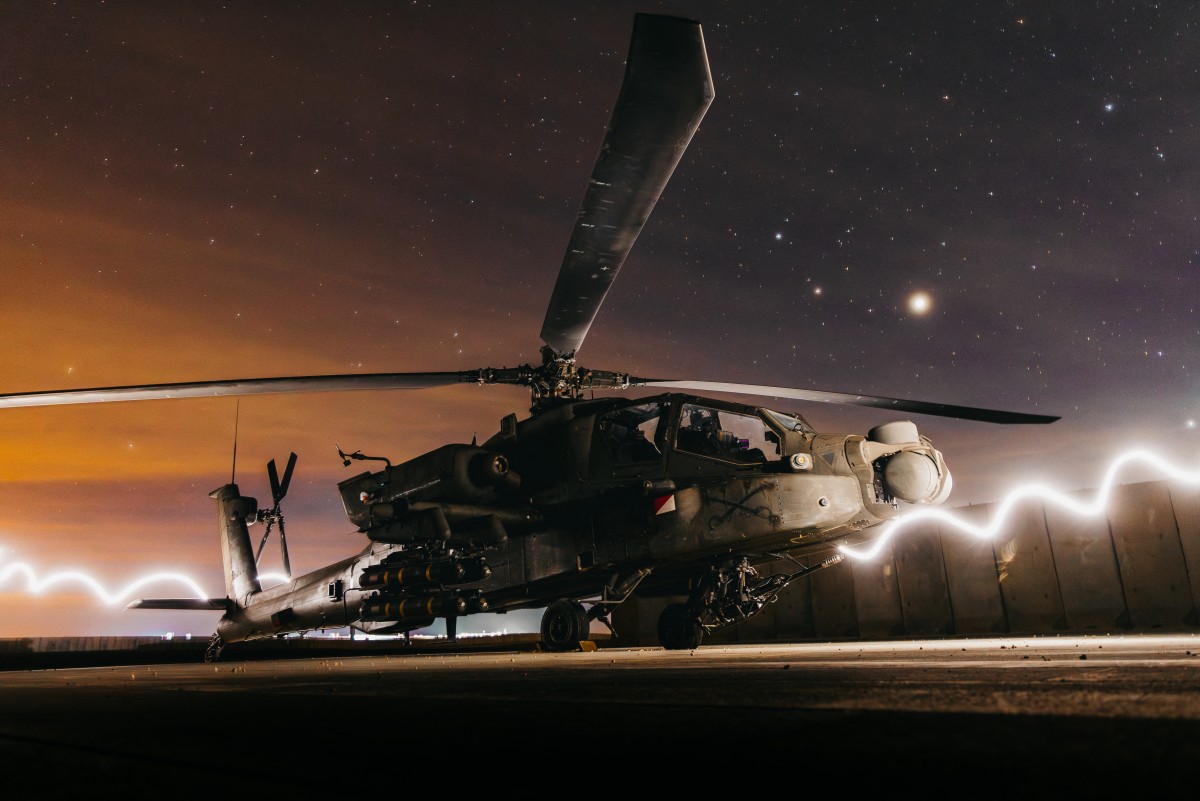
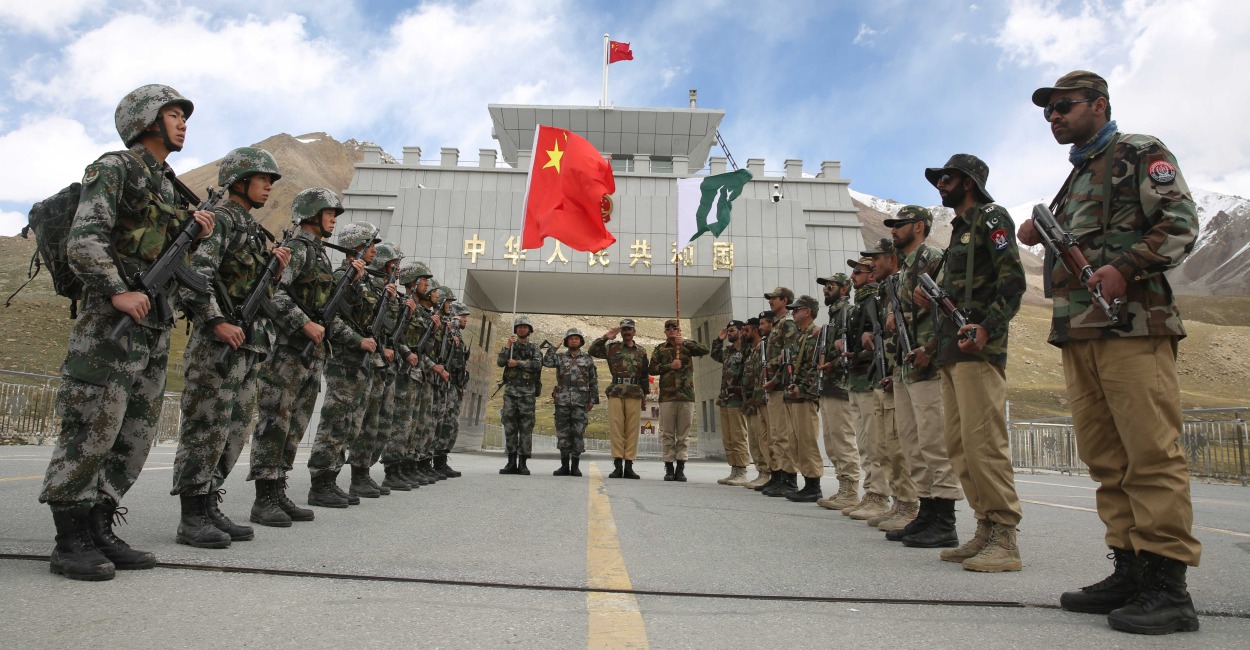
China and Pakistan have long described their relationship as an “all-weather strategic cooperative partnership,” famously calling it “higher than the mountains, deeper than the oceans, and sweeter than honey.”
This official warmth is now strongly reflected in public opinion in Pakistan.
The latest Pew Research Center survey found that Pakistan is the most pro-China country globally.
According to the 2026 survey conducted across 36 countries, Pakistanis hold the most positive view of China, with roughly 90% expressing favorable views.
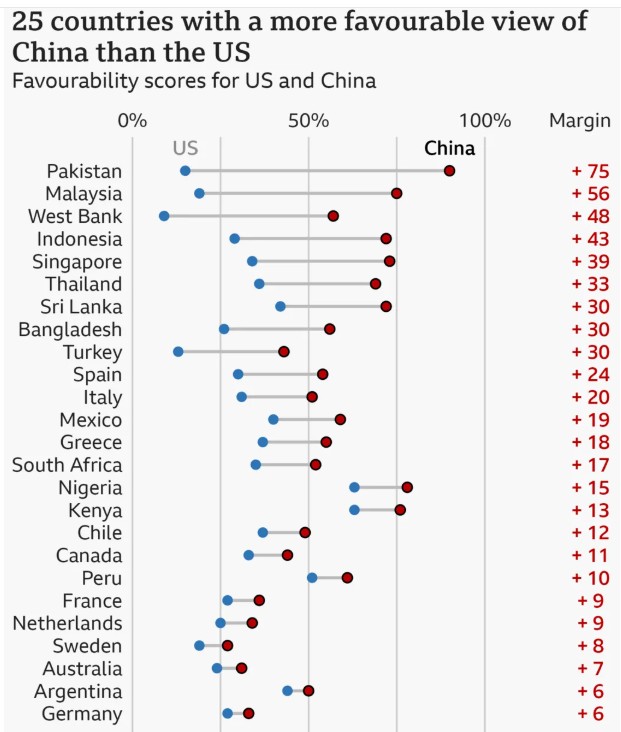
Though the survey notes that China is now viewed more positively than the US in many countries worldwide, Pakistan still stands out as an extreme outlier on the pro-China side of the spectrum.
Of the 36 countries surveyed, people in 25 countries now have a more favorable opinion of China than of the US. Pakistan is followed by Malaysia, where 75% of people hold pro-China views.
At the bottom end is Japan, where only 11% of the people hold a favorable opinion of China.
The pro-China sentiment in Pakistan is also reflected in faith in Xi Jinping’s leadership.
In Pakistan, 83% of the people hold a favorable opinion of Xi Jinping’s leadership. Next on the list is Kenya, where the number of people holding a favorable opinion of Xi’s leadership drops to 73%.
The numbers clearly show that in Pakistan, support for China is astonishing.
This is in sharp contrast to many other neighboring countries of China, such as India, South Korea, Japan, and the Philippines, where views of China remain deeply negative.
The high public support for China is reflected in other surveys as well.
For instance, the Gallup & Gilani Pakistan survey conducted in 2025 found that 61% of Pakistanis held a favorable opinion of China, while only 19% held a negative view.
Similarly, a 2025 study by the Institute of International Relations and Media Research (IIRMR) found that public goodwill toward China increased significantly between 2015 and 2025, following China’s launch of the multi-billion-dollar China-Pakistan Economic Corridor (CPEC).
This raises the question as to why, among all its neighbors, Pakistan is an outlier in holding such a favorable opinion of China.
Why is Pakistan The Most Pro-China Country?
Pakistan and China have been historical strategic partners, not least for their shared enmity towards India.
After the Second World War and decolonization in the 1950s, India and China were the two preeminent powers in Asia due to their large populations.
The two countries also inherited an unsettled border. In 1962, India and China fought a major war in the Himalayas.
Pakistan saw an opportunity that if it could befriend China, then India would face a nightmarish two-front war scenario on its northern, eastern, and western borders.
The very next year, in 1963, Pakistan signed the Sino-Pakistan Boundary Agreement, settling its boundary issue with China.
To reach this agreement, Pakistan ceded the Shaksgam Valley (also known as the Trans-Karakoram Tract), covering roughly 5,180 square kilometers, to China.
Two years later, in 1965, Pakistan attacked India.
Since then, China and Pakistan have maintained a strategic partnership, often targeted against India.
For instance, during last year’s India-Pakistan war, Beijing provided Islamabad with real-time satellite intelligence support, weapons, and diplomatic support.
China has also been Pakistan’s largest weapons supplier.
According to SIPRI, between 2021 and 2025, China supplied 80% of Pakistan’s weapons.
Many of these weapons were used by Pakistan against India during last year’s brief war, such as Chinese drones, the JF-17 Thunder and the J-10CE fighter jets, the PL-15 long-range air-to-air missile, and air defense systems like HQ-9.
China is also supplying Pakistan with eight Hangor-class AIP submarines.
Economically, China is Pakistan’s most important partner through CPEC.
Under CPEC, China is expected to invest over US$60 billion in Pakistan.
This has also created more than 250,000 jobs, added 8,000 MW of power generation capacity, and built over 500 km of roads and over 850 kms of power transmission lines.
China is also Pakistan’s largest bilateral creditor. Nearly a quarter of Pakistan’s foreign debt is owed to China.
It is thanks to Chinese help that Pakistan’s economy is still afloat.
Beyond economic and military assistance, China also provides diplomatic backing to Pakistan at international forums such as the UN, the UN Security Council, the SCO, BRICS, the FATF, and the MRTC.
For instance, China vetoed five times an India-backed proposal to blacklist Pakistan-based terrorist Maulana Masood Azhar.
Similarly, China placed technical holds on the blacklisting of other Pakistan-based terrorists such as Abdul Rauf Asghar, Sajid Mir, Talha Saeed, and others.
China has consistently defended Pakistan in FATF plenaries. Along with Turkey and Malaysia, China helped Pakistan avoid blacklisting and supported its eventual removal from the grey list in October 2022. In 2025, when India tried to get Pakistan re-listed on the grey list, China strongly opposed it.
China is also helping Pakistan’s nascent space program.
Geopolitically, Pakistan views China as a reliable counterweight to India. In a region where Islamabad has often felt isolated, Beijing’s consistent diplomatic, economic, and military backing has reinforced the perception of China as an “all-weather” ally.
However, this does not mean that there is no friction in the relationship.
In fact, China’s economic help, loans, and infrastructure building are also creating discontent on the ground.
Especially in Pakistan’s restive but resource-rich Balochistan province, there is growing discontent against China. Here, Chinese nationals, engineers, and China-funded projects have often been targeted.
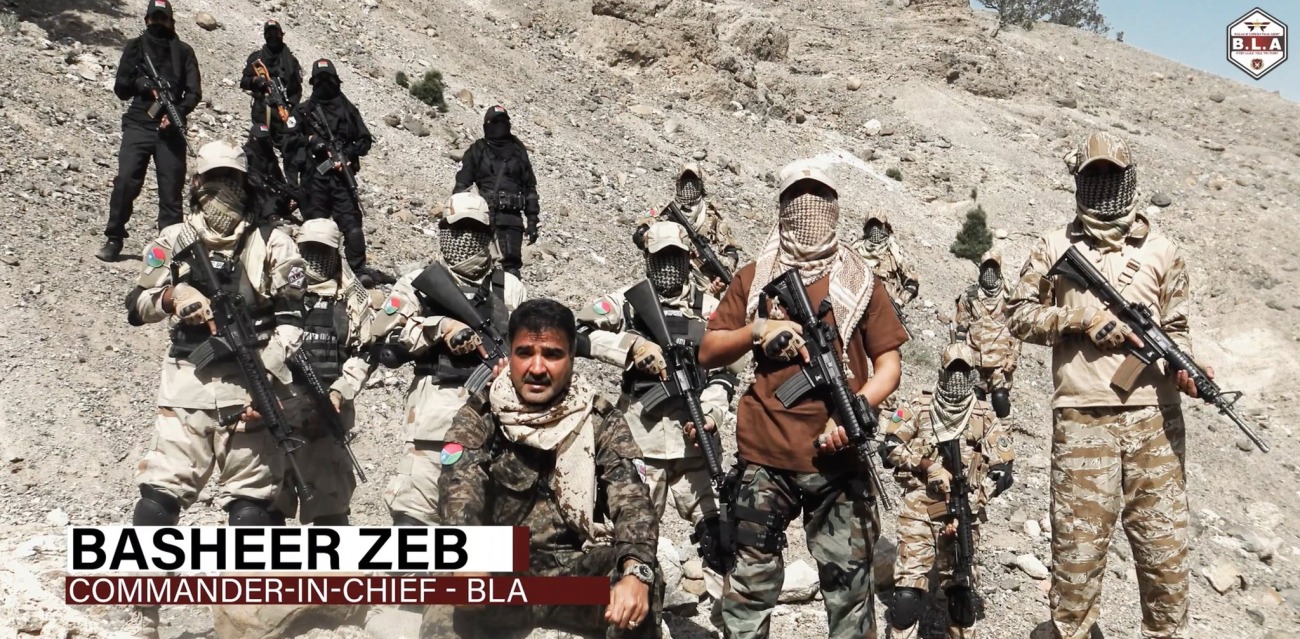
According to Pakistan’s National Counter Terrorism Authority (NACTA), since 2021, there have been 14 major terrorist attacks on Chinese citizens across Pakistan, in which 20 Chinese nationals have been killed and 35 injured.
This is a very sensitive issue in China, where there is a growing demand that Islamabad should allow Beijing to deploy its own forces for the protection of Chinese nationals working on CPEC projects.
Similarly, China’s loans to Pakistan are also a ticking time bomb.
In many developing countries, China supplied huge loans. Often, these loans lead to corruption and wasteful infrastructure projects in these countries. When these infrastructure projects fail to deliver a good return on investment (ROI), these countries begin defaulting on their loan commitments to China and often have to surrender national assets or resources to China.
For instance, Sri Lanka leased its Hambantota port to a Chinese company on a 99-year concession in 2017 amid severe debt pressures and a balance-of-payments crisis.
If Pakistan faces a similar debt crisis and leases the Gwadar port or another Balochistan asset to China, this could create strong anti-China sentiment in the region.
Pakistan’s improving relations with the US are another cause of worry in Beijing.
An April 2026 paper by Observer Research Foundation (ORF) analyst Antara Ghosal Singh, The Future of China and Pakistan’s ‘Iron Friendship,’ examines Beijing’s internal debates regarding Pakistan’s recent diplomatic overtures toward the United States.
The paper suggests that some Chinese analysts view Pakistan’s improved relations with Washington under the Trump administration as a potential risk to long-term cooperation, particularly regarding the China-Pakistan Economic Corridor (CPEC). While the foundational “all-weather” partnership remains intact, Beijing is reportedly recalibrating the pace and scope of its economic commitments.
Similarly, according to a January 2026 report by the Takshashila Institution, titled Limits of China-Pakistan Military Interoperability, the relationship functions as a “threshold alliance” rather than a formal military pact. While the two countries cooperate extensively in arms development and joint exercises, full operational integration remains limited due to doctrinal differences, command structures, and Pakistan’s mixed inventory of Western and Chinese platforms.
While the overall outlook for the China-Pakistan relationship remains bright, Beijing is expected to focus more on risk mitigation and tangible returns in the coming years.
Furthermore, a loan repayment crisis, more attacks on Chinese nationals and projects, and a worsening security situation in Pakistan could throw the relationship into uncharted territory.
As the popular saying goes, there are no permanent friends or enemies in geopolitics. For now, Pakistan is the most pro-China country, but things can quickly go off script.
- Nitin J Ticku holds a double master’s degree in Journalism and Business Management from the University of Glasgow. He has over 20 years of global experience in MARCOM, Journalism, and Digital Marketing, and has worked & traveled widely across Europe, the Americas, and Asia. Nitin is the Editor of the EurAsian Times.
- He can be reached at editor (at) eurasiantimes.com