
For more than a century, the United States has been one of the world’s most powerful cultural forces.
Hollywood movies have reached audiences in virtually every country, while American actors, musicians, and athletes have become global icons. At the same time, the American commitment to individual liberty and freedom of expression has resonated far beyond its borders.
Although the US emerged as the dominant military and economic superpower of the 20th century, it was its cultural influence, its “soft power”, that ultimately proved more decisive in winning the ideological struggle of the Cold War.
The Soviet Union beat the US in the space race, championed decolonization and the rights of the Global South, and yet the authoritarian streak in its polity, the lack of democracy, individual liberty, and creative freedom ensured that it could never match the cultural pull of the US.
For a long time, it was believed that China, notwithstanding its remarkable economic and technological growth, could never match US popularity because of these same factors.
That assumption is now proving short-sighted, as President Donald Trump’s second presidency has done the unthinkable: upended the historical trajectory of the last century.
According to the US-based Pew Research Center, China is now viewed more positively than the US in many countries worldwide.
Notably, this is the first time ever that the non-partisan think tank has recorded such results.
“Global views of the United States worsened last year as President Donald Trump’s second term began, though most people still had a more positive opinion of the US than of China. This year, that is no longer the case,” it said in its report.
China Beats the U.S. To Emerge as a More Favorable Country
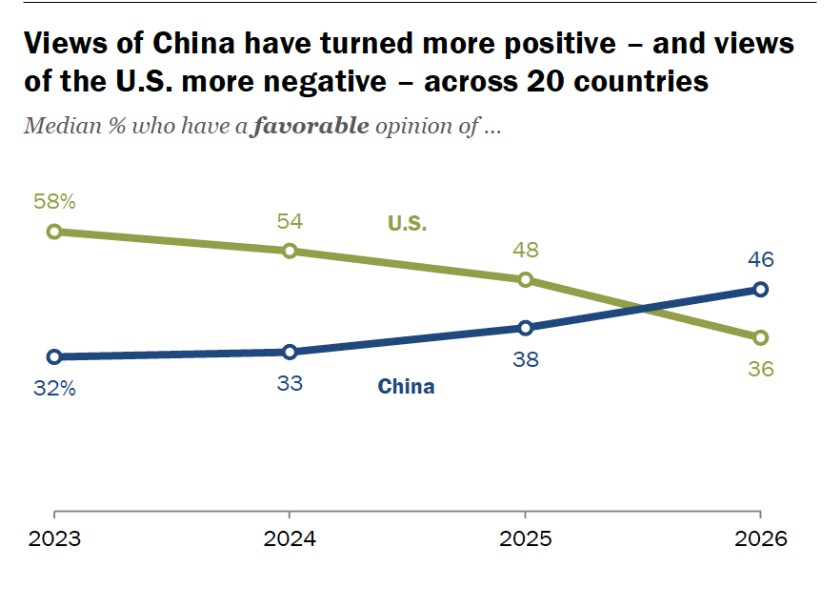
Views of China have improved in recent years, while opinions of the US have worsened, to the point where China is now seen more positively than the US in most of the 36 countries surveyed.
Just three years earlier, in 2023, while 58% of people viewed the US more positively than 32% who viewed China more positively, the story has flipped in the last three years.
In 2026, 46% of people view China more positively, compared with just 36% for the US.
But to what extent has this reversal been the result of the Trump presidency?
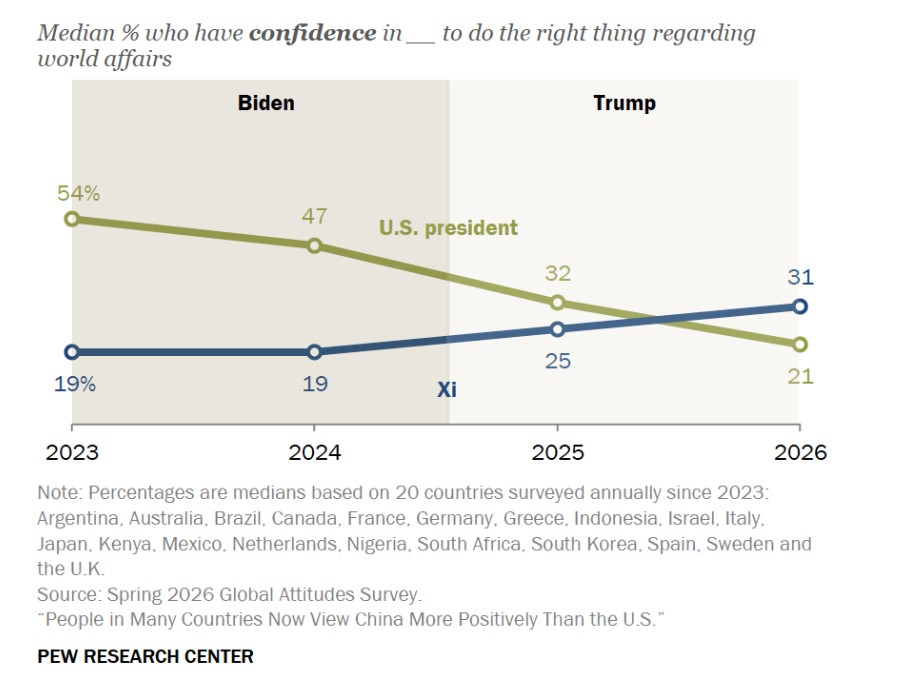
According to the same survey, confidence in these countries’ respective leaders to do the right thing regarding world affairs has followed a similar pattern.
“In the latter half of Joe Biden’s presidency, confidence in him was higher than confidence in Chinese President Xi Jinping across most countries surveyed.”
However, during the first two years of Trump’s second term, ratings of the US president worsened significantly.
In 2026, while 36% view Xi Jinping’s leadership more favorably, only 21% view Trump’s leadership more favorably.
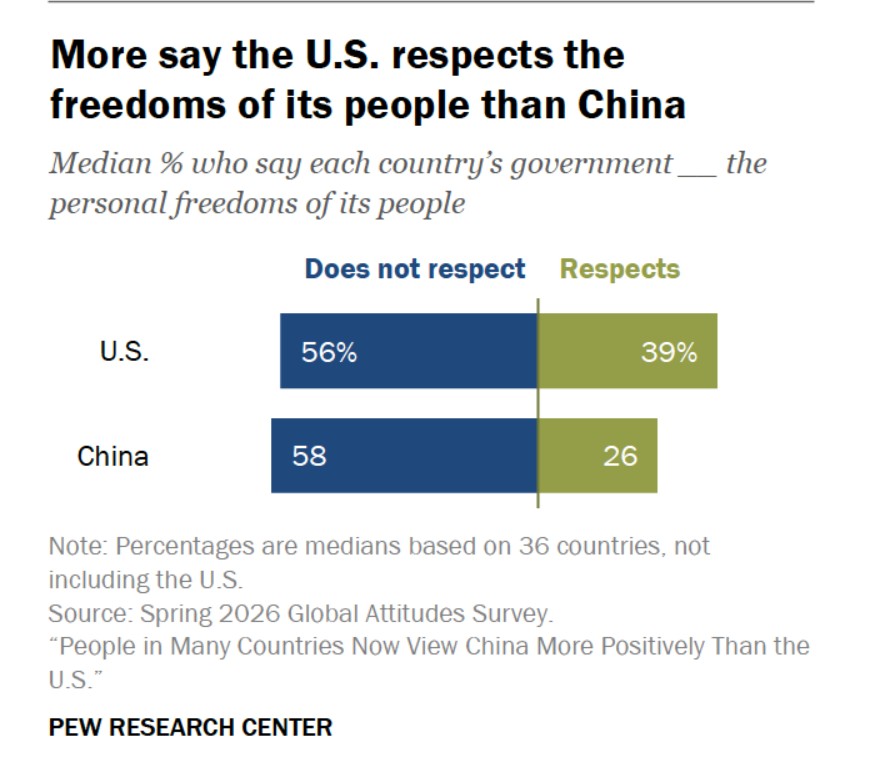
Despite declining confidence in the US and in Trump’s leadership, one area where the US still gets higher ratings than China is personal freedoms: More say the US government respects the personal freedoms of its people than say the same of the Chinese government.
Pew polled more than 42,000 people in 36 countries between February and May.
Of the 36 countries surveyed, people in 25 countries now have a more favorable opinion of China than of the US.
It marks the first time the center, which has been tracking global sentiments towards the superpowers since 2002, has seen such a result in so many countries, according to Jonathan Schulman, one of the study’s researchers.
While several Asia-Pacific and Middle Eastern countries view China more favorably than the US, there are also many surprises.
For instance, the U.S.’s nearest neighbors, Canadians and Mexicans, also view China more positively than the U.S.
Similarly, many European countries, including Spain, Italy, Greece, France, the Netherlands, Sweden, and Germany, also view China more favorably.
Notably, all these European countries, along with Canada, are also NATO members.
Turkey, another NATO member, also views China more favorably than the US.
Chile, Peru, and Argentina, three Latin American countries, also hold more favorable views of China.
Even in Australia, part of the Five Eyes alliance with the US, China enjoys a slight lead.
However, Pakistan has emerged as the most pro-China country globally.
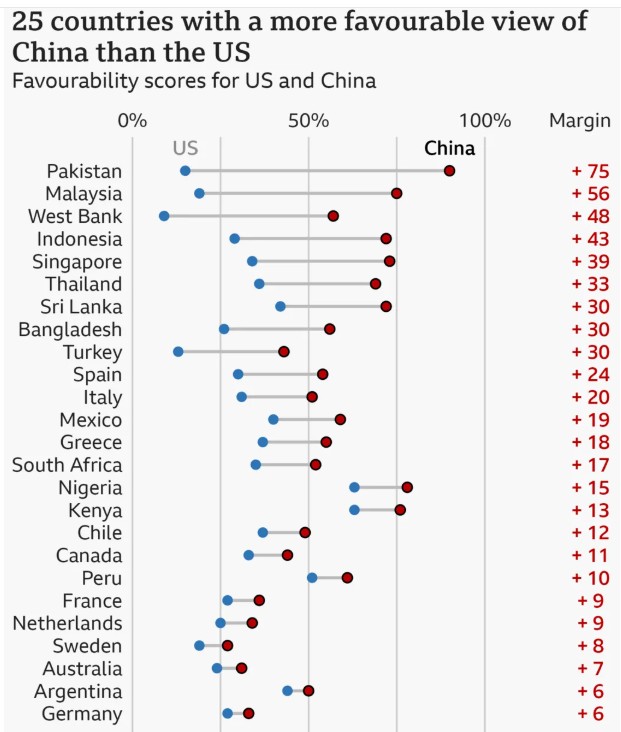
Pakistan is followed by Malaysia, the West Bank, and Indonesia, all Muslim-majority countries.
Only six countries have a more favorable opinion of the US than of China.
Not surprisingly, all of these countries, perhaps with the possible exception of India, are staunch US allies.
Israel is the most pro-US country globally, giving the US a 62-point lead over China.
Other pro-US countries are Japan, South Korea, the Philippines, and Poland.
One reason the US is not viewed favorably is that many people now consider it an unreliable power.
According to the survey, across 36 countries, as many as 50% of people consider the US an unreliable power.
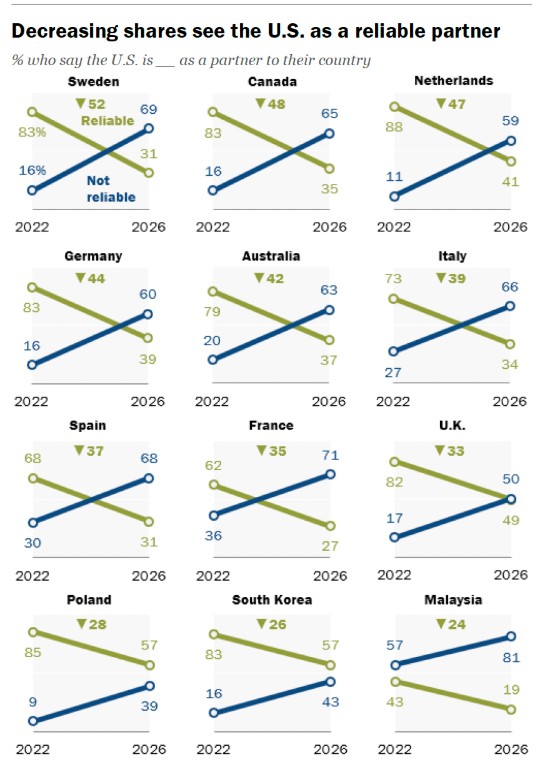
The share of the public who considers the U.S. a reliable partner has declined steeply in many countries since 2022.
This downward turn in opinion has taken place in several nations with which the U.S. has longstanding economic and security ties.
For example, in Canada, 83% described the U.S. as a reliable partner in 2022, compared with 35% today.
Similarly, the share of people who think the U.S. takes into account other countries’ interests when making foreign policy decisions has declined in most nations for which 2023 trends are available.
For instance, 60% of Germans three years ago said the U.S. considers other countries’ interests, but that share has dropped to 23% today.
President Trump’s repeated threats to take over Greenland by force must have contributed to this sentiment that Washington no longer takes into account the interests of its allies while making policy decisions.
In February, the US also attacked Iran, a decision that was opposed by many of its key European and NATO partners.
At the same time, China’s favorability has increased in more than a third of the countries surveyed in recent years.
In some places, views of China are now at or near historic highs.
For example, 51% of Italians today have a positive view of China, compared with 45% in 2025 and 31% in 2022 – a rise of 20 percentage points.
Similarly, in Spain, 54% of adults now have positive views of China, up 17 points since last year.
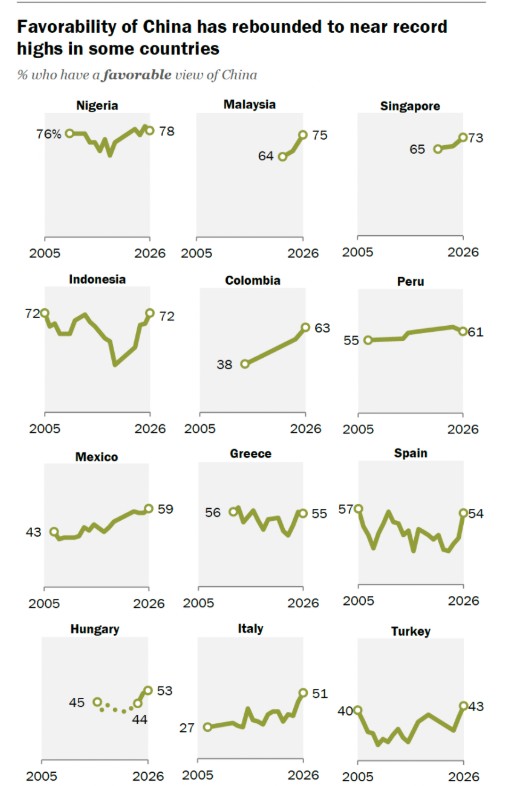
Views of China are also at or near historic highs in Colombia, Greece, Hungary, Indonesia, Malaysia, Mexico, Nigeria, Peru, Singapore, Sri Lanka, and Turkey.
Confidence is Low in Both Trump and Xi
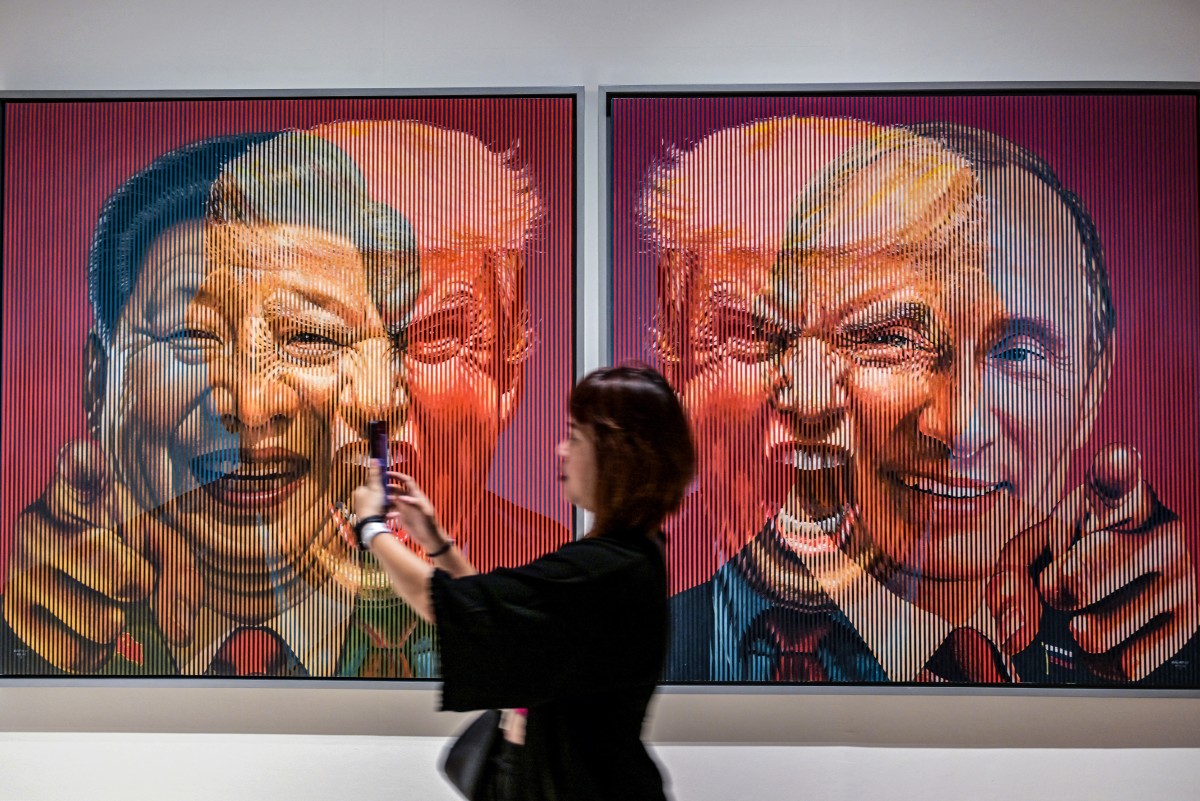
Confidence in both Trump and Xi is generally low. But people in many of the 36 countries surveyed view Xi more favorably.
In European countries, for example, neither leader gets a majority-positive rating, but views of Xi tend to be more favorable than views of Trump. In Germany, Greece, Italy, the Netherlands, Spain, Sweden, and the United Kingdom, Xi leads Trump by double digits, though his highest favorability rating is just 37%, from the U.K.
Again, Xi is viewed most favorably in Pakistan, followed by Malaysia, Singapore, Indonesia, and Bangladesh.
The lowest ratings for Xi came from Japan, as relations between Beijing and Tokyo have nosedived in recent years.
For Trump, the highest rating was 68% from the Philippines, and the lowest was 4% from the West Bank/East Jerusalem.
Trump’s low ratings, in many ways, mirror the US’s declining popularity globally.
Worryingly for the US, this is not the only survey to record its declining popularity.
According to polling company Gallup, China surpassed the US in global approval ratings last year.
“While neither country commands broad support, China surpassed the United States in global approval ratings in 2025, with a median of 36% approving of China’s leadership, compared with 31% for the US,” last year’s Gallup survey found.
“China’s five-percentage-point advantage over the U.S. is the widest Gallup has recorded in China’s favor in nearly 20 years,” the report added.
Whether these trends will last beyond Trump’s presidency is anybody’s guess.
However, for now, it could be safely said that China is viewed more favorably globally despite its authoritarian government, human rights abuses, lack of individual freedom or creative liberty, and rising tensions with almost all of its neighbors in the South China Sea.
- Sumit Ahlawat has over a decade of experience in news media. He has worked with Press Trust of India, Times Now, Zee News, Economic Times, and Microsoft News. He holds a Master’s Degree in International Media and Modern History from the University of Sheffield, UK.
- He can be reached at ahlawat.sumit85 (at) gmail.com