Argentina booked its spot in the FIFA World Cup final against Spain with a dramatic victory over England, but the celebration might have turned somber as the team faces potential disciplinary action for displaying a banner that read “Las Malvinas son Argentinas” translating to “The Falklands are Argentine.”
The move has sparked controversy, as the Falkland Islands remain disputed between Britain and Argentina. The two states even fought a war between April and June 1982 after Argentine forces captured the island, located 300 miles from its shore. The war ended in a setback for Argentina after 74 days of intense fighting.
Although the Falkland/ Malvinas Islands have been administered by the UK, Argentina has never fully relinquished its claims to the territory. The Argentine President, Javier Milei, earlier said he wanted to see the Falkland Islands handed over to Argentina through diplomatic means while advocating the removal of a UK-imposed arms embargo.
The United Kingdom rejects all claims and emphasizes the right of the island’s inhabitants to self-determination, who overwhelmingly favor British sovereignty.
“Sovereignty of the Falkland Islands is not up for negotiation, and we will defend its right to self-determination,” said the UK government in a statement last year.
🇦🇷 | Argentina players after the game with banner stating: “Las Malvinas Son Argentinas” 👀😅#FIFAWorldCup pic.twitter.com/yCMGvuXmlK
— ULTRA ATTACKIVE (@UltraAttackive) July 15, 2026
Argentina’s claim to the Falklands spilled over onto the field in its match against England, which some of the country’s top politicians consider an invader. Ahead of the game, for instance, Argentina’s vice-president Victoria Villarruel said the semi-final was “about putting the invaders in their place.”
After the match ended in Argentina’s victory, Villarruel posted a video of what appeared to be Argentine soldiers with a caption: “It wasn’t just another match.
“The Falklands are Argentine,” Villarruel posted. “They banned bringing them to the stadium and forgot that we carry them in our blood and our hearts.”
The UK officials have strongly criticized the incident. UK Business Secretary Peter Kyle called it “entirely inappropriate” and urged FIFA to investigate, whereas Downing Street reiterated the UK’s position on the self-determination of the disputed islands.
Notably, the semi-final match was not the first time Argentina’s team referred to the Falklands on the field. Earlier, the players also sang chants referencing the Falklands after their similar dramatic win over Egypt.
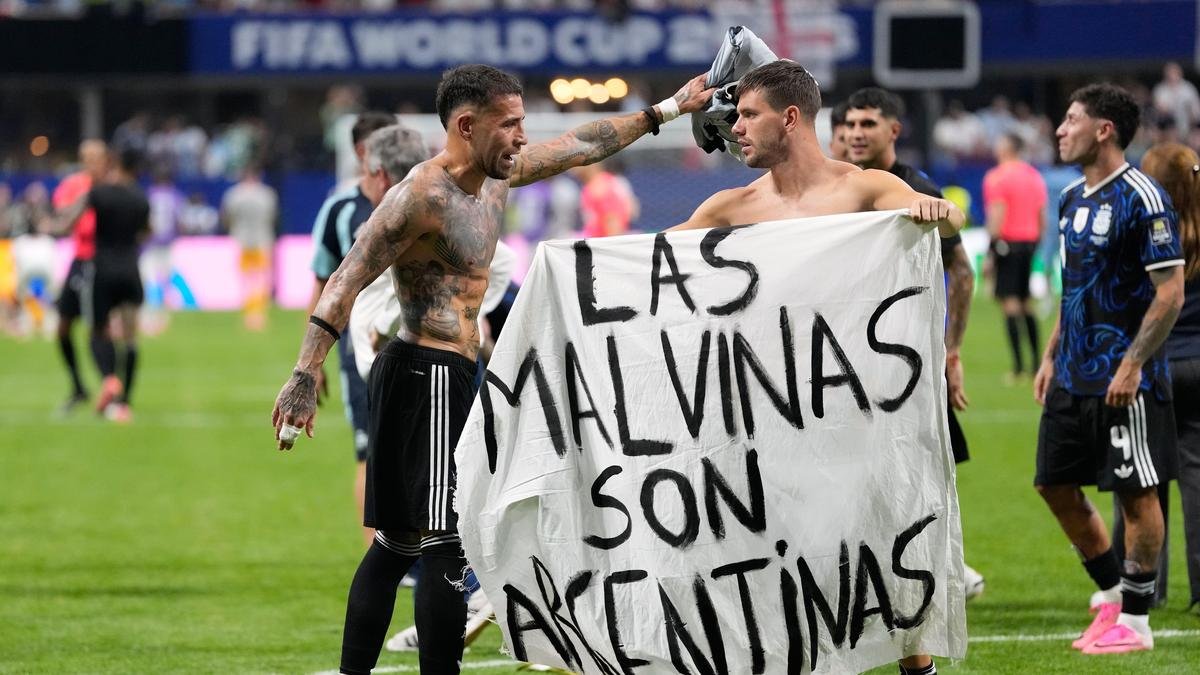
Similar to the latest banner incident, Argentina’s players held up banners with the same message before a friendly against Slovenia in 2014. This prompted FIFA to take action, and the Argentine Football Association was fined £20,000. At the time, FIFA’s governing body lamented that the gesture had breached rules on political action and team misconduct.
Notably, the Argentina-England game was hosted by the US, which maintains that the matter is a bilateral issue between the UK and Argentina.
“We encourage both parties to resolve their differences through dialogue in normal diplomatic channels. We recognize de facto United Kingdom administration of the islands but take no position regarding sovereignty,” it states.
Interestingly, there were speculative reports earlier this year that an internal Pentagon email had outlined options for the US to punish NATO allies—such as the UK—that failed to adequately support its operations in the Iran war. This included the re-evaluation of the US position on the Falklands, as EurAsian Times reported at the time.
Trump had been furious with the UK not joining offensive strikes on Iran.
The US Not Obligated To Protect Falkland Islands
The Falklands are a collection of islands in the South Atlantic Ocean, around 13,000 kilometers from Britain and 500 kilometers east of the Argentine mainland. They are made up of 778 smaller islands and two major islands, East Falkland and West Falkland.
France and Spain had colonies there at different times, but the UK seized control of the islands in 1833 and has been their custodian ever since.
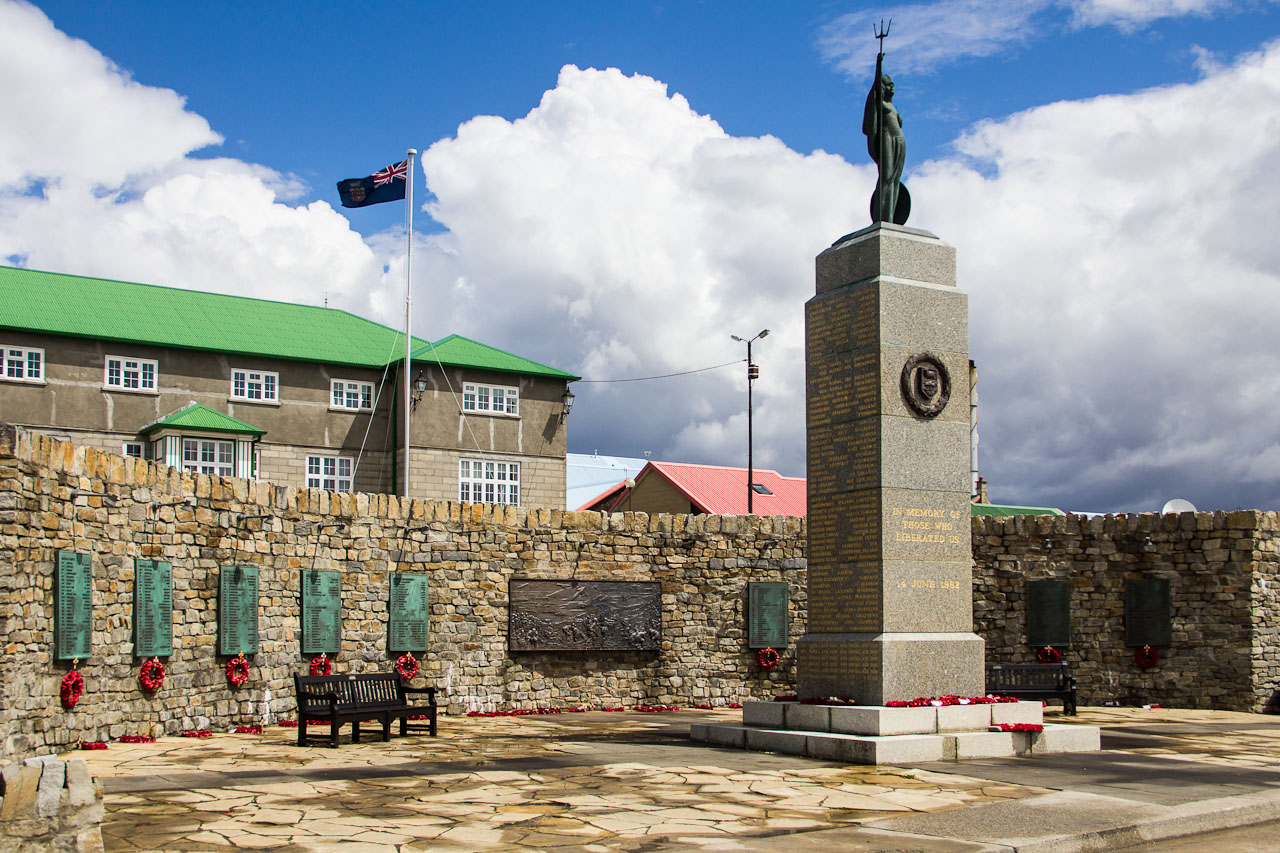
Argentina briefly attacked and took control of the Falkland Islands in April 1982—a move which was met with brute force as the UK dispatched a naval task force to confront the Argentine air force and navy.
This was followed by a large-scale amphibious invasion that culminated in a British victory after about 74 days of fighting, as previously explained by EurAsian Times.
Even though the war ended favorably for the UK, it is noteworthy that its closest ally—the United States—did not join the war against Argentina.
Although the US did not take an official stance on the issue, it attempted to discreetly mediate the dispute between Argentina and the UK at the beginning of the 1982 conflict.
However, once the war broke out, the US chose to provide behind-the-scenes support to the UK by supplying advanced AIM-9L Sidewinder missiles and intelligence, rather than joining the war, because Argentina was viewed as a useful anti-communist partner in Latin America during the Cold War.
Historians believe that the Reagan team was focused on countering Soviet and Cuban influence in Central and South America, and alienating Argentina would have risked pushing it closer to the USSR.
Moreover, the US wasn’t really obligated to assist the UK against Argentina because the Falklands conflict was outside NATO’s treaty area.
The Falkland Islands are not protected under NATO’s Article 5 mutual defense clause, which is restricted to the North Atlantic area north of the Tropic of Cancer, as defined in Article 6. This meant that Argentina’s invasion of the Falkland Islands, located in the South Atlantic, did not trigger the security clause, leaving the UK no choice but to fend for itself.
Nonetheless, the US government routinely blocks all resolutions passed by Argentina related to the sovereignty of the Falkland Islands.
Why Argentina Says the Falklands/Malvinas Belong to It
The Malvinas Islands are located approximately 500 km from the Argentine coast but over 13,000 km from the United Kingdom. From an Argentine perspective, it is difficult to justify how a territory lying just off the South American mainland could belong to a country on the other side of the Atlantic.
Argentina’s case rests on the principle of uti possidetis juris — the idea that newly independent states inherit the territories of the colonial power from which they gained independence.
As one official Argentine statement explains: “Argentina inherited Spain’s titles by succession of States under the uti possidetis juris principle of 1810… The Malvinas Islands were part of the Viceroyalty of the Río de la Plata.”
According to this view, when Argentina declared independence from Spain in 1816, it automatically inherited all Spanish possessions in the region, including the Malvinas. Argentine authorities point out that they exercised sovereignty over the islands in the early 19th century — establishing a political and military command in 1829 — until that control was broken.
The turning point in Argentina’s narrative came on 3 January 1833. In the words of multiple Argentine submissions to the United Nations: “On 3 January 1833, the Malvinas Islands were illegally occupied by British forces, who expelled the Argentine population and authorities legitimately established there, replacing them with British subjects.”
Argentina maintains that this was an act of force carried out in peacetime, which violated its territorial integrity. It has never recognized the occupation.
This position has found support at the United Nations. In 1965, the UN General Assembly adopted Resolution 2065, which recognized the existence of a sovereignty dispute and called on both countries to find a peaceful solution through negotiations. Later resolutions reinforced this view, describing the situation as a “special and particular colonial situation.”
For Argentina, the Falklands represent unfinished decolonization.
The UK argues that sovereignty over the Falkland Islands rests with the islanders themselves. British officials have repeatedly noted that the inhabitants have the right to self-determination and have expressed a clear desire to remain under British administration.
In a 2013 referendum, 99.8% of voters, with a turnout of 92%, chose to remain a British Overseas Territory. The British Government regards this result as a definitive expression of the islanders’ will.
- Contact the author at sakshi.tiwari13 (at) outlook.com
- Follow EurAsian Times on Google News