
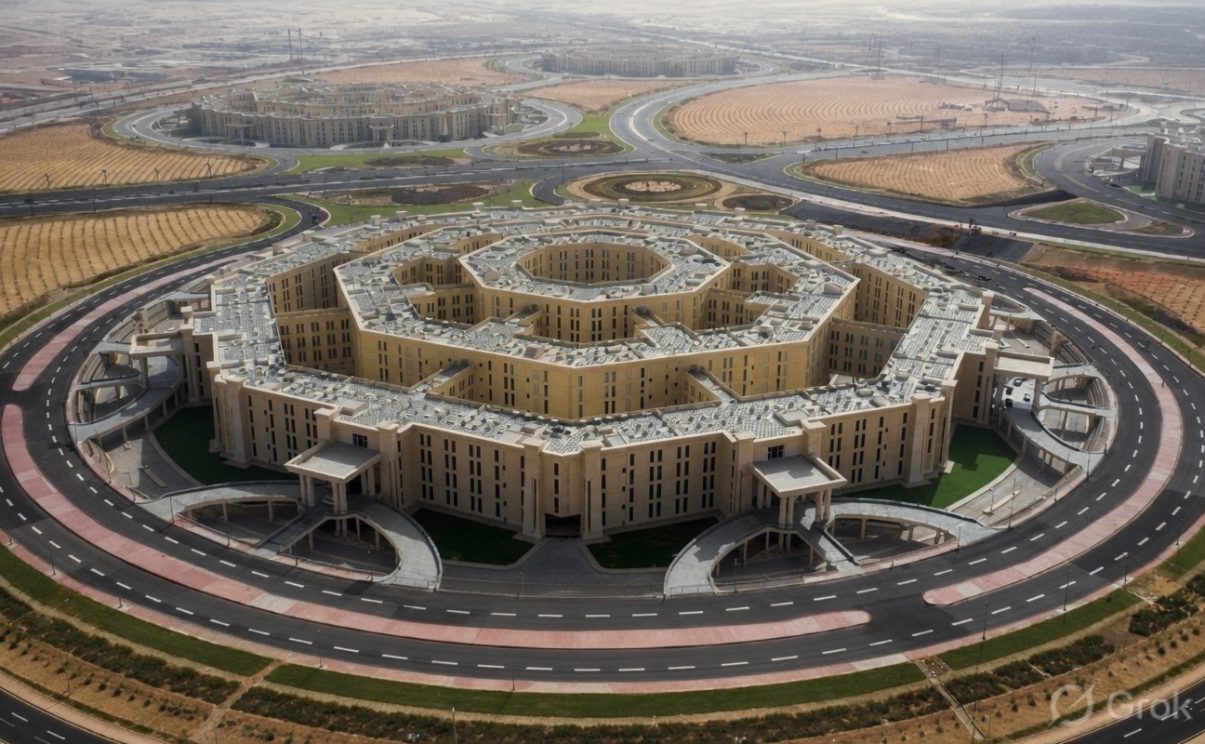
Egypt just inaugurated “The Octagon”, officially known as the State Strategic Command Headquarters, a massive new military complex spanning 22,000 acres in the New Administrative Capital, located about 45 kilometers east of Cairo.
Inaugurated by President Abdel Fattah el-Sisi on July 4, 2026, the complex is designed to serve as the central command-and-control hub for the entire Egyptian Armed Forces.
It surpasses the U.S. Pentagon in both overall land area and total floor space, with roughly 50.5 million square feet of built-up area, making it the world’s largest defense headquarters complex.
The facility comprises eight interconnected octagonal buildings arranged around central structures, connected by corridors. These buildings house the main operational commands, logistics centers, and national emergency management units.
The octagonal design symbolizes the various branches and commands of the Egyptian military.
The complex also includes 13 specialized zones dedicated to various functions and features extensive underground facilities for enhanced protection and operational continuity. Equipped with advanced digital infrastructure, artificial intelligence systems, and secure communications networks, the Octagon is intended to enable real-time, integrated command across all military branches. It also incorporates hardened subterranean command centers designed to withstand crises.
The project forms a key part of Egypt’s broader strategic vision to relocate major government and administrative functions from Cairo to the New Administrative Capital. By consolidating military command in a single, purpose-built, highly secure location, Egypt aims to improve coordination, decision-making speed, and national crisis response capabilities while projecting an image of modern military strength.
Beyond their massive footprints, many of these complexes are self-contained ecosystems. They serve as the “brain” for unified data networks, AI-driven crisis management, and cyber defense infrastructure across all branches of a nation’s military.
Beyond visible grandeur, they are fortified for extreme resilience and tight security against a range of contingencies. The geometry of these structures often represents unity among sovereign military branches.
USA – The Pentagon
The Pentagon is the headquarters of the United States Department of Defense, in Arlington County, Virginia, across the Potomac River from Washington, D.C. The building was constructed on an accelerated schedule during World War II.
As a symbol of the U.S. military, the phrase “The Pentagon” is often used as a metonym for the Department of Defense (DoD) and its leadership. The building houses the U.S. Secretary of Defense, the Joint Chiefs of Staff, and the leadership for all six branches of the U.S. Armed Forces (Army, Navy, Air Force, Marine Corps, Space Force, and Coast Guard).
The Pentagon houses administrative, intelligence, and logistical defense agencies such as the Defense Intelligence Agency and the Defense Logistics Agency. The building was dedicated on 15 January 1943. The initial cost was $31.1 million (equivalent to $600 million today).
The Pentagon is the world’s second-largest office building, with about 6.5 million square feet (600,000 sq.m) of floor space. It has five sides, five floors above ground, two basement levels, and five ring corridors per floor, totaling 28.2 km of corridors, and a central five-acre pentagonal plaza.
About 23,000 military and civilian employees work in the Pentagon, as well as about 3,000 non-defense support personnel. Additionally, the building supports a large contingent of private contractors, consultants, and non-defense support personnel, functioning essentially as its own self-contained city with its own police force, clinics, and commercial services.
On the building’s main concourse is the Hall of Heroes, opened in 1968 and dedicated to the more than 3,460 recipients of the Medal of Honor, the United States’ highest military decoration.
The building has a heliport, a Metro station, and a bus station. It is possible to walk between any two points in the Pentagon in less than ten minutes. The complex includes eating and exercise facilities as well as meditation and prayer rooms. Arlington National Cemetery is to the north.
From 1998 to 2011, the Pentagon was reconstructed in phases to bring it up to modern standards and improve security and efficiency.
In 2001, the Pentagon was damaged during the September 11 attacks. Five Al-Qaeda hijackers flew American Airlines Flight 77, a Boeing 757 airliner, into the western side of the building, killing themselves and 184 other people, including 59 on the airplane and 125 in the Pentagon.

At the time of the attacks, the Pentagon was under renovation, and many offices were unoccupied; only 800 people were there, as opposed to the usual 4,500, resulting in fewer casualties. In 2009, an outdoor memorial dedicated to the Pentagon victims of the September 11 attacks was opened directly southwest of the building.
Russia
The Ministry of Defense of the Russian Federation is headquartered in the General Staff building on Frunzenskaya Embankment at Arbatskaya Square in Moscow.
The building ground was broken for construction in 1940, and the building was dedicated in 1952. Additional buildings were added to the complex in 2014. The Main Building and its broader headquarters complex feature a total floor space of approximately 6.5 million square feet (about 603,870 square meters).
Other ministry buildings are located throughout Moscow.
The main structures are primarily occupied by the Minister of Defense and the Chief of the General Staff of the Armed Forces, as well as other high-ranking military commanders, civilian administrative leadership, and the National Defense Management Center (NDMC).
The NDMC is the supreme governing body that centralizes command for the entire Russian Armed Forces (Russian Ground Forces, Russian Aerospace Forces VKS, and Russian Unmanned Systems Forces (USF).
The main headquarters of the Russian Navy is located in the historic Admiralty building on the Neva River in Saint Petersburg, Russia. While the historical command center is in St. Petersburg, administrative command and top-level defense operations are managed from the central Russian Armed Forces headquarters at the Ministry of Defense in Moscow.
It also houses the core operational, strategic, and logistical departments overseeing the Russian Armed Forces. Administrative departments, including various directorates handling procurement, the military construction complex, healthcare, and efficiency improvements, are also housed here.
The headquarters of the Russian Strategic Rocket Forces (RVSN) is located in Vlasikha, a closed military town situated approximately 2.5 km northwest of Odintsovo in Moscow Oblast. The headquarters of the Russian Special Operations Forces Command (KSSO / SSO) is located at the Kubinka-2 Special Operations Center in the Moscow Region, Russia. The headquarters of the Russian Airborne Forces (VDV) is located next to the Ministry of Defense complex.

Traditionally, Defense Ministers have been former generals in the armed forces. The first ‘real’ non-uniformed Defense Minister was Anatoly Serdyukov, appointed in February 2007. Serdyukov was a former Tax Minister with little siloviki or military associations beyond his two years of military service. Serdyukov launched the military reform in 2008.
The Ministry of Defense is managed by a collegium chaired by the Defense Minister and including the deputy Defense Ministers, heads of the Main Defense Ministry and General Staff Directorates, the commanders of the Joint Strategic Commands/Military Districts, the three Services, and three branches, who together form the principal staff and advisory board of the Minister of Defense.
China
China’s Central Military Commission (CMC) is housed in the Ministry of National Defense compound (August 1st Building) on Fuxing Road in Haidian District, West Beijing. It serves as the supreme military command and decision-making body for the People’s Liberation Army, the People’s Armed Police (PAP), and the Militia.
The CMC chairman is also the general secretary of the Chinese Communist Party, consistent with the CCP’s absolute control over the military. Almost all the members are senior generals or admirals, but the chairmanship has always been held by the party’s most senior leaders (who are civilians under the principle that “the Party commands the gun”) to ensure the loyalty of the armed forces.
In 1982, the State Central Military Commission was established in order to formalize its role within the government structure. In 2016, a series of institutional reforms of the CMC bodies was undertaken, with the PLA’s four general departments being replaced by 15 departments that report directly to the CMC. The CMC thus controls the 15 general departments and the five theatre commands. It oversees each of the PLA’s service branches.
For operational security, the CMC’s Joint Staff Department and its Joint Operations Command Center (JOCC) maintain hardened underground command nodes in the Western Hills (Xi Shan) of the Haidian District. Additionally, the CMC’s General Office facilitates day-to-day administrative duties and military diplomacy. The command is highly centralized and chaired directly by President Xi Jinping, with oversight exercised by 15 functional departments, commissions, and directly affiliated bodies.
The HQs of People’s Liberation Army Ground Force (PLAGF), PLA Air Force (PLAAF), PLA Navy (PLAN), PLA Rocket Force (PLARF), PLA Aerospace Force (PLAASF), PLA Cyberspace Force, and PLA Information Support Force (ISF) are all co-located.
The current CMC HQs at August 1st Building (Bayi Building) has a total floor area of 90,255 square meters. The main structure is 12 floors above ground and includes 2 basement levels. It was designed by the Fourth Design and Research Institute of the PLA’s Engineer Corps.
The new CMC headquarters, currently under construction in the Qinglonghu area southwest of Beijing, covers roughly 1,500 acres (over 6 square kilometers).

This makes the facility approximately 10 times larger than the US Pentagon. Observers and experts have highlighted the facility’s immense scale and its heavy focus on hardened underground bunkers to protect military leaders. “Just the underground facilities cover 5 square kilometers of space to store six months of supplies for 50,000 people. And these are not mere storage spaces.
The deepest bunkers, according to intelligence reports, involve alternating layers of steel and concrete. The complex will reportedly house not just military leaders and facilities, but also deep bunkers built to withstand American bunker-buster bombs, and even a possible nuclear strike.
Ministry of Defense (United Kingdom)
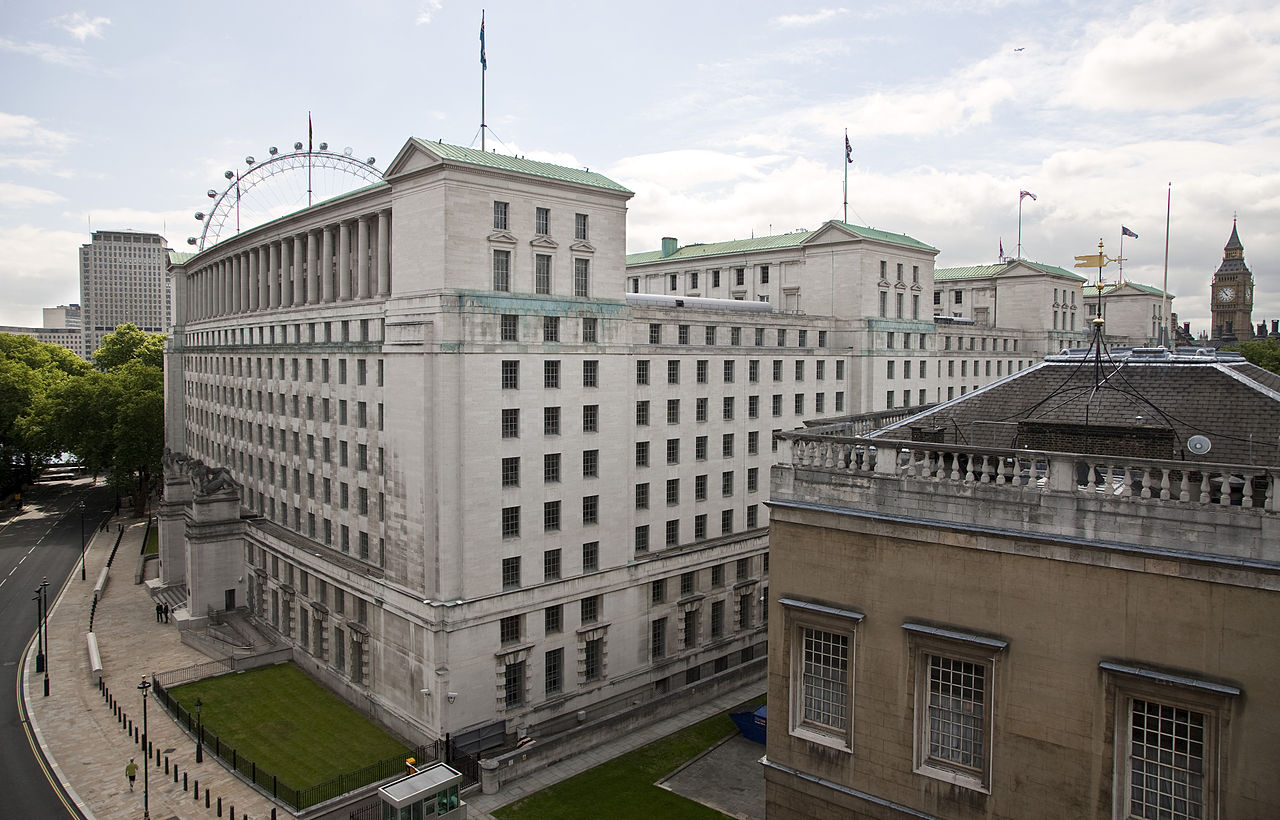
The UK MOD is headquartered in the historic Ministry of Defense Main Building on Whitehall in central London. Designed in Edwardian Baroque style, it sits on the site of the former Palace of Whitehall. The MOD also manages the day-to-day running of the armed forces, contingency planning, and defense procurement. Operational equipment and procurement for the armed forces are managed from the massive, purpose-built MOD Abbey Wood facility in Filton, Bristol.
The UK MOD Main Building spans approximately 3 hectares of land and sits 35 meters (116 ft) tall with 10 floors. Its vast interior features approximately 272,683 square meters of office space, housing both political leadership and the Ministry’s strategic staff.
During the 1920s and 1930s, looking back at the performance of the state during the First World War, there was a need for greater co-ordination between the three services that made up the armed forces of the United Kingdom: the Royal Navy, the British Army and the Royal Air Force.
On forming his government in 1940, Winston Churchill created the office of Minister of Defense to exercise ministerial control over the Chiefs of Staff Committee and to co-ordinate defense matters. The post was held by the Prime Minister of the day until Clement Attlee’s government introduced the Ministry of Defense Act of 1946.
After 1946, the three posts of Secretary of State for War, First Lord of the Admiralty, and Secretary of State for Air were formally subordinated to the new Minister of Defense, who had a seat in the Cabinet.
The three service ministers – Admiralty, War, Air – remained in direct operational control of their respective services, but ceased to attend Cabinet. The Chief of the Defense Staff (CDS) is the professional head of the British Armed Forces and the most senior uniformed military adviser to the Secretary of State for Defense and the Prime Minister.
The UK MOD executes seven core defense tasks: defending the UK and overseas territories, providing nuclear deterrence and strategic intelligence, supporting civil emergencies, projecting expeditionary power, contributing to global security and influence, and securing critical national infrastructure.
The British Army Headquarters was established in November 2011 and is located at Marlborough Lines near Andover, Hampshire, England. The Royal Navy HQ is located in Portsmouth, Hampshire, England. Portsmouth acts as the central administrative hub and operational command for the Surface Fleet.
The main headquarters of the Royal Air Force (RAF) is located at RAF High Wycombe in Buckinghamshire, England. Known as HQ Air Command, it is the primary command responsible for controlling the RAF’s frontline aircraft and global air operations. Clearly, in the UK, the service HQs are not co-located with the MOD.
Indian MoD
The Indian MoD (Rakṣā Mantrālaya) is responsible for coordinating and supervising all government agencies and functions directly related to national security and the Indian Armed Forces. The MoD provides a policy framework and resources to the armed forces to discharge their responsibility in the context of the country’s defense.
The Parliamentary Standing Committee on Defense, consisting of elected members from both the Lok Sabha and the Rajya Sabha, is tasked with this ministry’s legislative oversight.
The MoD is transitioning its headquarters from the historic Secretariat Building at Raisina Hill to modern, integrated complexes across the city. Operations are currently spread across several hyper-specific, localized headquarters and office buildings. Kartavya Bhavan II serves as the new administrative hub for the overarching Ministry. The physical location is the former residence of the Vice President.
Thal Sena Bhawan will be situated opposite the Manekshaw Center in the Delhi Cantonment, and the 39-acre campus serves as the Indian Army’s central headquarters. Naval HQ (Nausena Bhawan) is located in the Delhi Cantonment area.
This is the dedicated integrated headquarters for the Indian Navy. The Coast Guard HQ will continue to be at the erstwhile Dhyan Chand Stadium. Mehram Nagar (near Mahipalpur) will be the site of the Integrated Defense Staff (IDS) headquarters. These modern facilities will improve efficiency and workflow.
The Indian Air Force headquarters is currently located at Vayu Bhawan on Rafi Ahmed Kidwai Marg in Central Secretariat, New Delhi, and may be relocated later.
Additionally, as part of the Central Vista redevelopment, major multi-story Defense Office Complexes have been established at Kasturba Gandhi (KG) Marg and Africa Avenue near Chanakyapuri. While the Defense Minister and the civilian apparatus of the MoD are relocating to Kartavya Bhavan-II, the Service Chiefs and their Principal Staff Officers may operate primarily from their respective operational headquarters.
However, the CDS, service chiefs, and some key functionaries who have to interact with the MoD much more often will get a second office in the new MoD buildings.
Advantages and Challenges of Co-Located MoD and Service HQs
For any country to be a superpower, it has to have a powerful military.
Ministries of Defense, or of War, and Military headquarters command authority through striking architectural design. Structures like the US Pentagon project this power by blending fortified security with massive scale, designed to dominate the landscape and symbolize national defense capabilities. They are housed in buildings that exude strength and power.
The massive footprints and large, symmetrical geometries create a sense of dominance and structural permanence. Imposing aesthetics include minimalist, rigid facades, often associated with architectural brutalism, projecting strength, operational efficiency, and unyielding readiness. Strategic location, with proximity to government seats, integrates them directly with the nation’s political leadership.
These buildings have to be secured from air attacks and ground intrusions. The operations rooms have to be deep to protect from bunker-buster bombs, Nuclear, Chemical, and Biological attacks.
Access has to be tightly controlled. The building has to be secured from all directions. The communication networks have to be secured. Fortified design includes thick, reinforced-concrete walls, hardened bunkers, and controlled access points built to withstand severe external threats.
The three major global powers, the USA, Russia, and China, have housed the entire military hierarchy in a single complex. While this carries risks of attack, it helps improve civil-military and inter-service integration and enables faster decision-making.
One school of thought was that India should have created a Pentagon-like structure. A relatively smaller power like Egypt has done it. Another way to look at it is that putting all your eggs in one basket carries risks.
Having an integrated MoD and Service Headquarters under one roof eliminates bureaucratic silos, reduces procurement delays, and fosters better jointness. It bridges the historical gap between civilian bureaucrats and military personnel, ensuring a cohesive national security strategy.
Co-locating the Department of Military Affairs (DMA), Department of Defense (DoD), and service branches significantly speeds up file movement, approvals, and acquisitions. Historically isolated, the two sides are brought into a unified space, bridging gaps, preventing duplication of effort, building institutional trust, and enabling seamless civil-military integration.
A centralized physical structure supports jointness and interoperability, allowing the Army, Navy, and Air Force to coordinate strategy effortlessly. Joint institutions like National Defence Academy (NDA), and National Defence College (NDC) have paid their dividend.
Consolidating multiple defense offices into a secure command building reduces logistical overhead, lowers carbon footprints, and maximizes the use of shared assets by optimizing resources.
Experts stress that modern security threats require a consolidated approach rather than fragmented departmental operations. “An integrator model is essential to creating combined portfolios of capability that meet modern defense challenges.
This ensures alignment from the outset, so they deploy, adapt, and sustain together. Institutionally, ministries of defense serve as the fulcrum of civilian control, matching political directives to military means, but the civil-military fusion brings much higher operational returns.
- Air Marshal Anil Chopra (Retired) is an Indian Air Force veteran, fighter test pilot, and ex-director-general of the Center for Air Power Studies. He has been decorated with gallantry and distinguished service medals during his 40-year tenure in the IAF.
- He can be reached on X: @Chopsyturvey
- Follow EurAsian Times on Google News