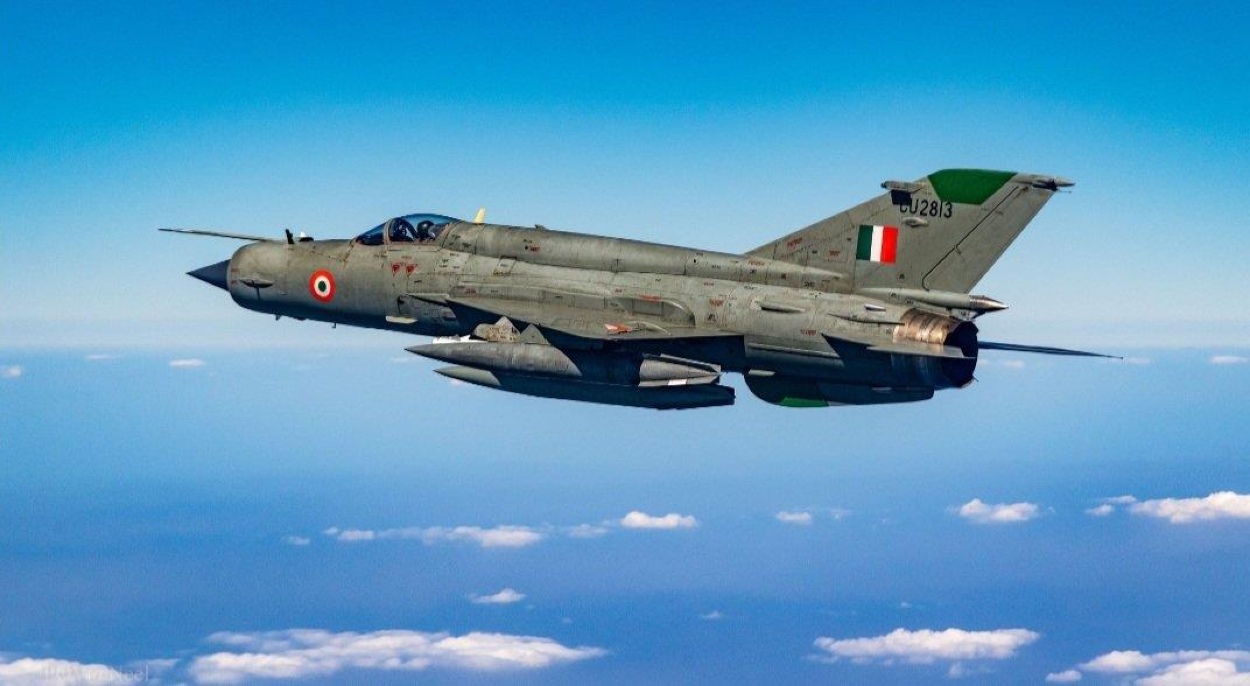
The MiG-21 may have flown into the sunset when the Indian Air Force (IAF) retired the Soviet-origin aircraft in September 2025, but its strong reputation refuses to fade away, as shown in a new Netflix series.
However, there is another tale of the MiG-21’s valor in defending Indian sovereignty—the time when it shot down a Pakistani Navy aircraft merely two weeks after winning the Kargil war.
One chapter of MiG-21’s legacy is now streaming on Netflix in the six-episode war drama “Operation Safed Sagar,” which centers on No. 17 Squadron “Golden Arrows” and their MiG-21s flying from Bhatinda, Punjab, during the 1999 Kargil War.
The series focuses on the squadron’s contribution to the IAF’s Operation Safed Sagar, the air campaign that ran alongside the Army’s Operation Vijay to evict Pakistani intruders from Indian territory.
The story of these MiG-21-wielding Golden Arrows is one of the lesser-highlighted aspects of the air campaign during the war. The unit began as a dedicated fighter-reconnaissance (FR) unit and provided hard photographic proof of the intrusion before transitioning into strike missions that directly hit Pakistani positions and logistics inside Indian territory until the Mirage-2000s got ready with laser-guided bombs.
By the early 1990s, the Golden Arrows had been converted into the specialist FR unit for the western theatre, focusing on army co-operation and battle-damage assessment (BDA) rather than high-risk deep penetration, according to publicly available information.
In May 1999, as the scale of the intrusion became clear, the squadron—then commanded by Wing Commander B.S. Dhanoa (who later became IAF chief)—ferried north on 18 May. They began flying their first reconnaissance sorties almost immediately, producing conclusive evidence of Pakistani intrusion.
During one such sortie, an IAF MiG-21 was shot down by Pakistani troops using a Stinger surface-to-air missile. Another MiG-21 piloted by Squadron Leader Ajay Ahuja commenced a search mission to locate the downed pilot when his own jet was hit by a Stinger. Squadron Leader Ahuja managed to eject but landed in Pakistan-occupied Kashmir (PoK), following which he was captured and killed.
The broader Operation Safed Sagar faced significant constraints: high-altitude performance limits, the political decision not to cross the Line of Control (LoC), and the need to improvise tactics with aging platforms.
While the Golden Arrows continued reconnaissance and battle-damage assessment sorties, they also had to improvise and support the ground troops trying to recapture their positions.
The squadron’s first attack mission —and its first since the 1971 Indo-Pakistan war— came when bombs were dropped on Point 5140.
From late June onward, the unit conducted day and night attacks on administrative bases, supply lines, and positions in the critical hills of Kashmir. In fact, some of the most exquisite and visually stimulating scenes from the show are from night missions, during which the pilots relied on handheld GPS, visual spotting, and calculated trajectories.
The older MiG-21s managed to accurately target enemy positions during a very critical phase of the war and opened the way for ground troops to recapture occupied posts.
“The shift in tactics to higher weapon-release altitudes to stay clear of the SAM lethal envelope introduced additional challenges, including reduced weapon accuracy. These were offset by changes in attack profiles, steep-dive attacks, the novel use of GPS-aided level bombing by day and night, better target-to-weapon matching, the first use of laser-targeting pods, and precision-guided weapons. The continuous bombing by these older platforms, despite their reduced accuracy compared to precision weapons, had a tremendously demoralizing effect on the enemy and boosted the Army’s morale, which was fighting herculean battles in unbelievably adverse conditions,” reads an older article from the vault of the New Delhi-based think tank, the Observers Research Foundation.
The aircraft’s power margin helped at altitude, even as payload and accuracy suffered in some ways. Nonetheless, it helped the Indian Army gain ground until the Mirage 2000s were adequately ready to conduct decisive strikes on Tiger Hill.
“Air strikes began on 26 May, and through the early phases of Operation Safed Sagar, the Arrows served as the IAF’s eyes and auditors—flying BDA behind strike packages and, later in the campaign, even strike missions. By war’s end, the unit stood among those with the highest mission counts in both reconnaissance and strike. The squadron received Battle Honors, and the roll of gallantry includes the Vir Chakra awarded posthumously to Sqn Ldr Ajay Ahuja, lost while on a BDA sortie,” according to IAF History.
By the end of the war, the Golden Arrows squadron was among the highest in both reconnaissance and strike missions, and was honored with several battle honors.
Interestingly, the MiG-21 made another unforgettable kill just two weeks after the Kargil War ended, when it downed a Pakistani aircraft carrying 16 people aboard.
MiG-21 Downs Intruding Pakistani Aircraft
The Kargil War ended on July 26, 1999.
On August 10, 1999, at precisely 10:51 a.m., an aircraft was detected by IAF ground radars on a specific flight path near Badin, in the Sindh province of Pakistan, and very close to the Indo-Pakistan border.
At the time, the aircraft was moving gradually toward the Indian-Pakistan border, its trajectory set in a south-easterly direction.
The IAF’s ground radar sensors monitored the aircraft as it approached the border region. New Delhi was still very suspicious of any illicit activity by Islamabad and its armed forces after the Kargil war.
The aircraft in question was identified as a Pakistani-operated Atlantique aircraft, flight Atlantic-91. It was a long-range maritime patrol aircraft equipped with air-to-surface missiles and capable of conducting anti-submarine operations and ground-attack missions.
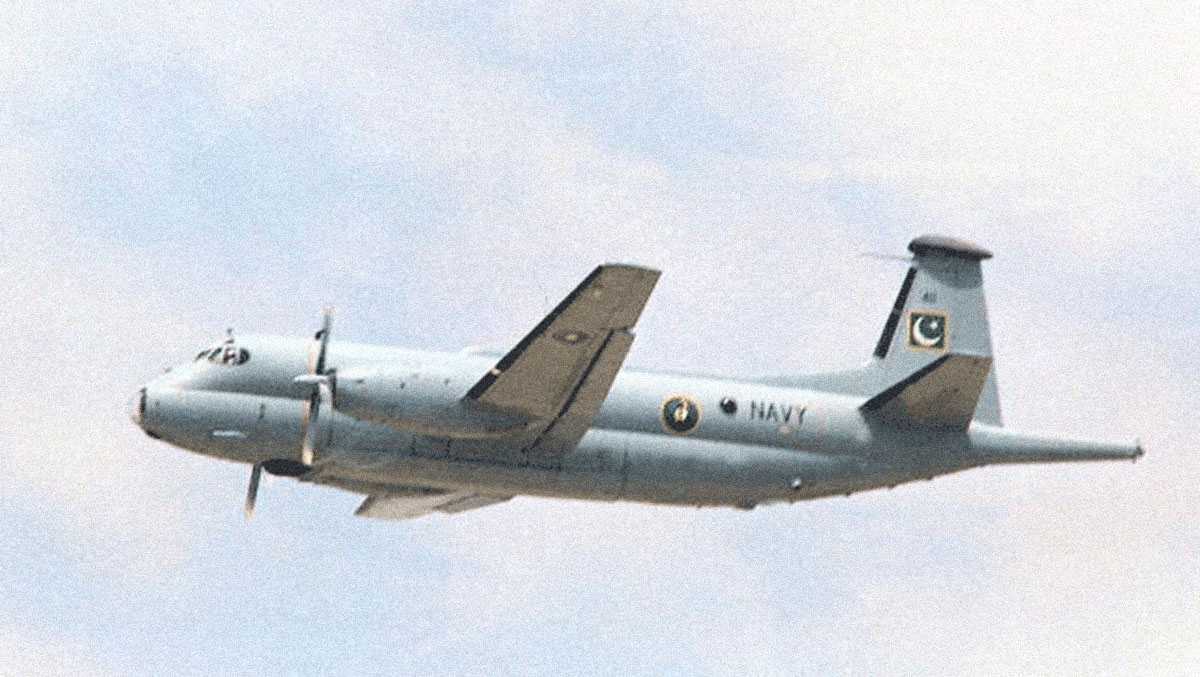
In an unexpected move, the Atlantic-91 entered Gujarat’s Kutch area near the Indo-Pakistan border, breaching Indian airspace.
The intrusion violated the 1991 air accord between India and Pakistan, which explicitly stated that all aircraft (except helicopters) from both nations must maintain a minimum distance of 10 kilometers from the border.
The IAF responded by scrambling a MiG-21 from the Naliya airbase in Kutch, and by 10:59 am, the aircraft was airborne.
One of these jets was piloted by Squadron Leader Prashant Bundela.
The IAF pilot closed in on the intruder aircraft and visually confirmed its identity.
Acting on ground control’s instructions, Squadron Leader Bundela flew alongside the Pakistani aircraft and ordered its crew to follow him and land at once. However, the Atlantic-91 ignored the order and instead turned toward Bundela’s MiG-21 in what were described as threatening maneuvers.
Since the Atlantic-91 had violated the existing agreement and entered Indian airspace, it was treated as a hostile aircraft, an assessment that was further reinforced by its continued defiance of IAF orders.
The Atlantic-91 faced two options: comply with instructions and land, or risk being shot down. It chose neither. Instead, it ignored the orders and turned toward the border in an attempt to escape into Pakistani territory.
After trying every available option to get the Pakistani aircraft to land, Squadron Leader Bundela was permitted to neutralize the aircraft. With the aircraft only about five kilometers from the International Border, he fired an R-60 air-to-air missile.
The missile struck the left engine, and the Atlantique-91 went down in flames, killing all 16 on board.
This was the first air-to-air kill by the IAF’s MiG-21 after the Kargil War.
Later, Pakistan asserted that the plane was on a harmless patrol mission, citing its lack of weapons.
New Delhi, on the other hand, questioned the training mission near the Indian border, noting that all nations normally conduct training exercises in designated locations. Additionally, it contended that the Atlantique’s main operational area is over the ocean, suggesting that a training trip near/within foreign territory was not a standard exercise but rather a surveillance mission.
Pakistan later filed a case against India at the International Court of Justice (ICJ) on 21 September 1999, seeking nearly US$60 million in restitution. India contested the Court’s jurisdiction, and in June 2000, the ICJ upheld India’s position and dismissed the case.
The episode elevated the MiG-21’s reputation within the IAF. The pilots flying these jets were widely praised for their skill in neutralizing what was then regarded as a clear security threat.
On 8 October 2000, Squadron Leader Bundela—later promoted to Wing Commander—was awarded the Vayu Sena Medal for his gallantry.
- Contact the author at sakshi.tiwari13 (at) outlook.com
- Follow EurAsian Times on Google News