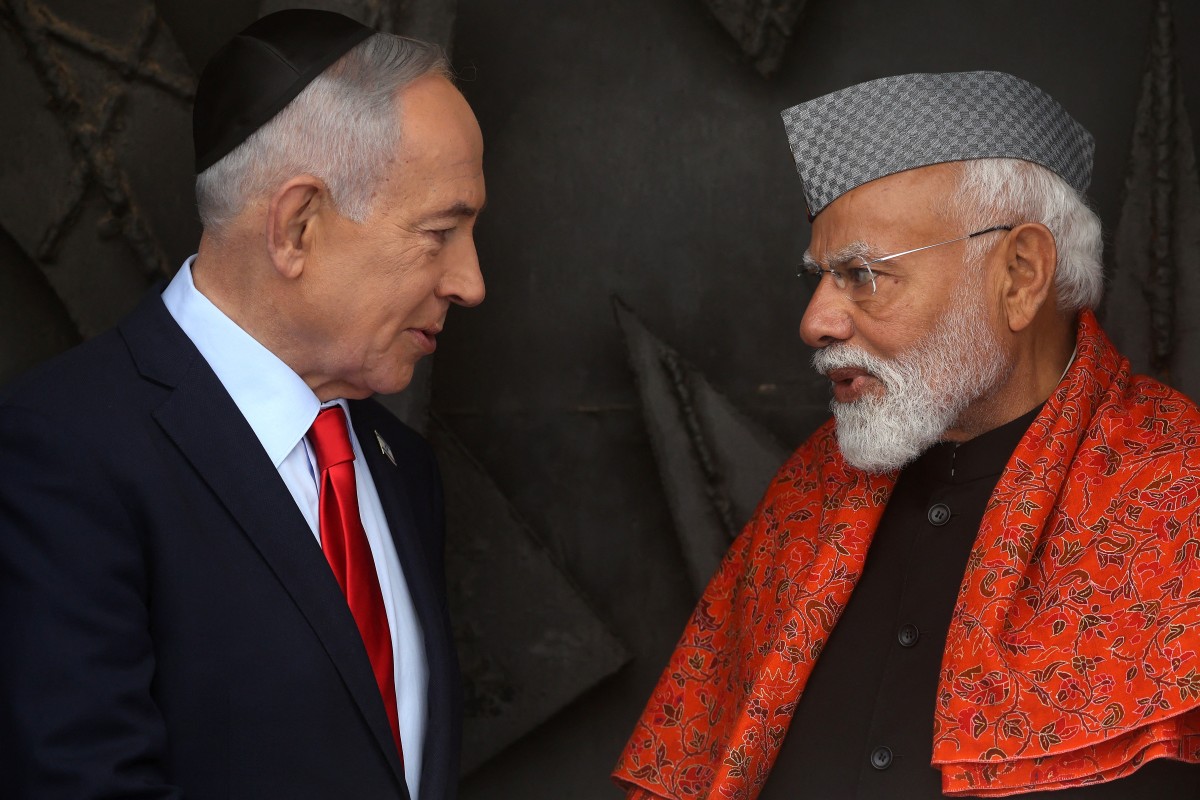
On February 27, barely 24 hours before Israel and the US launched devastating air strikes on Iran, Indian Prime Minister Narendra Modi, leader of the world’s largest democracy, was addressing the Israeli parliament, the Knesset.
In the process, Modi became the first Indian Prime Minister to address the Knesset. While the timing itself was somewhat controversial, a peculiar remark Modi made in his address to the Knesset sparked considerable trolling of the Indian Prime Minister.
Reportedly, Prime Minister Modi called Israel ‘the fatherland’ and India ‘the motherland’.
Many media outlets widely reported his remarks.
Commentators suggested that Modi was suggesting a profound, mystical, genealogical relationship between India and Israel. Many also commented on the gender framing in Modi’s speech, identifying Israel as male (fatherland) and India as feminine mother (motherland).
For instance, writing in Frontline, a left-leaning magazine in India, author and civil rights activist Anand Teltumbde, said, “The Fatherland-Motherland formulation is particularly rich when examined closely. In Modi’s cosmology, India is the nurturing mother—patient, suffering, civilizational, eternal. Israel is the father—strong, martial, uncompromising, willing to use necessary force.”
“Hindu nationalism’s civilizational grievance meets Israeli occupation’s military methods; India’s democratic facade meets Israel’s ethnic supremacist substance; mother’s spirituality meets father’s pragmatic violence. It is, one must admit, a perfect match,” he added.
While rich in literary symbolism, these commentators are guilty not just of blowing something out of proportion, but of something much worse: falsifying and misrepresenting the context itself.
First, let us see what Prime Minister Modi’s exact quote was.
He said, “There was movement from India to Israel too, when many Indian Jews migrated to Israel in the mid twentieth century. Today, a vibrant Indian-origin Jewish community lives here. They have contributed to the building of modern Israel, in laboratories and hospitals, in classrooms, and also on the battlefield. They hold firmly that Israel is their fatherland and India their motherland. We are proud of them.”
Modi’s quote – “Israel is their fatherland and India their motherland,” mentioned in the specific context of the Indian-origin Jewish community, was transformed into – “Israel is the Fatherland, India is the Motherland.”
Secondly, to read gender in the binary of fatherland/motherland is linguistically, culturally, and historically incorrect.
The False Fatherland-Motherland Binary
Throughout the world, people have referred to their homeland as fatherland, motherland, or even mother fatherland.
Furthermore, various people have used both fatherland and motherland to refer to their countries throughout history.
The choice of “father” versus “mother” has nothing to do with gender and often stems from linguistic roots, cultural traditions, historical usage, and subtle differences in connotation.
The terms “fatherland” and “motherland” both refer to one’s native country or homeland, evoking a deep sense of belonging, loyalty, and national identity.
Fatherland typically traces back to the Latin patria (from pater, meaning “father”), which originally meant the land of one’s fathers or ancestors. This implies heritage, lineage, inheritance, tradition, government, and order.
Many Germanic and some Slavic languages favor versions of “fatherland”.
For instance, in German it’s ‘Vaterland,’ in Dutch it is ‘Vaderland,’ Norwegian ‘Fedreland,’ in Swedish ‘Fädernesland,’ and so on.
Motherland often connects to ideas of birth, nurturing, fertility, and the “soil” or earth that “gives life.” It evokes a caring, maternal figure who raises and protects her children, the citizens. In many languages, the word for “homeland” or related terms is grammatically feminine, reinforcing this imagery.
For instance, in Russian it is Rodina (Motherland) or Matushka Rossiya (Mother Russia).

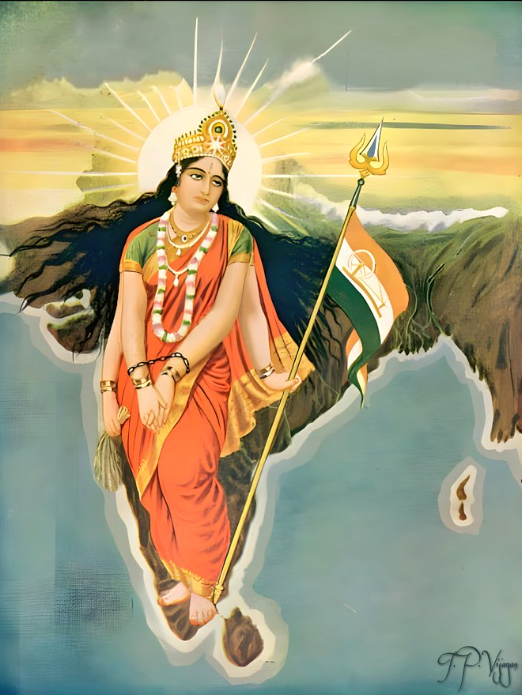
Similarly, in India, the homeland or the country is often portrayed as ‘Bharat Mata’ or ‘Mother India’.
@RRRMovie
Some other languages and countries use various forms of both “motherland” and “fatherland”. For instance, in Spain, it is ” Madre Patria” for the “mother fatherland.”
Grammatical gender in languages also plays a role: If “country” or “land” is feminine in a language, mother imagery flows more naturally.
In short, the different uses stem from subtle differences in how a nation is metaphorically framed. Both terms, however, serve a similar purpose: to evoke a sense of belonging and patriotism among citizens by employing familial imagery of a father or mother.
Now, coming to the second context in which Modi used the fatherland-motherland imagery.
Prime Minister Modi was specifically referring to the Indian Jews who migrated to Israel in the 20th century. These Indian Jews, Modi said, “hold firmly that Israel is their fatherland and India their motherland.”
Indian Jews’ Movement to Israel in 20th Century
In the 20th century, two groups of Indian have migrated to Israel on religious grounds.
The first group is the ‘Bene Israel,’ who mostly lived on India’s western coast.
The second group is called ‘Bnei Menashe,’ who mostly lived in Northeast India in the states of Manipur and Mizoram.
Notably, while the Bene Israel maintained a continuous Jewish identity for centuries, the same cannot be said of the Bnei Menashe.
The framing of Jewish identity among the Bnei Menashe was largely the result of 19th- and 20th-century Christian evangelical conversion movements among local tribes of Tibetan-Burmese origin.
At the same time, the genetic studies among the Bnei Menashe have not shown any noticeable Middle Eastern/Jewish heritage.
Therefore, we will limit ourselves to discussing the Bene Israel group, who mostly lived on the Konkan coast and in Maharashtra.
A 2016 genome-wide study analyzed 18 Bene Israel individuals alongside 486 people from Jewish, Indian, and Pakistani populations. It found substantial admixture: 45% Middle Eastern Jewish ancestry + 55% local Indian ancestry.
Notably, the Jewish component is paternal, that is, male Jewish migrants mixed with local Indian females, distinct from general Middle Eastern or Ancestral North Indian (ANI) signals, and unique among Indian groups.
The admixture happened 19 to 33 generations ago, that is, it could have happened over a millennium ago.
Post-admixture, the community experienced a bottleneck and high endogamy, as is the norm in Indian castes, where all castes practice a high degree of endogamy.
This parental lineage from the Middle Eastern Jewish population and the maternal lineage from the Indian population helped frame Israel as the fatherland and India as the motherland for this group.
Furthermore, since India has historically been framed as ‘Mother India,’ this fatherland-motherland imagery has been further strengthened.
Seen in this context, it is amply clear that Prime Minister Modi was referring to how specific Indian Jewish groups, post their migration to Israel in the 20th century, have tried to navigate their complex cultural heritage by framing Israel as the fatherland and India as the motherland.
Modi was stressing that this group of Indian Jews, now living in Israel, has contributed immensely to the development of Israel, and they are acting as a bridge between India and Israel.
- Sumit Ahlawat has over a decade of experience in news media. He has worked with Press Trust of India, Times Now, Zee News, Economic Times, and Microsoft News. He holds a Master’s Degree in International Media and Modern History from the University of Sheffield, UK.
- VIEWS PERSONAL OF THE AUTHOR
- He can be reached at ahlawat.sumit85 (at) gmail.com