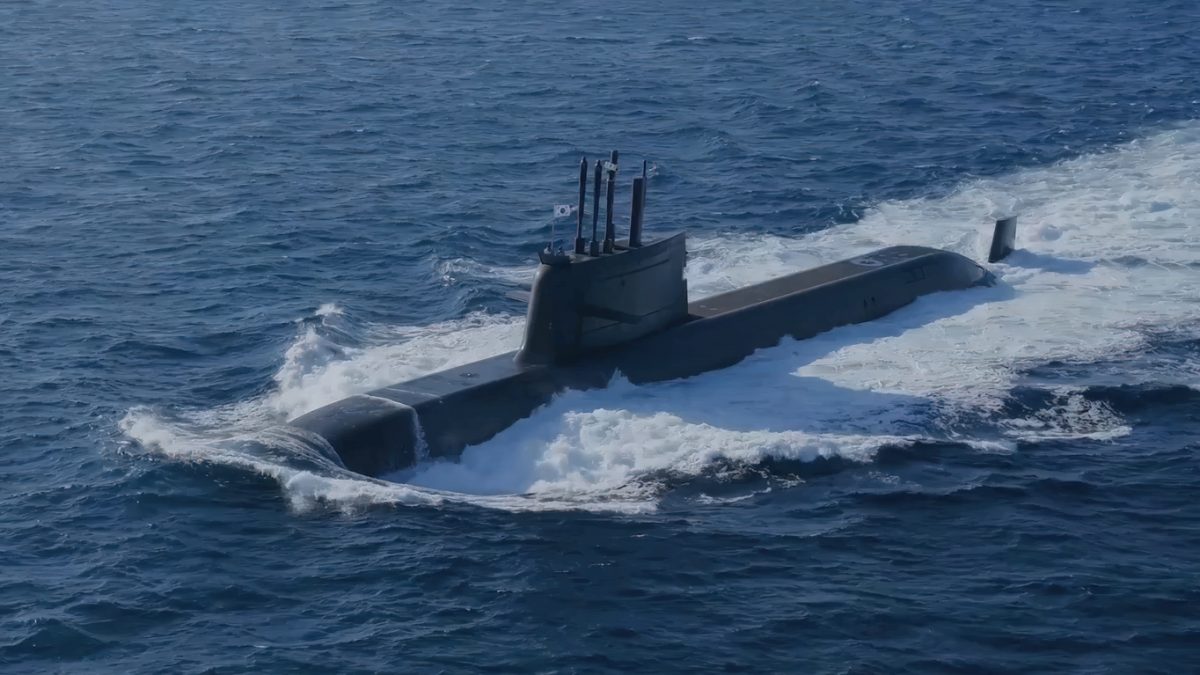
South Korea has unveiled what has been described as a “historic plan” to develop nuclear-powered submarines.
The Republic of Korea (South Korea) Ministry of National Defense (MND) released the “Basic Plan for the Development of the Republic of Korea Nuclear-Powered Submarine” this week. The project has been officially named Jangbogo N, with the “N” referring to “next-generation” and “nuclear-powered,” according to local reports.
If successful, South Korea would become only the third Asian country to operate nuclear-powered submarines, after China and India, and only the seventh worldwide.
The development of a nuclear submarine that can remain submerged for months without refueling ushers in a new era of South Korean power projection in the hotly contested Indo-Pacific region. The Ministry of National Defense has announced that the first nuclear-powered submarine will be built by the mid-2030s.
The official unveiling of the plan comes months after US President Donald Trump said in October 2025 that he had given Seoul his approval to proceed with it. “I have given them approval to build a nuclear-powered submarine, rather than the old-fashioned and far less nimble diesel-powered submarines that they have now,” the US President said at the time.
Interestingly, though, South Korea clearly noted that it would build all its nuclear-powered submarines at home, and not in the US, as earlier claimed by Trump. “South Korea will be building its Nuclear Powered Submarine in the Philadelphia Shipyards, right here in the good ol’ U.S.A. Shipbuilding in our Country will soon be making a BIG COMEBACK,” he had emphatically announced in a social media post back in October.
“This is the first official road map outlining how Korea will systemically develop and acquire a nuclear-powered submarine capability,” South Korean Minister of National Defense Ahn Gyu-back stated while presenting the nuke-sub development plan during the inaugural meeting of the Future Defense Strategy Committee, held at the submarine command in Jinhae, Changwon, South Gyeongsang Province.
📌「대한민국 핵추진잠수함 개발 기본계획」 발표
국방부는 5월 26일(화)에 「대한민국 핵추진잠수함 개발 기본계획」을 발표했습니다.
「대한민국 핵추진잠수함 개발 기본계획」은 대한민국이 핵추진잠수함을 체계적으로 개발하기 위한 추진 방향을 국내·외에 최초로 제시하는 문서로서 주요 내용은… pic.twitter.com/jkVjS3soQt
— 국방부 (@ROK_MND) May 26, 2026
The Minister stressed that the submarine’s “extended underwater endurance” and “increased mobility” would provide vastly improved operating capabilities when compared to traditional diesel-powered submarines.
Additionally, the Minister hinted that the nuclear submarine effort was mainly aimed at deterring North Korea. The new submarines “will play a core role in responding to threats such as North Korea’s submarine-launched nuclear and missile threats,” he emphasized.
The Republic of Korea Navy (ROKN) already operates a large number of diesel-electric submarines, including the KSS-I, KSS-II, and KSS-III, the latter of which is an indigenous design that has recently been promoted for export.
However, unlike diesel-electric submarines, nuclear-powered submarines can remain submerged for weeks or months. This means South Korea would be able to maintain continuous surveillance and tracking of North Korean submarines and nuclear missile-launching platforms in the future. At present, South Korea’s diesel subs are constrained to shallow waters around the Korean Peninsula, which requires them to snorkel frequently and makes them more detectable to North Korean forces.
The induction of the nuclear-powered submarines will enhance South Korea’s ability to detect, track, and destroy North Korean ballistic missile submarines (SSBs) before they can launch attacks. This is very critical as North Korea has embarked on a spree to develop more advanced and lethal underwater nuclear capabilities, and possesses a host of conventionally-powered submarines armed with nuclear weapons.
Moreover, the nuclear propulsion provides high sustained speed and unlimited range. This will allow the South Korean nuclear-powered submarines to operate farther from home bases, patrol wider swathes of the Sea of Japan and the Yellow Sea, and respond more quickly to threats in the region.

While North Korea does not yet have the capability, building a nuclear-powered submarine has been a long-standing goal of the Supreme Leader Kim Jong Un. Notably, Pyongyang published images of the North Korean patriarch inspecting what it claimed were nuclear-powered submarines in December 2025.
There is speculation that Pyongyang is chasing the goal to develop a nuclear-powered submarine with Russia’s help, in exchange for military assistance provided against Ukraine.
Earlier this month, a Russian cargo ship allegedly carrying nuclear reactors for submarines, possibly for North Korea, sank under mysterious circumstances.
In addition to challenging and deterring North Korea, constructing a nuclear-powered sub would also bolster South Korea’s larger military ambitions and transform the RoKN into a blue-water navy capable of projecting force far away from its shores.
Not just that, it would officially undermine China’s reputation as the only country in the neighborhood with nuclear-powered submarines.
The Chinese government has previously opposed South Korea’s plans for nuclear-powered submarines, urging Seoul and the US “to fulfill their nuclear non-proliferation obligations and do things to promote regional peace and stability, and not the other way around.”
South Korea’s Ambitious Nuclear Sub Plan
“This is not simply a shipbuilding project but a national strategic project,” South Korean Defense Minister Ahn said, underlining that the program will require the combined capabilities of the nuclear and shipbuilding sectors.
The Minister said the country will be able to manage the project throughout the vessel’s whole life cycle, from design and construction to operation, maintenance, and decommissioning, by using Korea’s superior civilian nuclear and shipbuilding technologies.
According to the plan, low-enriched uranium will be used as nuclear fuel for the submarine reactor, and the reactor will be designed to enable long-cycle operation, reducing the need to replace nuclear fuel.
The country will design and construct the nuclear-powered submarine to ensure autonomy and stability in the acquisition, sustainment, and maintenance of forces, the plan noted. Moreover, the platform and propulsion system of the nuclear-powered submarine will be developed by actively integrating top-notch technologies accumulated over a long period in South Korea’s civilian nuclear and shipbuilding sectors to ensure a high degree of reliability and safety.
To ensure sustainable operation, the entire process—including design, construction, operation, maintenance, nuclear fuel management, and dismantling of the nuclear-powered submarine—will be developed and managed from a total life-cycle perspective.
The document also contains certain reassurances.
It states that South Korea will create a safeguards system for nuclear-powered submarines that meets strict non-proliferation requirements together with the International Atomic Energy Agency (IAEA), and reaffirms that it does not want to acquire nuclear weapons.
However, analysts believe this may be an eyewash or a temporary reassurance that could be quickly walked back. According to them, Seoul would try to build nuclear weapons to create deterrence against North Korea, which fields an army of these devastating missiles.
The plan states that throughout the entire process of obtaining and managing low-enriched uranium, the nuclear fuel needed for the propulsion system of nuclear-powered submarines, it will faithfully carry out its non-proliferation commitments in close coordination with the United States.
The announcement comes as Seoul places greater emphasis on strengthening strategic capabilities amid rising global security uncertainties. For example, the US hinted at a troop drawdown earlier this year, and its engagement in the Iran War has reduced its combat readiness in the Indo-Pacific region.
The independent development of a nuclear-powered submarine may not be smooth, as challenges persist.
For one, miniaturizing a safe, reliable naval reactor is extremely difficult.
While the plan does not explicitly state so, the US could assist South Korea in developing propulsion systems. Last year, for instance, the South Korean defense minister said that the country would construct its own submarines and modular reactors while obtaining enriched uranium fuel from the United States. However, even with US help, full integration will take time, raising the cost of each submarine.
Moreover, there are speculations that this could escalate the arms race in the region, as Pyongyang would make further attempts to develop its own nuclear submarines.
Nonetheless, South Korea has rapidly expanded its military capabilities, including the development of indigenous submarines, warships, fighter jets, armored vehicles, and tanks, and has become an export powerhouse in Asia, cementing its position as a reliable non-Russian, non-Western defense supplier. An indigenous nuclear-powered submarine would further bolster the country’s image as a defense powerhouse driven by innovation and scale.
- Contact the author at sakshi.tiwari13 (at) outlook.com
- Follow EurAsian Times on Google News