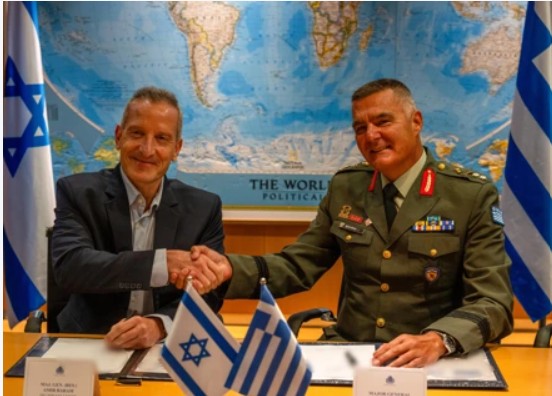
In what appears to be the largest-ever defense export deal, Israel has agreed to build a multilayered air-defense network for Greece as the two countries deepen defense cooperation amid rising tensions with Turkey.
The deal, worth US$3.6 billion, will be the largest defense export deal in Israel’s history.
“This is the largest defense export deal in the history of Israel-Greece relations, and one of the largest in the history of the State of Israel,” Israel’s Defense Ministry wrote in a statement.
Greece’s multilayered integrated air defense system will be called the “Achilles Shield,” combining Israel’s David’s Sling, BARAK MX, and SPYDER interceptors with Israeli-made radars and a national command system designed to counter ballistic missiles, aircraft, heavy rockets, and drones.
Rafael manufactures David’s Sling and SPYDER, and Israel Aerospace Industries (IAI) manufactures the BARAK MX system. The deal also includes MMR multi-mission radars for air surveillance, manufactured by ELTA Systems, an IAI subsidiary.
Israel will also build a new national command-and-control system, developed by Rafael, that will consolidate the full range of air defense capabilities. The command-and-control (C2) system will be similar to the system used in Israel. It will also incorporate artificial intelligence capabilities.
The C2 network is designed to combine data from existing Greek sensors and radars with NATO-standard information from Greek F-16s and F-35s, which will be fed into the Achilles Shield system.
In addition, a supplementary deal valued at €26 million (US$30.17 million) was signed during the meeting for the sale of Rafael’s Drone Dome systems to defend strategic sites against UAVs and drones and to reinforce existing defenses.
Therefore, most of the funds from the deal will go to Rafael.
US ‘Kill Switch’ Fear Returns as Japan To Move Classified Military Data to American Clouds in 2027
Greek companies are expected to receive about €750 million (US$ 870 million) of the deal’s total value as subcontractors for Rafael and IAI. Greece’s defense ministry said that 19 Greek companies are already involved in the project.
Defense Minister Nikos Dendias said Greece would become the first country in the European Union to adopt such a multilayered air-defense system.
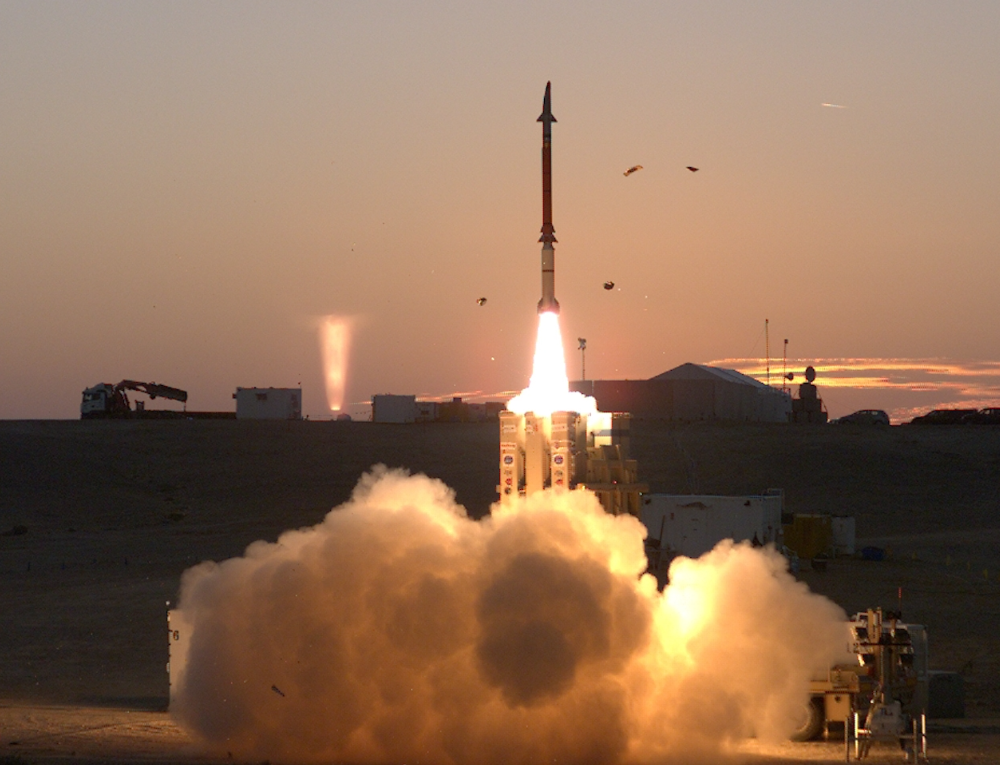
David’s Sling is a Medium- to Long-Range air and missile defense system. It uses the two-stage Stunner hit-to-kill interceptors. David’s Sling is designed to intercept tactical ballistic missiles, large rockets, cruise missiles, and aircraft at ranges of roughly 40–300 km.
Operational since 2017, David’s Sling sits between Israel’s Iron Dome (short-range) and Arrow (long-range/ballistic) multilayered missile-defense architecture.
Barak MX is a land- and naval air-defense system that uses a family of vertically launched interceptors with active radar seekers, ranging from 15 to 150 km. It is effective against aircraft, drones, cruise missiles, and some ballistic threats.
Meanwhile, Spyder is a mobile short-to-medium-range system that fires adapted air-to-air missiles – Python-5 (infrared) and Derby/I-Derby ER with active radar. It has a range of 15-40 km, is highly mobile, and is used to defend high-value targets.
According to the Jerusalem Post, SPYDER batteries will be deployed on Greek islands, including popular vacation destinations visited by many Israelis.
The Spyder AD system has been sold to several countries, including India, the Czech Republic, Vietnam, Singapore, and others.
‘Achilles Shield‘ is part of Greece’s massive US$27 billion defense splurge under the “Agenda 2030” reform, and it aims to provide protection on five levels – anti-missile, anti-ballistic, anti-aircraft, anti-ship, anti-submarine, and anti-drone.
Notably, Greece is already a major customer of Israeli defense systems.
Greece-Israel Defense Partnership
Greece and Israel have strengthened their defense partnership in recent years.
Notably, Israel, Greece, and Cyprus, all three of which have adversarial relations with Turkey, have strengthened defense cooperation among themselves.
In January, Greece and Israel agreed to expand cooperation on drone and underwater-vehicle swarms, cyber threats, military exercises, and defense technology.
In April, Greece bought PULS rocket artillery, manufactured by Elbit, capable of firing precision rockets up to 300 km. The system is comparable to American HIMARS.
Both are truck-mounted, highly mobile multiple-launch rocket systems (MLRS) designed for fast, precise long-range artillery strikes.
Greece has also bought Spike missiles (Rafael), Heron UAVs (IAI), SPICE precision-guided bombs (Rafael), and Rampage missiles (Elbit Systems and IAI).
Cyprus has also reportedly purchased Israel’s Barak MX system to defend its airspace.
In September last year, the EurAsian Times reported that Israel has deployed a Barak MX system in Cyprus.
Together, these countries are creating a new axis in the Mediterranean to counter Turkey’s rising regional ambitions. Turkey, meanwhile, has recently signed the Mecca pact with Pakistan and Saudi Arabia, which includes a NATO-style mutual defense agreement.
Greece and Israel are also part of the ambitious India-Middle East-Europe Corridor (IMEC), which seeks to connect India, the UAE, Saudi Arabia, Israel, Greece, and Europe.
Incidentally, Turkey opposes this corridor because it sidelines Ankara, which believes no Mediterranean trade route is possible without its involvement.
Greece and Turkey share historical territorial disputes and have fought a war over Cyprus in 1974. Greece and Turkey also have significant disputes related to gas exploration in the Aegean Sea and the Mediterranean.
Canada: Are Trump & Putin Working Together or Separately to Break Up World’s Second Largest Country?
Greece’s new integrated air-defense network is a problem for Turkey, which already trails Greece and Israel in the air: Israel flies the F-35, Athens has ordered it, and Ankara still does not have it.
The massive deal is another victory for Israeli air defense systems, which are not only battle-tested but have also won major deals across Europe in recent years.
The Rise of Israeli Air Defense Systems in Europe
Three of the largest defense export deals in Israeli history have all been for air-defense systems.
In 2023, Israel signed a deal with Germany to sell the Arrow 3 missile defense system to Berlin for US$3.5 billion.
In June this year, Israel’s Rafael Advanced Defense Systems (RADS) signed a landmark agreement with Romania worth approximately 2 billion euros (US$2.3 billion) to supply the Spyder air defense systems.
Together with the deal with Greece (US$3.5 billion) for an integrated air defense network, these are the three largest export deals in Israel’s history.
Israel also signed a 2023 deal with Finland worth US$345 million to supply the David’s Sling air defense system.
Again, in 2024, Israel signed a US$583 million deal with Slovakia to supply the Barak MX air defense system.
In December, 2024, Cyprus took delivery of the Barak MX air defense system, capable of intercepting threats up to 150 kilometers (95 miles) away.
Meanwhile, Switzerland has begun talks with Israeli air defense manufacturers for a second air defense system, possibly Rafael’s David’s Sling.

However, the US is the silent third party in most of these deals, as many of the Israeli air defense systems, from Iron Dome to David’s Sling and Arrow 3, have been developed in close cooperation with the US.
For instance, Israel’s Rafael and Raytheon (now part of RTX) jointly produce David’s Sling.
Similarly, Boeing is the principal co-developer and primary production partner for the Arrow 3 exo-atmospheric ballistic missile defense system, working alongside Israel Aerospace Industries (IAI). Boeing also partnered in developing the Arrow 2 AD system, a precursor to the Arrow 3.
Nevertheless, these massive deals for Israeli air defense systems have helped Israel get record export orders.
In June, the EurAsian Times reported that Israel’s defense exports surged to a new all-time record in 2025, reaching US$19.2 billion despite widespread boycott calls and the exclusion of Israeli firms from several international arms exhibitions.
In fact, Israeli defense exports had surged nearly 30% in 2025.
Notably, this surge in Israeli defense exports is led by missiles, rockets, and air defense systems.
“Missile, rocket, and air defense systems continued to lead in 2025, accounting for over a quarter (29%) of total deal volume,” according to Israel’s defense ministry. In contrast, missile, rocket, and air defense systems made up 48 percent of deals in 2024 and 36 percent in 2023.
A major reason for the success of Israeli air defense systems is their combat performance against drones, missiles, and rockets launched by Hamas, Hezbollah, Houthis, and Iran during the last three years of war.
Meanwhile, European countries are trying to strengthen their air defenses in light of Russia’s war in Ukraine and fears of a wider war between Russia and NATO countries in the coming years.
Long lead times for Patriot batteries, a global shortage of Patriot interceptors, and the lower cost of Israeli air defense systems have also made those systems an easier sell in Europe.
- Sumit Ahlawat has over a decade of experience in news media. He has worked with Press Trust of India, Times Now, Zee News, Economic Times, and Microsoft News. He holds a Master’s Degree in International Media and Modern History from the University of Sheffield, UK.
- He can be reached at ahlawat.sumit85 (at) gmail.com