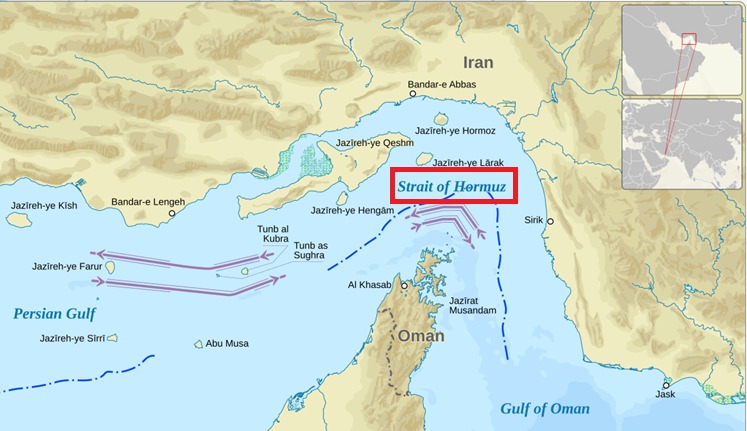
Iran has opened the Strait of Hormuz for now, but it was demanding US$2 million for the safe passage of every tanker through the strategic waterway.
Even though the idea of a country collecting tolls for the safe passage of naval ships from a natural sea passage is anathema to the rules-based global maritime order, governed by the 1982 UN Convention on the Laws of the Sea (UNCLOS), if the only choice is between expensive oil and no oil at all, most of the countries would happily pay a hefty toll of US$2 million per oil tanker.
The United Nations Convention on the Law of the Sea (UNCLOS), which guarantees the right of “transit passage” through straits used for international navigation, makes it clear under Articles 37 to 44 that ships and aircraft are entitled to continuous and expeditious passage that cannot be impeded or suspended by the coastal state even if the Strait falls under its territorial jurisdiction.
Notably, Article 26 of the UNCLOS prohibits states from levying charges on vessels merely for passage, allowing fees only for specific services rendered.
It says, “No charge may be levied upon foreign ships by reason only of their passage through the territorial sea” and “Charges may be levied upon a foreign ship passing through the territorial sea as payment only for specific services rendered to the ship. These charges shall be levied without discrimination.”
However, if paying this toll keeps the oil flowing and the wheels of the global economy moving, then, over time, most countries will get used to this unjustified demand from Iran.
Though such a toll system would upend UNCLOS, it would let the genie out of the bottle. Once the world accepts Iran’s demand for a toll on the Strait of Hormuz, there is nothing to stop other countries from trying to impose a similar toll-collection system on the straits near their own countries.
Currently, the world is fixated on the Strait of Hormuz, and indeed, it is a critical waterway through which nearly 20% of the global crude, 20% of the natural gas, and 33% of fertilizers pass.
However, there is no dearth of such critical waterways, which are even more crucial for global maritime trade and perhaps even easier to block.
Speaking in the Singapore parliament last week, the country’s foreign minister, Vivian Balakrishnan, reminded the world that the Strait of Malacca is far more critical to global energy supply routes and to global container traffic.
Singapore’s Foreign Minister on why he cannot accept negotiating with Iran for safe passage of ships. Definitely worth listening to: pic.twitter.com/6sxH2NcVLP
— Eric 𝕏 (@WorldStrategist) April 11, 2026
Furthermore, Balakrishnan highlighted that while the Strait of Hormuz is still 21 nautical miles wide at its narrowest point, the Strait of Malacca is only two nautical miles wide.
Thus, the Strait of Malacca is far more critical to the global economy and could be easily blocked.
Indeed, while 20% of global crude passes through the Strait of Hormuz, as much as 29% passes through the Strait of Malacca.
Similarly, while nearly 11% of global maritime trade passes through the Strait of Hormuz, as much as 24% passes through the Strait of Malacca.
Clearly, if Singapore, let’s say, were to collaborate with Malaysia and Indonesia to start imposing tolls for safe passage through the Strait of Malacca, it could earn far more money than Iran.
Furthermore, countries such as China, Japan, Korea, Vietnam, Laos, Thailand, the Philippines, Australia, and New Zealand are entirely dependent on the Strait of Malacca for their energy supply and maritime trade.
As mentioned earlier, the Strait of Malacca is only two miles wide at its narrowest point, as opposed to the Strait of Hormuz, which is over 21 miles wide.
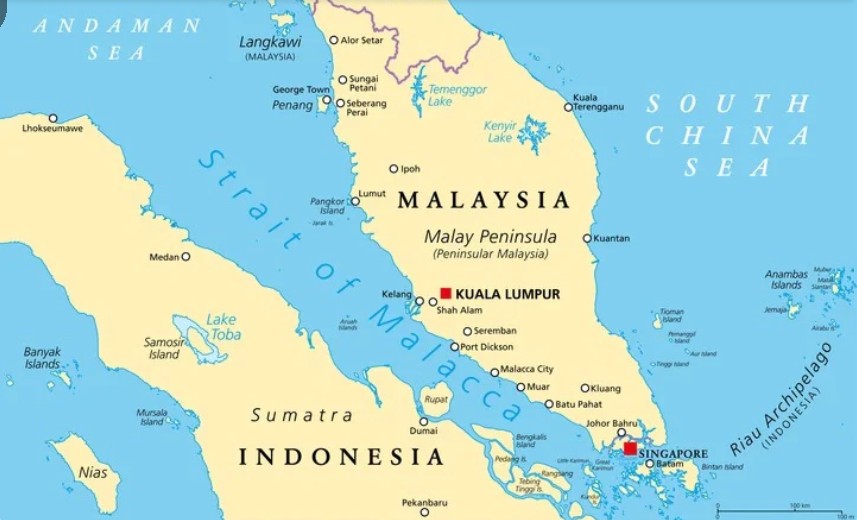
Also, while it takes a ship nearly six hours to transit the Strait of Hormuz, it takes nearly 20 hours to cross the Strait of Malacca.
During these 20 hours, the ship could be easily targeted in the narrow water channel by the nearby coastal states, in this case Indonesia, Malaysia, and Singapore.
The Bab el-Mandeb Strait (“Gate of Tears”) in the Red Sea is another crucial choke point on a critical maritime sea route.
All ships going to and coming from the Suez Canal must transit the Bab el-Mandeb Strait. Therefore, it serves as the vital link connecting East Asia and West Asia to Europe and North Africa.
Nearly 10-12% of global crude and 14% of the global maritime trade passes through the Bab el-Mandeb Strait.
The Bab el-Mandeb Strait is only 18 nautical miles wide at its narrowest point.
If this crucial waterway is blocked, all ships will have to transit around the Cape of Good Hope, which will increase shipping costs by nearly US$300,000 to US$1 million per ship and the transit time by 10 to 14 days per voyage. That can wreak havoc on global maritime trade.
In fact, much before the Iranians blocked the Strait of Hormuz, the Iranian-backed Houthis had targeted Western ships, particularly those belonging to the US and Israel, transiting the Bab el-Mandeb Strait.
Already, this had a devastating impact on maritime trade through the Red Sea.
Before 2023, nearly 12% of global crude oil passed through the Red Sea; however, since the Houthis began targeting ships in the Bab el-Mandeb Strait, that share has dropped to just 5%.
Similarly, global container traffic has dropped significantly, while insurance costs for ships transiting the Red Sea have risen sharply.
The Strait of Gibraltar is another crucial choke point in the Mediterranean Sea.
Here, the narrowest point is only 8 nautical miles wide, between Punta de Tarifa in Spain and Point Cires in Morocco.
Approximately 100,000 vessels cross the Strait of Gibraltar every year, averaging nearly 300 vessels per day.
This accounts for 10–20% of global maritime traffic.
If, like Iran, Spain also starts collecting a US$2 million toll per ship, it can earn nearly US$600 million per day.
Obviously, if all countries start imposing tolls on straits near their borders, global shipping costs will increase manifold, triggering global inflation and adversely affecting maritime trade.
Iran’s logic is that it would use the tolls collected from the Strait of Hormuz in rebuilding the infrastructure that has been destroyed in the war.
However, only two countries, the US and Israel, had attacked Iran, and Tehran wants to impose a universal toll on all ships transiting the Strait of Hormuz.
Also, if once such a toll has been normalized, other countries will also try to open a new source of revenue.
The US$2 million toll Tehran wants to impose on every oil tanker might not look like a big amount; however, it has the potential to destroy the very foundations of global maritime trade. Under no circumstances should such a demand be accepted.
- Sumit Ahlawat has over a decade of experience in news media. He has worked with Press Trust of India, Times Now, Zee News, Economic Times, and Microsoft News. He holds a Master’s Degree in International Media and Modern History from the University of Sheffield, UK.
- THIS IS AN OPINION ARTICLE. VIEWS PERSONAL OF THE AUTHOR
- He can be reached at ahlawat.sumit85 (at) gmail.com