If anything, the ongoing conflicts in the Middle East have reaffirmed the intensified weaponization of the trade routes. The Strait of Hormuz is closed, the Bab al-Mandab Strait is vulnerable to Somalian pirates, and the Red Sea is hostage to the whims of Yemeni militias in the face of drones, speedboats, and mines.
However, what is even worse is that the alternatives to global trade that nations, particularly India, have been pursuing via land routes, such as the India-Middle East-Europe Economic Corridor (IMEEEC) and the International North-South Transport Corridor (INSTC), are no longer feasible without Iran’s cooperation.
Recent years have seen the geopolitics of traditional trade routes, particularly the waterways such as Suez, Malacca, and Panama that can be easy chokepoints, shift towards “friend-shoring,” land-based corridors, and emerging Arctic routes. It was said that geoeconomics was changing the contours of geopolitics.
The Eurasian Times has previously analyzed how Russia is slowly and steadily playing its geoeconomic game in the Arctic by emphasizing the importance of access to Arctic ports and the further development of the Northern Sea Route (NSR), which connects the Pacific and Atlantic. China has joined Russia in this game, with both geopolitical and geoeconomic dimensions.
The Northern Sea Route is a shipping lane from the Kara Sea to the Pacific Ocean, specifically running along the Russian Arctic coast from the Kara Gates Strait between the Barents Sea and the Kara Sea, along Siberia, to the Bering Strait. It has several alternative passages and routes between Novaya Zemlya and the Beringia landmass.
The NSR is expected to give Russia enormous strategic and commercial benefits. For instance, compared with the Suez Canal route, shipping through the NSR will reduce the distance between Shanghai and Rotterdam (Europe’s largest commercial port in the Netherlands) by almost 2,800 nautical miles, or 22 percent. This route is also likely to reduce the transportation cost by 30 to 40 percent.
Similarly, while a container ship from Tokyo to Hamburg (Germany’s major port city) sails for about 48 days via the Suez Canal, it can cover the same distance in about 35 days via the NSR.
As regards the land-based alternatives, these are trade corridors that integrate sea, road, rail, and other infrastructure networks, designed to facilitate efficient, fast, and secure transport of goods between countries and regions, often bypassing traditional maritime bottlenecks. Here, many landlocked countries are connected to seaports, fostering economic development in hinterland regions.
In fact, some of the most important such proposed corridors criss-cross overland borders with road, rail, inland water, and coastal linkages between economies.
For instance, since 2013, China, through its so-called Belt and Road Initiative (BRI), has been building land and sea networks to diversify away from traditional maritime bottlenecks such as the Strait of Malacca. It has financed ports, railways, and pipelines across more than 140 countries to secure overland and maritime paths to Europe, Africa, and the Middle East.
That it has, in the process, resulted in what is called “debt-trap diplomacy”, thanks to the unpopular phenomena of “using Chinese contractors, Chinese standards, and Chinese loans”, is a different matter.
One of the important and in a way successful BRO projects has been “the China-Europe rail freight corridor”, connecting Chinese cities to over 200 European cities. Running via northern routes (via Russia) and the growing Middle Corridor (via Caspian Sea), this freight rail connects major hubs like Duisburg and Warsaw in roughly 10–18 days, primarily carrying electronics, vehicles, and high-value cargo.
Similarly, there is the Türkiye–Iraq Development Road Project, a regional connectivity initiative with significant geo-economic and diplomatic implications. Officially launched on October 3, 2023, by Iraqi Prime Minister Mohammed Shia’ al-Sudani, the project envisions creating an integrated trade corridor stretching from the Grand Al-Faw Port, which is currently near completion on Iraq’s Persian Gulf coast, northward through Iraqi territory to the Turkish border at Ovaköy. From there, the corridor extends into Türkiye, linking with European markets via road and rail infrastructure.
Another example of an alternative trade corridor is Mexico’s proposal for a land bridge connecting the Atlantic and Pacific Oceans to bypass the Panama Canal.
Likewise, Thailand is considering the Kra Isthmus corridor to connect the South China Sea and the Bay of Bengal, providing an alternative to the congested Strait of Malacca.
Reportedly, in August 2025, Armenia and Azerbaijan signed an agreement to develop the “Trump Route for International Peace and Prosperity” (TRIPP), which would connect Azerbaijan to its Nakhchivan exclave via Armenia’s Syunik province. This US-brokered 99-year lease project involves road/rail links, oil/gas pipelines, and fiber-optic infrastructure, operating under Armenian jurisdiction but managed by a private US company.
India, too, has such connectivity projects with two of its Southeast Asian neighbors. India-Myanmar connectivity projects, anchored by the Kaladan Multi-Modal Transit Transport Project (expected 2027) and the India-Myanmar-Thailand (IMT) Trilateral Highway, seek to integrate Northeast India with Southeast Asia. These projects involve upgrading ports and road networks.
However, the major alternate corridors that India is involved with are the IMEEEC and the INSTC. The IMEEEC, better known as simply IMEC for convenience, was announced in 2023 during the G20 Summit in New Delhi. And it has been endorsed by the United States, India, Saudi Arabia, the United Arab Emirates, France, Germany, Italy, and the European Union. Israel has also assured its support.
The idea comprises an “Eastern Corridor” connecting India to the Gulf region and a “Northern Corridor” connecting the Gulf region to Europe. It will include a railway and ship-rail transit network, as well as road transport routes. This is conceived as a strategic alternative to existing maritime trade routes passing through the Red Sea and the Suez Canal.
The proposed route would connect ports in India with those in the United Arab Emirates, then via road or rail to the Mediterranean port of Haifa in Israel, and from there to ports in Greece.
On the other hand, the INSTC is a multimodal transportation network connecting India and Iran and then to Russia and Northern Europe. It is a 7200 km-long project, and when completed, it will be the shortest trade route connecting India with Russia, 30 percent cheaper and 40 percent shorter than the traditional Suez route, reducing transit time to an average of 23 days for Europe-bound shipments from the traditional 45-60 days.
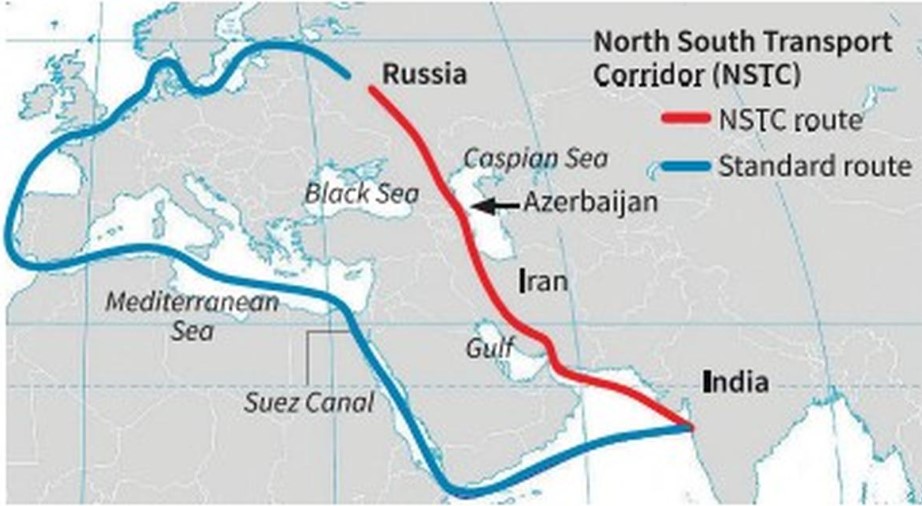
The INSTC is also a multimodal network of ship, rail, and road for moving freight, approved by India, Russia, and Iran at the Euro-Asian Conference on Transport in St. Petersburg on September 12, 2000. Other members included Turkey, Oman, Syria, Belarus, and Ukraine; the Central Asian nations of Tajikistan, Kyrgyzstan, Kazakhstan; and the Caucasus nations Armenia and Azerbaijan.
This project was said to be operationalized partially in 2024, with India playing a pioneering role in conceptualizing and promoting this corridor. India has plans to connect it to Central Asian markets and integrate it with Iran’s Chabahar Port at a later stage.
However, the ongoing Middle Eastern War between Iran and the US-Israel combine seems to have turned out to be bad news for both the INSTC and IMEC. Vulnerability in the Strait of Hormuz due to Iranian threats jeopardizes connectivity between Indian ports and the two UAE ports — Jebel Ali and Fujairah — as proposed under the IMEC project.
Of course, analysts like M Jamshed argue that, in the current geopolitical landscape, Fujairah appears to be the most viable option because it is located on the Gulf of Oman and would remain unaffected by any potential blockade of the Strait of Hormuz. But he also mentioned the challenges. Though the existing Etihad Rail network already connects all seven Emirates from Fujairah to Al-Ghuwaifat near the Saudi border, a missing rail segment of approximately 300 km still needs to be constructed between Al-Ghuwaifat and Haradh in Saudi Arabia. Then, to complete the IMEC route, an east-west rail corridor across Jordan will be required to link Al-Haditha with Israel’s rail network at Beit She’an.
All these need peace and stability within the region, which is not the case at the moment.
As regards the INSTC, it faces bigger challenges. Because Iran has to play a central role in this project. Here, Iran retains structural advantages in connecting India with Central Asia and Russia. Its ports, particularly Chabahar, offer strategic depth that remains crucial for India.
But Iran, hitherto facing internal and external constraints, is now at war. This has further accentuated Infrastructure gaps, financial limitations, and sanctions-related risks on the path of the INSTC.
Thus, at present, it appears unlikely that major advancements in these two projects will occur until stability returns to the region in general and Iran in particular. And that means that geopolitics is overriding geoeconomics again.
- Author and veteran journalist Prakash Nanda is Chairman of the Editorial Board of the EurAsian Times and has been commenting on politics, foreign policy, and strategic affairs for nearly three decades. He is a former National Fellow of the Indian Council for Historical Research and a recipient of the Seoul Peace Prize Scholarship.
- CONTACT: prakash.nanda (at) hotmail.com