India’s evolving fifth-generation AMCA and the still-to-be-delivered LCA Mk1A continue to grab the headlines. But there are other eggs in the Indian defense production basket that still need to be hatched.
The long-delayed indigenous trainer aircraft for the Indian Air Force (IAF) seems to be missing in action. While one can understand that the technology-hungry, state-of-the-art fighters may be difficult to master, but the world’s fastest-growing large economy and fourth most powerful military should surely be able to make its own training aircraft.
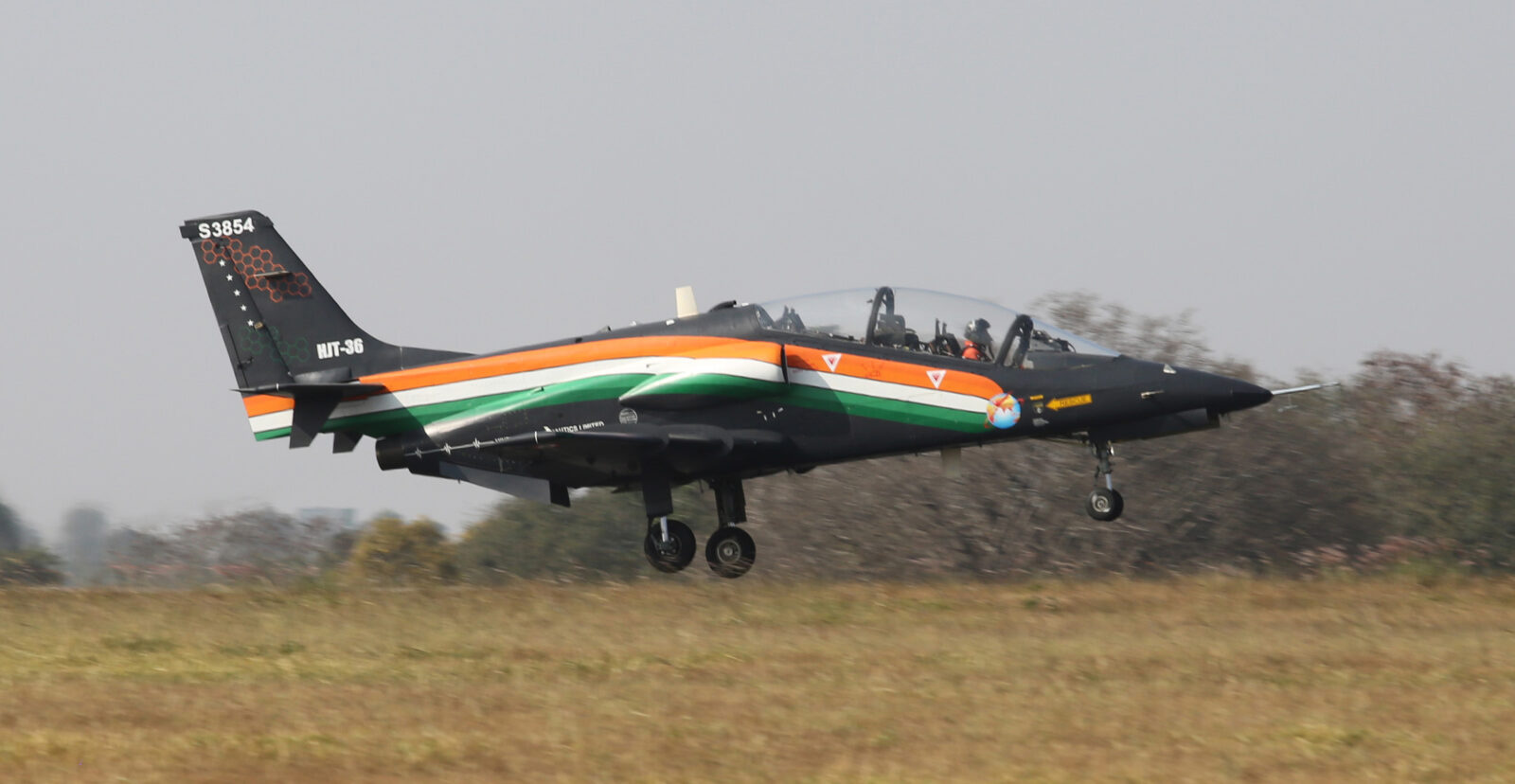
Even smaller countries like Poland, the Czech Republic, Italy, Switzerland, Sweden, Brazil, among others have had successful trainers. IAF continues to await the basic trainer HTT-40 and the Intermediate Jet Trainer HJT-36, both mired in developmental delays.
The IAF has also issued a Request for Information (RFI) to procure approximately 150 Next-Generation Stage-III Advanced Jet Trainers (AJTs) to replace the BAE Hawk Mk-132 aircraft. It is time to look at why India has been missing the indigenous trainer bus.
The Piston Trainers – Early Start
India had a private aircraft company called Hindustan Aircraft Limited (HAL), which was established in Bangalore in December 1940. It became a public sector defense production undertaking (DPSU), Hindustan Aeronautics Limited (HAL), in October 1964.
India’s first fully indigenous-designed and developed aircraft was the HAL HT-2. HAL produced it as a primary training aircraft for the IAF.
It made its first flight on 05 August 1951 and joined the IAF in 1955. Designed by the famous Dr. V. M. Ghatge, this tandem-seat aircraft was powered by a 155 hp Cirrus Major III piston engine. It served the IAF until 1989, a clear 34-year run.
The single-engine North American T-6/T-6G Harvard served as a Stage II trainer for the IAF. The aircraft had been inducted into the Royal Indian Air Force (RIAF) in the 1940s. The RIAF, and later IAF, procured hundreds of these aircraft for training and auxiliary roles. They served the IAF till the late 1980s.
The HAL HPT-32, which replaced the HT-2, was also a propeller-driven basic trainer aircraft that made its maiden flight in January 1977 and entered IAF service in 1982 with the ultimate aim of replacing the HT-2.
This side-by-side seating trainer had serious safety and engine reliability concerns and was grounded by the IAF in 2009 following 19 pilot fatalities across 17 major crashes over its 32 years’ service life. The aircraft had to be replaced by the imported Swiss Pilatus PC-7 Mk II.
Early Jet Trainers
The IAF acquired the British jet fighter de Havilland Vampire in November 1948. It was then Asia’s first jet fighter. In 1953, the IAF procured the two-seat T.55 trainer variant to transition pilots into faster jet-powered fighters. Trainees moved from the HT-2 and Harvard to this Stage III training.
The Vampires also flew combat and night-interdiction sorties during the 1965 & 1971 Wars. Finally, the fleet was retired in 1975 after 22 years of training service.
The HAL HJT-16 Kiran is an Indian two-seat, jet-powered intermediate trainer aircraft designed and manufactured by HAL. The aircraft performed its maiden flight in September 1964. Mass production commenced shortly thereafter. During the 1980s, the IAF procured a number of Kirans powered by a more powerful engine and with more hard points, and designated them Kiran Mk II.
The Kiran production stopped in 1989. A total of 250 Kiran aircraft were built. The IAF’s Surya Kiran aerobatic team also flew the aircraft. As the IAF awaits the HAL HJT-36 “Yashas”, the Kiran has already been in service for over 50 years. By the 2010s, use of the type was gradually declining as increasing numbers of newer BAE Systems Hawks, built under license by HAL, were introduced into IAF service. The IAF plans to retire the aircraft by 2027.
To supplement the Kirans and replace the Vampires, the IAF acquired the PZL TS-11 Iskra from Poland in 1975.
India was the sole export customer for the Polish-designed trainer, receiving an initial batch of 50 Iskra bis D aircraft in 1975 followed by 26 additional aircraft in the 1990s, totaling 76 aircraft. It was retired in December 2004 after nearly three decades of service.
BAE Hawk
The IAF inducted the BAE Systems Hawk Mk 132 as the Stage-III Advanced Jet Trainer (AJT) to train pilots to transition to frontline supersonic fighters. The aircraft entered IAF service in 2008. The initial 24 were made in the UK, and HAL in Bengaluru license-produced or assembled 99 in India.
After training, pilots transition straight to high-performance jets like the Su-30MKI, Rafale, and Mirage 2000. The IAF’s Surya Kiran aerobatic team also flies it. Beyond training, the tandem-seat aircraft is fully combat-capable and cleared to carry air-to-air missiles, rockets, and practice munitions for light-strike roles.
An additional order of 20 aircraft was stalled due to high pricing issues. The IAF plans to replace its aging Hawk MK 132 fleet with 150 new advanced jet trainers. The RFI’s have been sent out, and responses are expected by 05 October 2026. The aircraft are expected to have fly-by-wire controls, digital engine control (FADEC), glass cockpits, and Live, Virtual, and Constructive (LVC) training capabilities. It would be another import it seems.
HTT-40 Inordinate Delays
The HTT-40 is a tandem-seat basic trainer aircraft powered by a 1,100 hp turboprop engine. In early 2012, the company forecast building 106 aircraft. The aircraft has faced several technical, supply chain, and institutional hurdles over the years.
Early on, around 2012, the IAF had rejected the project over cost and time concerns compared to imported alternatives like the Pilatus PC-7 Mk II, 75 of which were acquired. Later, it was decided to go ahead with indigenous aircraft.
The project formally began in 2013 with internal funding of ₹350 crore from HAL. On 28 February 2015, it was reported that the MoD had selected 68 HAL HTT-40 trainers and 38 Pilatus trainers to replace its current trainer fleet, stating that this move was “commercially viable”.
The aircraft was initially planned to have a Pratt & Whitney engine, which the company later declined. On 21 June 2015, HAL chose the Honeywell Garrett TPE331-12B turboprop to power the trainer. HAL flew the first prototype on 31 May 2016. The deal was signed on 27 July 2022 for 88 engines, kits, maintenance, and support worth more than $100 million. Honeywell promised to work with HAL to extend export support.
In July 2019, it was anticipated that initial operational clearance (IOC) would be reached by the end of 2019 and that, after an order was placed, the first aircraft would be delivered to the IAF within a year. An HTT-40 prototype demonstrated critical six-turn spin test capability in September 2019 and sought final operational clearance (FOC).
By August 2021, the HTT-40 had completed its spin certification flight testing. The platform received its provisional certificate of airworthiness from the Center for Military Airworthiness and Certification (CEMILAC) on 6 June 2022. The Ministry of Defense signed a formal contract worth over ₹6,800 crore for 70 HTT-40s on 07 March 2023.
Early prototypes suffered from excess weight, requiring time-consuming structural and aerodynamic optimization to meet the desired performance SQRs. Completing the rigorous stall and spin tests extended the timeline. In the meantime, the COVID-19 pandemic further slowed assembly, testing, and component delivery schedules.
The imported Honeywell TPE331-12B turboprop engine encountered delays due to the obsolescence of the Engine Electronic Controller (EEC). Later, HAL faced persistent supply chain disruptions from Honeywell for series production. Under the engine contract, Honeywell missed its initial September 2025 delivery deadline due to global supply chain disruptions.
Because no production engines were available, HAL failed to meet its fiscal 2025–26 delivery target of 12 aircraft to the IAF. Meanwhile, it kept test-flying early series-production frames with used “Category B” prototype engines.
Finally, Honeywell has delivered the first batch of three TPE331-12B engines to HAL in mid-2026 and committed to a steady delivery rate moving forward. HAL proposes to start deliveries in 2026-27. HAL has reportedly scaled up manufacturing across its Bengaluru and Nashik facilities, targeting an eventual output of 18 to 20 aircraft per year.
HJT-36 Delays and Current Status
The HAL HJT-36 “Yashas” is a subsonic intermediate jet trainer aircraft designed and developed by HAL for the IAF and Indian Navy. It is meant to replace the HJT-16 Kiran as the Stage-2 trainer. Originally named Sitara, the jet was designed as a conventional jet trainer with low-swept wings, a tandem cockpit, and small air intakes on either side of its fuselage.
HAL started design work in 1997. In 1999, following reviews by the IAF, the MoD awarded HAL a contract to develop, test, and certify two prototype IJT aircraft at a cost of ₹180 crore. The contract was scheduled for completion in July 2004.
The first two prototypes flew on 7 March 2003 and in March 2004, respectively. In April 2005, the project cost was revised to ₹467 crore, and the timeline for IOC and FOC was expected in 2006-07 and 2007-08, respectively.
In April 2005, the SNECMA Turbomeca Larzac engine was replaced by the NPO Saturn AL-55I (16.9 kN) to meet higher thrust requirements. In February 2006, the MoD submitted a proposal to the Cabinet Committee on Security (CCS) to procure 12 IJT Limited Series Production (LSP) aircraft. The contract, costing ₹486 crore, was cleared in March 2006.
Aircraft deliveries, originally scheduled between March 2008 and March 2010, were further revised to 2011-12. Later, a CAG report flagged that LSP orders can be placed only after IOC certification from CEMILAC. This was ignored. On 8 February 2007, IJT prototype PT-1 was lost in an accident at Yelehanka AFS.
In November 2008, Air HQ initiated a proposal to supply 73 IJT aircraft. On 4 February 2009, PT-2 met with an accident while landing during a routine test flight. Following the crashes and delays, the IOC and FOC were further delayed.
The first AL-55I engine was received from Russia in December 2008, 2 years later than committed, and was installed on PT-1. Flight tests with the new engine started in May 2009. However, the relatively new Russian engine led to “teething engine problems” which eventually lowered the availability of the IJT prototypes and LSP variants for test flights.
The first flight test for the LSP aircraft occurred in January 2010, and IOC was now expected by July 2011. In March 2010, the IAF placed an order for 73 HJT-36 serial production trainers at a cost of ₹6,180 crore, before IOC certification and LSP aircraft deliveries were complete. As per MoD, the LSP aircraft order would be completed by 2011-12 and the timeline for delivery of 73 SP aircraft was between 2013 and 2017.
On 28 April 2011, one prototype crashed near Hosur during a routine test flight, and the aircraft was lost. In December 2013, HAL declared the aircraft as ‘weeks’ from certification.
In February 2014, the MoD announced that IJT development was in the advanced stages of certification, with more than 800 test flights completed so far. The activities reportedly left to obtain FOC were refining stall characteristics and spin testing. Aircraft production was to commence immediately thereafter.
However, it became clear that the stall could not be tested until HAL redesigned the entire aircraft to correct its “inherent asymmetry”. BAE Systems was consulted on certain design changes, specifically the tail. Afterward, the design underwent mathematical and wind tunnel testing. The modified aircraft was expected to complete the spin tests by September 2015, and production to begin.
In 2016, the program and the testing came to a halt after the aircraft “departed from controlled flight” while testing spin characteristics. Multiple attempts to overcome these issues without a major redesign, including nose strakes, ventral fins, and wing fences, had not delivered the desired outcome, as wing drops were still observed as soon as the aircraft stalled. Further changes were made. None of these design alterations provided any improvement.
In March 2017, Jane’s reported that due to the HJT-36’s “unsolvable” issues associated with critical stall and spin characteristics, the aircraft is not ready to serve as India’s IJT. Bihrle Applied Research Inc (BAR), an American world-class aerospace technology company specializing in wind tunnel testing and aircraft simulation, was consulted, and the airframe was modified to improve spin-recovery characteristics.
The modified aircraft flew on 17 April 2019. After the modifications, a new Anti-Spin Parachute system (ASPS) was developed to ensure the safety of the aircraft and test crew during spin flight testing. The wind tunnel testing facility of France-based ONERA was used to verify the design modifications.
Major design changes were made to the empennage, with the vertical fins pushed back by a meter and the rudder extended beyond the vertical stabilizer to the rear fuselage, increasing control-surface area by 30 percent. Other control surfaces added compared to the original design included nose strakes, ventral fins, and leading-edge strakes at the wing root.
The IJT then successfully demonstrated the capability to carry out six turn spins to both the left and right-hand sides. Yet the aircraft required two more years of testing before it would be ready for certification. On 12 February 2025, it was reported that the IAF has not placed any order for the updated aircraft but would lease 4 to 5 aircraft from HAL. Further orders will be placed if the user is satisfied with its training and operational capabilities.
During the opening ceremony of Aero India 2025, the HJT-36 was renamed as Yashas after undergoing significant design modifications. The formal induction timeline for induction into the IAF remains open-ended and unlikely this financial year.
To Summarise
India has a history of struggling to develop indigenous trainer aircraft.
Both the HT-2 and HPT-32 were underpowered. A large part of the training sortie was wasted in climbing before commencing training maneuvers. Yet the HT-2 served the IAF well, and many pilots learned finer skills after mastering this otherwise difficult-to-fly aircraft.
In the case of HPT-32, engine reliability was a major issue, resulting in many fatal accidents and the premature withdrawal of the fleet. Despite many attempts, HAL could not resolve the engine fuel system issues.
The initial Larzac engine of the HJT-36 was found to be underpowered. The change to a Russian engine wasted a few years of development time. Similarly, the HTT-40 engine supply chain has remained an issue.
Curiously, India has faced aero-engine supply chain issues for all American engines, including for LCA and AMCA programs.
Safe Stall and Spin characteristics, handling, and training qualities have been an issue with the HJT-36. This is a mandatory requirement for training stages.
Specifications like MIL-F-8785 require military trainers to demonstrate predictable, repeatable, and prompt recovery from deliberate multi-turn spins. These issues had been recognized very early in the program.
HAL initially thought it could seek concessions on this count. Subsequently, major airframe changes had to be made after foreign consultancy. Effectively, they had to start de novo. Years were wasted in this process.
Though any aircraft is equally complex to develop, India had been making trainers since the 1950s, and requirements were well understood. Also, technologies were relatively simpler. India’s inability to make its own even smaller piston and jet engines remains an Achilles’ heel.
Lastly, there remain lessons in program management. There are no shortcuts in aviation.
- Air Marshal Anil Chopra (Retired) is an Indian Air Force veteran, fighter test pilot, and ex-director-general of the Center for Air Power Studies. He has been decorated with gallantry and distinguished service medals during his 40-year tenure in the IAF.
- He tweets @Chopsyturvey
- Follow EurAsian Times on Google News