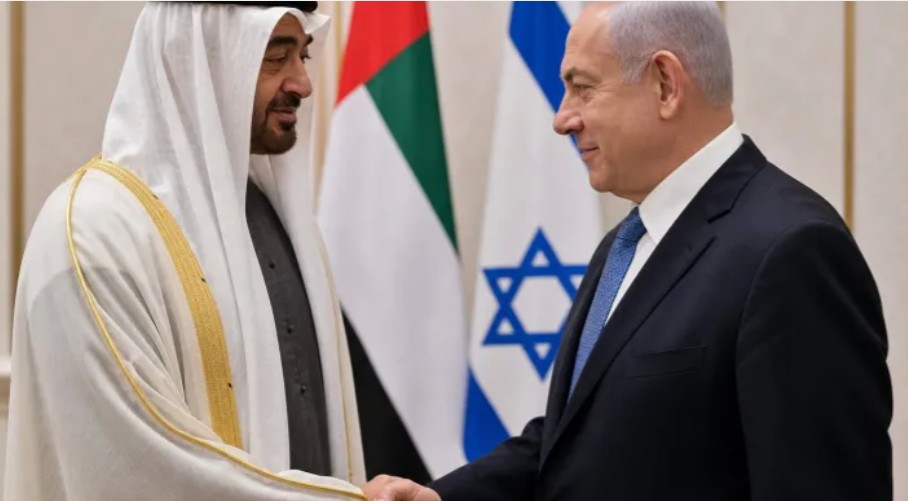
In the crucible of the Middle East, where ancient grudges, tribal blood feuds, great power rivalries, and sectarian conflicts have long defined geopolitics, a pragmatic partnership between two historical adversaries, the UAE and Israel, is rewriting the rules of engagement.
This emerging axis can not only deliver concrete economic, technological, and military gains but also rearrange global trade linkages and redefine Middle Eastern geopolitics for years to come.
For years, the relationship between the two countries remained discreet and low-profile. It is now coming into the open, with both sides increasingly at ease with public engagement.
The milestone was definitely the 2020 Abraham Accords; however, in the shadow of the Iran War, the blockade of the Strait of Hormuz, global energy supply shocks, disproportional targeting of the Emirati kingdom by Tehran, and emerging faultlines between the UAE and Saudi Arabia, Abu Dhabi’s closest strategic partner for decades, the budding UAE-Israel relationship has attained a new logic and urgency.
From Open Hostility to Discreet Normalization
The United Arab Emirates achieved independence from Britain in 1971.
However, it took nearly two decades before formal diplomatic contact was established.
The 1979 Islamic Revolution in Iran changed the region’s geopolitics. The new Islamic regime in Iran was determined to export its Shia revolution to neighboring Gulf countries. The UAE, as a small state just across the Strait of Hormuz, found itself particularly vulnerable.
In the 1990s, during the Oslo Accords, the first covert diplomatic engagement took place between the Emiratis and Israel.’
The representatives of these two countries met discreetly in Washington.
The UAE sought to purchase advanced F-16 fighter jets from the US and asked Israel for cooperation so Tel Aviv would not object to the US sale of aircraft to the UAE.
The Oslo Accords were announced in 1995, and three years later, in 1998, the UAE and the US announced a deal to purchase 80 American-made F-16C/D Block 60 “Desert Falcon” fighter jets.
The deal, valued at US$ 6.4 billion, was formally signed in 2000.
In 1994, parallel to the Oslo Accords, Jordan became the second Arab country, after Egypt, to sign a peace deal with Israel. The peace deal delinked normalization of relations with Israel from concrete progress on the Palestine issue or with the return of refugees to Gaza or the West Bank.
This same template will form the basis of the later Abraham Accords.
In the decade leading up to the Abraham Accords, the UAE and Israel gradually normalized their relations through intelligence sharing, joint counter-terror efforts, and even Mossad-facilitated COVID-19 equipment deals in 2020.
According to a Chatlam House research paper, “The Abraham Accords were the culmination of a long process that saw Israel and the UAE’s core interests begin to align, over an extended period.”
As one interviewee noted in a Chatlam House round-table discussion, “the accords [didn’t] come out of [a] vacuum. It was the culmination of 10–15 years of tacit relations between the UAE and Israel. It has been evolving, and there was a lot of dealing and exchange of views, benefits, but it was never official, [though] everyone knew about it.”
According to the Middle East Institute, “The Abraham Accords built on efforts by previous US administrations to promote closer ties between Israel and other Arab states, which had been developing under the radar since the signing of the Oslo Accords in the 1990s.”
The Abraham Accords Milestone
The real turning point in the relationship was the 2020 Abraham Accords.
On September 15, 2020, the UAE became the third Arab state, after Egypt and Jordan, to normalize fully with Israel. Bahrain also signed the Abraham Accords.
In December 2020, Israel and Morocco established official diplomatic ties. Kazakhstan formally joined the grouping on November 6, 2025, although it has had normalized relations with Israel since the 1990s.
The Abraham Accords sidestepped the Palestinian issue and instead focused on trade, economic, and security dividends.
Both countries opened embassies, launched direct flights, and visa waivers followed. People-to-people contacts surged; by 2023, over one million Israelis had visited the UAE, though Emirati visits to Israel remained modest.
Economically, the partnership has been transformative. Bilateral trade, negligible pre-2020, exploded post-accords.
In 2024, it reached US$3.24 billion. The next target is to cross US$5 billion, and a landmark Comprehensive Economic Partnership Agreement (CEPA) aims to push figures toward US$10 billion within five years.
Israel-UAE Defense Partnership
However, after the accords, the UAE and Israel also strengthened their defense cooperation.
In 2022, Israel sold the UAE its advanced Rafael-made SPYDER and
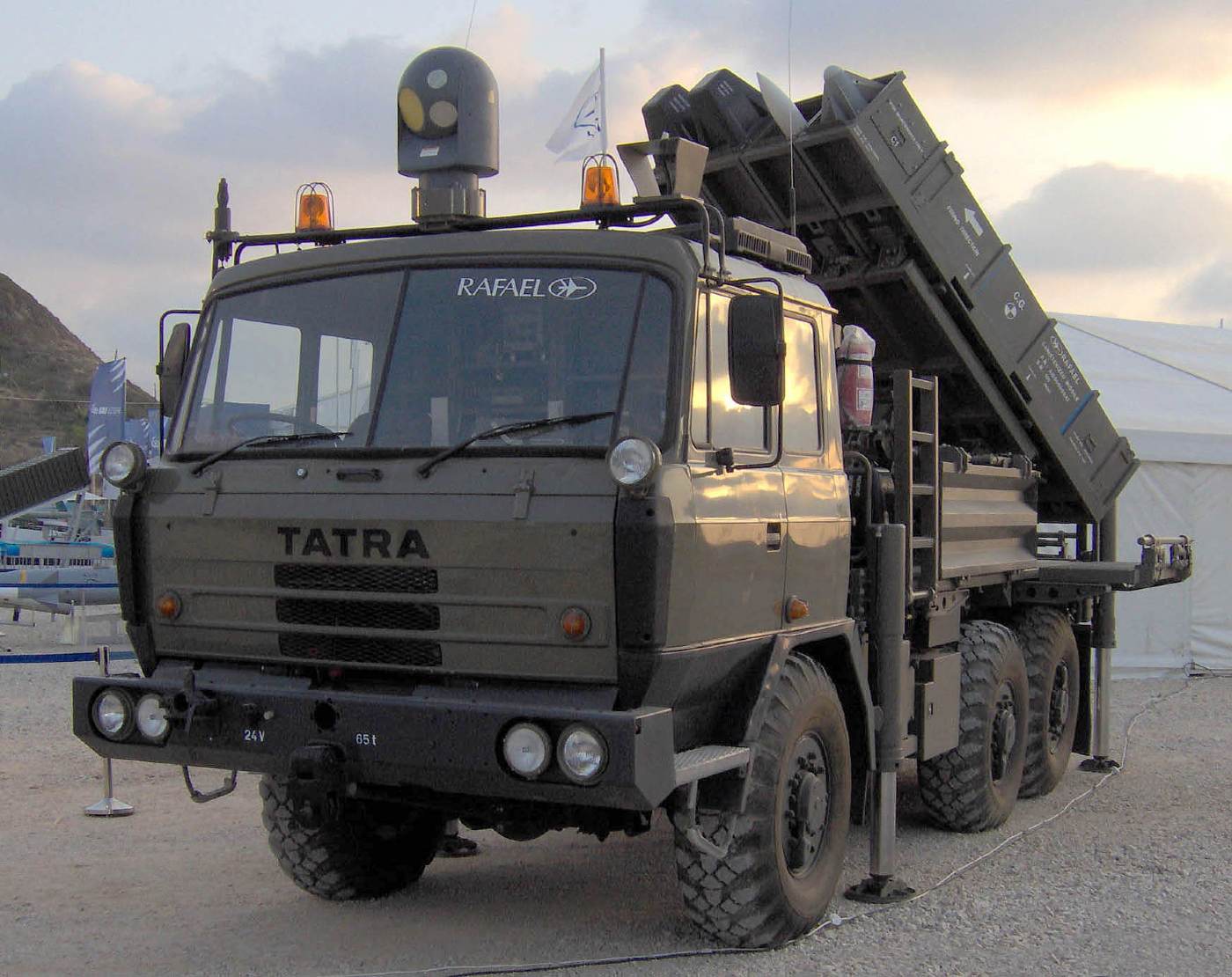
The deal was signed after a series of suspected Houthi drone attacks on Abu Dhabi in January and February 2022, which killed three Emirati citizens.
This deal also highlighted a silent force pushing the UAE and Israel closer to each other. The larger-than-life role of Iran in the region, which has, for years, armed and supported non-state actors like Hamas, Hezbollah, Houthis, Palestinian Islamic Jihad (PIJ), and others, as a means to extend its influence in the region.
The 2022 drone strikes on Abu Dhabi by Iran-supported Houthis not only exposed gaps in the UAE’s air defense network but also underlined that both Abu Dhabi and Tel Aviv share the same regional adversary, Iran.
Besides, the UAE and Israel have also conducted joint military drills. The two countries conducted joint naval drills in the Red Sea in 2021.
In 2023, Israel and the UAE announced their first bilateral naval exercise and unveiled a jointly developed unmanned maritime vessel.
In April 2025, the UAE sent Mirage 2000-9 fighter jets to join the U.S. and Israeli Air Forces for a multinational exercise in Greece, indicating continued cooperation despite the Gaza war.
However, the real test arrived amid escalating tensions with Iran.
During the ongoing Iran War, Israel deployed Iron Dome batteries and advanced drone-detection systems to Abu Dhabi.
More importantly, Israel also deployed its troops to the UAE to operate these air defense systems, the first such overt troop and hardware deployment to an Arab partner.
Further, according to The Financial Times, Jerusalem also sent an advanced surveillance system, known as Spectro, to help the UAE detect Iranian drones from up to 20 kilometers (12.4 miles) away.
Meanwhile, according to the Times of Israel, Jerusalem dispatched a version of the Iron Beam laser-based air defense system to the United Arab Emirates to help protect the Gulf nation from missile and drone attacks.
Emirati officials reportedly also attended a meeting in Israel during the ceasefire alongside the Commander of CENTCOM, highlighting joint planning of strategy and operations between the UAE, the US, and Israel during the conflict.
Separately, the UAE is in advanced negotiations with Israel’s Elbit Systems to acquire the Hermes 900, a Medium-Altitude Long-Endurance (MALE) UAV. This deal includes technology transfers for local production by the UAE’s EDGE Group, aiming to bolster domestic defense capabilities.
Notably, the UAE has also signed a security agreement with India, and New Delhi and Tel Aviv also share a robust strategic and defense partnership. India is also the UAE’s second-largest trade partner. In fact, India, the UAE, and Israel, along with the US, are also part of the I2U2 (India-Israel-UAE-US) Economic Corridor.
The India-Middle East-Europe Economic Corridor (IMEC), unveiled at the 2023 G20 in New Delhi, is the axis’s crown jewel. This rail-sea-energy-digital network links Indian ports through the UAE and Saudi Arabia, across Jordan and Israel, to European hubs.
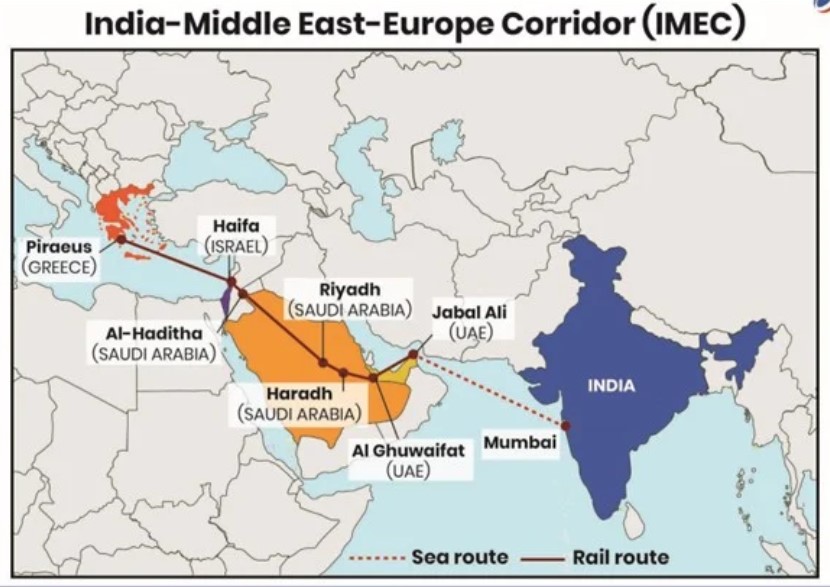
It promises faster, cheaper trade than Suez routes while countering China’s Belt and Road. Israel serves as the critical eastern Mediterranean gateway, and the UAE as the Gulf logistics hub.
This economic corridor can become one of the world’s foremost maritime trade routes, turning the UAE into a hub for global aviation, logistics, and trade.
This level of security and economic cooperation among India, Israel, the US, and the UAE underscores a new emerging axis in the Middle East.
It is possible that due to this emerging axis between the UAE and Israel, Tehran has disproportionately targeted Abu Dhabi in this war.
However, deeper ties with Israel also carry the risk of isolation in the Muslim world. At a time when the UAE has already withdrawn from OPEC and its relations with Saudi Arabia have hit rock bottom, a charge of betraying the Muslim cause and unity can be a risky proposition for the Emiratis.
- Sumit Ahlawat has over a decade of experience in news media. He has worked with Press Trust of India, Times Now, Zee News, Economic Times, and Microsoft News. He holds a Master’s Degree in International Media and Modern History from the University of Sheffield, UK.
- VIEWS PERSONAL OF THE AUTHOR.
- He can be reached at ahlawat.sumit85 (at) gmail.com