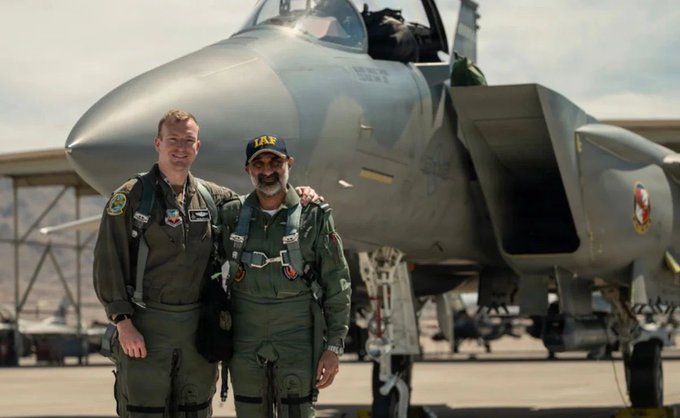
During his recent weeklong visit to the US starting April 6, the Indian Air Force (IAF) Chief of Air Staff (CAS), Air Chief Marshal (ACM) Amar Preet Singh, flew a familiarisation sortie in a Boeing F-15EX Eagle II fighter jet at Nellis Air Force Base in Nevada.
Officially, the CAS was on a routine exchange visit to foster deeper relations between the IAF and the U.S. Air Force (USAF). High-ranking air force officials from both nations routinely visit each other’s countries to discuss interoperability, joint training, shared strategic priorities in the Indo-Pacific, and modernization.
In the past 15 years, four IAF Chiefs have made official visits to the US, as follows:
1. July 2013: Air Chief Marshal NAK Browne at the invitation of USAF Chief of Staff Gen. Mark A. Welsh III.
2. May 2015: Air Chief Marshal Arup Raha at the invitation of USAF Chief of Staff Gen. Mark A. Welsh III to strengthen bilateral defense cooperation.
3. September 26–28, 2017: Air Chief Marshal Birender Singh Dhanoa to attend the Pacific Air Chiefs Symposium in Hawaii.
4. April 6–13, 2026: Air Chief Marshal Amar Preet Singh to strengthen the India–US defense partnership and deepen cooperation between the two air forces.
The USAF Chief of Staff/Secretary of the Air Force has visited India three times in the same period, as follows:
1. August 2016: Secretary of the Air Force Deborah Lee James to discuss defense and trade cooperation.
2. February 1–7, 2018: Chief of Staff Gen. David L. Goldfein to discuss Indo-Pacific cooperation.
3. March 21, 2023: Secretary of the Air Force Frank Kendall to advance the U.S.–India Major Defense Partnership and bilateral security cooperation.
From the above, it is clear that exchange visits don’t take place at predetermined intervals. Instead, they are based on invitations.
As such, despite being labeled as routine visits, they are neither routine nor mere optics. There is always a strong undercurrent aimed at deepening the partnership. From the US point of view, CAS visits are aimed either at selling US weapons to India, aligning India more closely with US unipolar global ambitions, or both.
Recent CAS Visit
Based on media reports, the invitation to ACM AP Singh to visit the US was likely intended to lay down the modalities for surveillance by US MQ-9B SkyGuardian drones being sold to the IAF, as well as the possible sharing of data.
The ACM’s familiarisation sortie in a Boeing F-15EX Eagle II fighter jet was likely intended to soften any IAF resistance to the purchase of the F-15EX and its weapon systems.
During India’s MMRCA procurement process for foreign fighter jets, the US had pitched its F-16 and F-18 fighters to the IAF, which ultimately chose the French Rafale fighter. However, due to irreconcilable differences over ToT, France and India were unable to finalize a contract. In 2018, the MoD placed an interim order for 36 Rafales and terminated further procurement under the MMRCA program.
Multi-Role Fighter Aircraft (MRFA) Program
The MoD then initiated the balanced procurement of 110 fighters under the Multi-Role Fighter Aircraft (MRFA) program. On April 6, 2018, it released a fresh RFI stipulating that a maximum of 15 percent of aircraft were to be procured in flyaway condition, and 85 percent would be manufactured in India through technology transfer (ToT) under “Make in India.” The RFI mandated a guarantee of 75 percent aircraft availability at all times.
The F-15EX was a late entrant in the MRFA program, which was initially confined to former MMRCA contestants.
New Delhi first showed interest in the F-15EX in October 2020, shortly after the U.S. Air Force awarded Boeing a nearly $1.2 billion contract to build the first lot of eight F-15EX advanced fighter jets to help the service meet its capacity requirements and add capability to its fighter fleet.
“There is a possibility that the F-15EX could be sold on a government-to-government basis,” a top government official familiar with the discussions told Hindustan Times at that time.
However, at that point, Boeing had not yet been licensed to sell the F-15EX abroad.
On January 28, 2021, the US government granted Boeing a marketing license to offer the F-15EX Eagle II fighter jet directly to the Indian Air Force (IAF) under its MRFA procurement program.
It is not clear whether Boeing’s pitch for the F-15EX conformed to the Indian MoD RFI of April 6, 2018, particularly regarding its willingness to offer ToT and local manufacture in India under “Make in India.”
Notably, the Boeing fighter was never offered for evaluation by the IAF, which raises doubts about the sincerity of Boeing’s pitch.
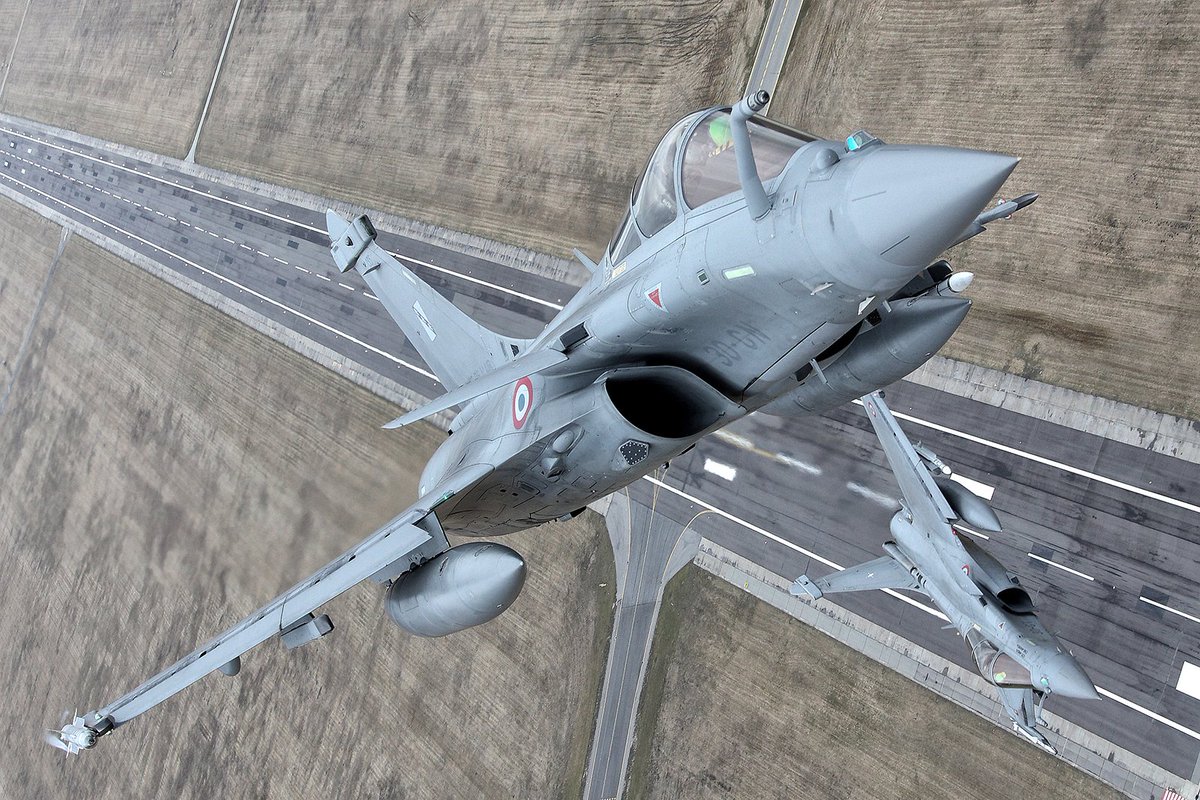
Meanwhile, the IAF, having invested heavily in building the maintenance and logistics infrastructure for the Rafale, continued to express enthusiasm for additional procurement of the French fighter, which had performed creditably in Op Sindoor.
The CAS, in his interaction with the press on October 3, 2025, confirmed the IAF’s interest in acquiring additional Rafale fighter jets under the MRFA program, stating: “This is one of the options that is available with us because we had already done our own homework in terms of the earlier MMRCA contract. In that, we found Rafale to be the best aircraft suited for us amongst those candidates.”
However, he acknowledged that a decision in favor of Rafale would depend on the French willingness to share manufacturing technology with India.
Alluding to the 2018 RFI that mandates ToT with the guarantee of 75 percent availability of aircraft at all times, he said, “So whichever design house is ready to come up with the proposal to Make in India, to give us technology, give us more freedom, I think that design house should be chosen,” he added.
Rafale Procurement Go-Ahead
In January 2026, the Defense Procurement Board (DPB) reportedly gave its go-ahead to an Indian Air Force proposal to buy 114 French-origin Rafale jets.
Contract negotiations between India and France are underway. The DPB go-ahead has to be cleared by the DAC, headed by Defense Minister Rajnath Singh. Finally, before the contract is signed, it must be approved by the Cabinet Committee on Security.
Source Code Issues
Some unverified media reports suggest that the French government has refused to provide India with the source code for the Rafale’s Thales RBE2 AESA radar, the Modular Data Processing Unit (MDPU), and the SPECTRA electronic warfare suite.
These reports may sound alarming to many defense enthusiasts, but they need not be.
The IAF does not need the full source code of the Rafale. What it needs is programming access to the full source code. In an earlier analysis for the EurAsian Times, I explained the difference in detail.
A programming interface provides access to the underlying code through a layer of abstraction.
There is no reason for France to withhold full access to the Rafale source code, just as there is no reason for the IAF to request the transfer of the full source code. The author believes that good negotiations can effectively seal the deal while safeguarding the interests of both France and India.
MRFA – A Near Done Deal
The IAF has made its choice clear in favor of Rafale. The renewed US pitch for the F-15EX aims to leverage the controversy, whether wittingly or unwittingly, created by the media over the source code. The IAF is unlikely to pursue a red-herring offer; notably, however, the US has made one—exposing its insincerity.
Need for Stealth Fighters
The IAF has officially projected to the MoD a need for 2–3 squadrons of a stealth fighter to address an emerging stopgap requirement. Ironically, what the US is ready to offer is not the F-35 but a Su-30 MKI substitute that will drain billions from the IAF’s capital expenditure over the next few years in acquiring the aircraft, creating a logistics and maintenance infrastructure, and procuring an entirely new line of weapon systems.
The loss of four F-15EX fighters during the recent Iran war would be difficult for the IAF leadership to ignore were it inclined to change its mind at this late stage.
According to News Agency ANI, during ACM AP Singh’s visit, U.S. Air Force Chief of Staff Gen. Ken Wilsbach welcomed India’s procurement of the MQ-9B SkyGuardian drone. I wonder if the CAS found the endorsement reassuring, considering how easily Iran has been able to shoot down these very expensive drones.
In summary, what the IAF urgently needs is not the F-15EX but an upgrade to the highly potent BrahMos-armed Su-30MKI, which can also be adapted to launch Indian-developed hypersonic aeroballistic missiles in the future.
- Vijainder K Thakur is a retired IAF Jaguar pilot, author, software architect, entrepreneur, and military analyst.
- This is an Opinion Article. Views Personal of the Author
- Follow the author @vkthakur