Italy refused to join the US war against Iran and denied access to its military bases to US aircraft flying offensive sorties against the West Asian country. However, in a stark illustration of the risks of operating near active war zones, some Italian aircraft reportedly got caught in the crossfire.
When the US launched Operation Epic Fury on February 28, President Donald Trump anticipated that Iran would be decapacitated within days. However, the Iranian IRGC (Islamic Revolutionary Guards Corps) responded almost immediately after the first round of strikes by attacking Gulf states that housed US military personnel and assets.
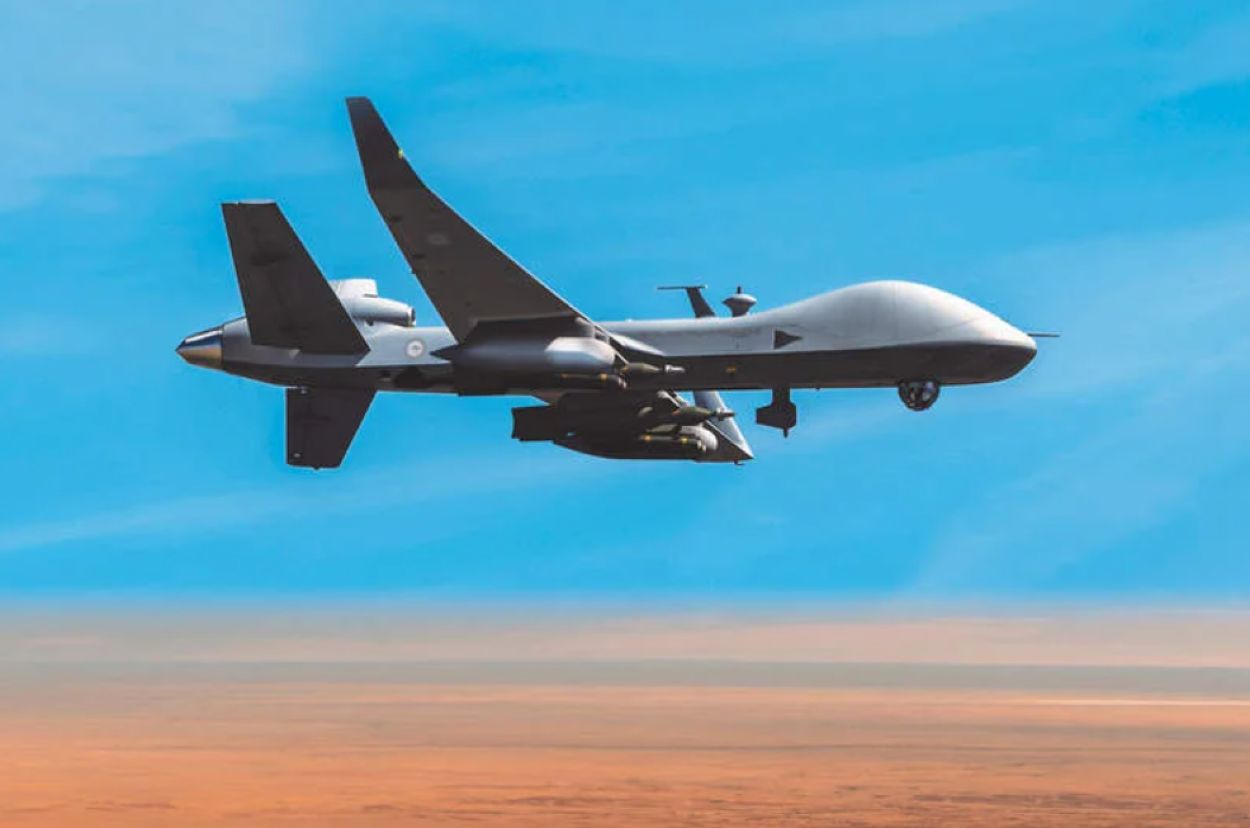
One such attack on Kuwait, which hosts one of the largest US military footprints in the region, damaged an Italian MQ-9A Reaper drone during Iran’s counter-offensive, according to a recent report in Italy’s most widely read newspaper, Corriere della Sera. The report states that the Reaper was destroyed on the ground at the Ali Al Salem air base in Kuwait during a missile and drone attack on March 15.
The MQ-9A in question was one of six drones from the 32nd Wing at Amendola Air Base in southeast Italy that were deployed to the Middle East to perform ISR (Intelligence, Surveillance, and Reconnaissance) in support of operations against ISIS.
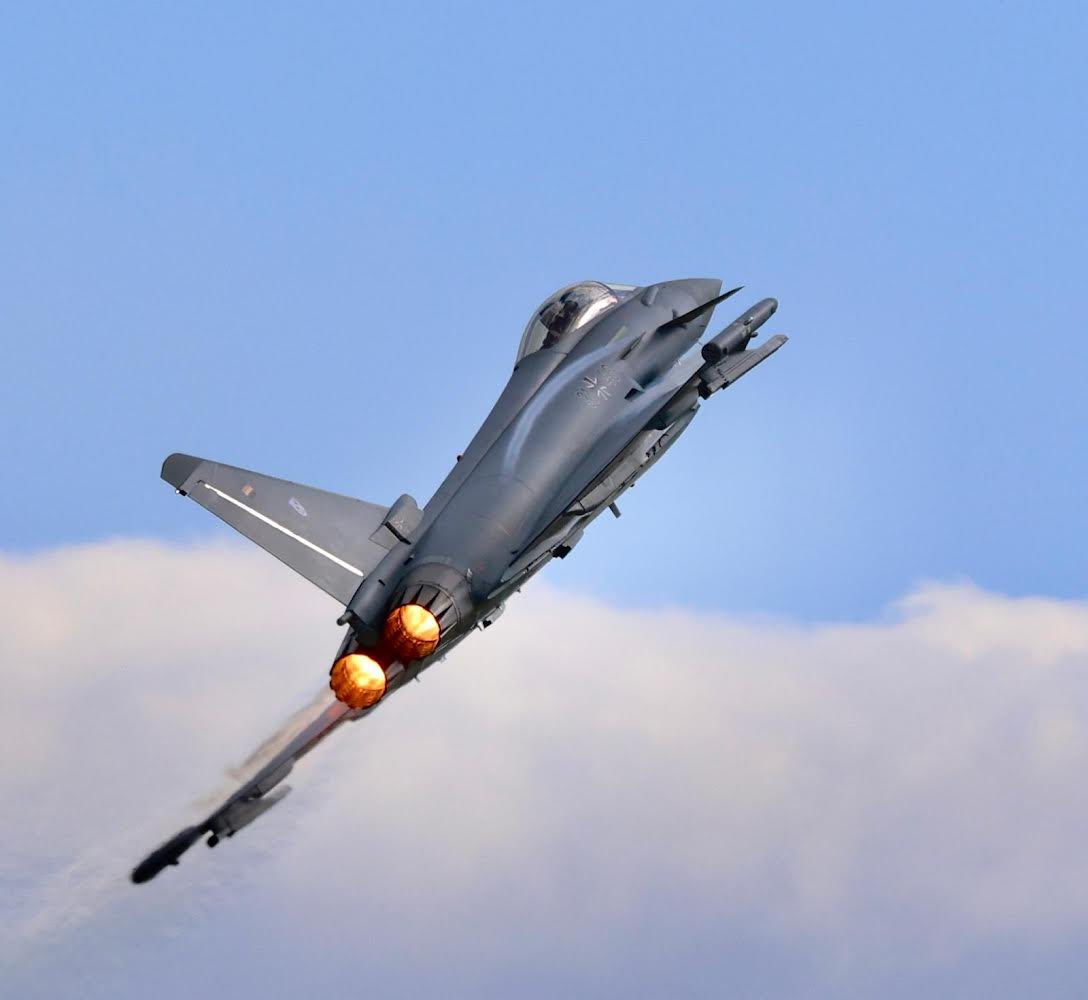
Ali Al Salem Air Base hosts Italian Air Force assets, such as Eurofighter Typhoon jets and drones, as part of the international coalition against ISIS.
Nicknamed “the Rock” due to its elevated position above the surrounding desert plains, the base is one of the most important military facilities in the Middle East. It also reportedly hosts the 386 AEW and supports regional missions, including airlift and logistics for US Central Command (CENTCOM), which is likely why it was targeted by the Iranians.
Citing “authoritative sources familiar with the matter,” the Corriere report states that the Italian Defense Ministry had previously evaluated the possibility that its aircraft in Kuwait could be targeted and had discussed potential force-protection measures. At the time, the Italian military even considered relocating the aircraft to prevent them from being targeted in Iranian attacks, the report states.
However, the military subsequently abandoned the plans, citing concerns that even such a defensive measure could be seen as a hostile act by the Islamic Republic, which was being pounded by the US and Israel. Rome sought to avoid any action that might be seen as bringing Italy into the war against Iran.
Following deliberations, the military decided to leave the aircraft on the ground. The MQ-9A, worth about 34 million Euros, was parked inside a shelter at the Ali Al Salem air base.
Notably, General Luciano Portolano, Chief of Defense Staff, announced the drone’s destruction a day after the attack.
“This morning, Ali Al Salem Air Base in Kuwait, which hosts U.S. and Italian capabilities and personnel, was the target of a drone attack that hit a shelter housing a remotely piloted aircraft belonging to the Italian Air Task Force. The aircraft was destroyed. I immediately spoke with Colonel Mangini to ascertain the condition of the Italian personnel present at the base. At the time of the attack, all personnel were safe and were not involved. I promptly informed Minister of Defense Crosetto of the incident, and I remain in constant contact with him to continuously monitor the situation of all our contingents abroad,” said the Chief of the Italian Defense General Staff, without directly naming the MQ-9A drone.
“The aircraft that was hit was an indispensable asset for the conduct of operational activities and had remained deployed at the base in order to ensure continuity of operations,” the statement added.
Interestingly, reports from late March indicated that an Iranian ballistic missile attack on the same Kuwaiti air base caused serious damage to two US MQ-9 Reaper drones. This means that Italy wasn’t the only one to lose drones of that class in that conflict. The United States, on its part, lost more than two dozen MQ-9 drones in the conflict with Iran.
In addition to the MQ-9, Italy’s Eurofighter Typhoons were speculated to have suffered some damage in an Iranian strike on the base.
Earlier, for instance, open-source reporting and some media reports suggested that two Italian Eurofighters had sustained damage in an Iranian strike but were repairable. The Aviationist news portal observes in a recent report that three of the four Italian Eurofighters that were supposedly present at the base at the time of the attack had returned home a few days later, indicating that only one aircraft may have been affected in the strike or that one of the two purportedly damaged jets had only minor damage and could return home.
If all these claims are true, Italy would be only the second NATO state to suffer military losses and damage during the Iran War, apart from the United States, which reportedly lost a total of 42 aircraft.
Italy Did Not Participate In the US-Iran War
In an interview with Fox News in late June, NATO chief Mark Rutte highlighted NATO support for the US amid reported frustrations from President Trump about allied contributions.
He added that allies have given the United States military support throughout the war with Iran, but he “totally” understands the president’s dissatisfaction with the alliance. “When it comes to NATO, I know there is disappointment,” Rutte said. “But let’s also see that these are isolated cases, because there is something more to say about this. Country after country, ally after ally after ally, have made their bases available for Epic Fury.”
Rutte specifically claimed that 500 American aircraft used Italian bases, and Bucharest had to reduce commercial flights so that American forces could store tanker equipment at the city’s airport during Operation Epic Fury.
This triggered a political storm for Italian Prime Minister Giorgia Meloni as her political opponents accused her of misleading the public when she stated Italy was staying out of the conflict and that Rome was just permitting logistical and technical operations at the US facilities in Italy
Meloni, in turn, accused Rutte of presenting a misleading narrative.
“In his — let’s call it enthusiastic — account, the secretary-general has lumped together things that are actually quite different from one another, confusing the types of authorized flights,” Meloni told reporters during a Franco-Italian summit in southern France. “We did not participate in the conflict with Iran. By the way, if we had participated in the Iran conflict, there would be no explanation for this disappointment that the U.S. president keeps reiterating very often,” she added.
Italy only permitted bases to be used for technical and logistical activities, Meloni reaffirmed, adding that she was clueless as to why Rutte provided this “oversimplified account.” Meanwhile, the Italian Defense Minister Guido Crosetto called the remarks “completely misleading” and noted that Rutte had “nothing to do with Operation Epic Fury.” He insisted that authorizations followed existing agreements and did not extend to strikes.
Notably, Italy and Spain were among the first NATO states to block US access to their bases for launching strikes against Iran. In fact, Meloni publicly opposed the war and told the parliament that the US-Israeli military operations were a part of a dangerous and expanding trend of interventions “outside the scope of international law.”
The Corriere report highlighted that the destroyed drone serves as visible proof that Italy did not participate in offensive operations against Iran — directly contradicting statements by NATO Secretary General Mark Rutte, who portrayed Italy as more actively involved.
- Contact the author at sakshi.tiwari13 (at) outlook.com
- Follow EurAsian Times on Google News