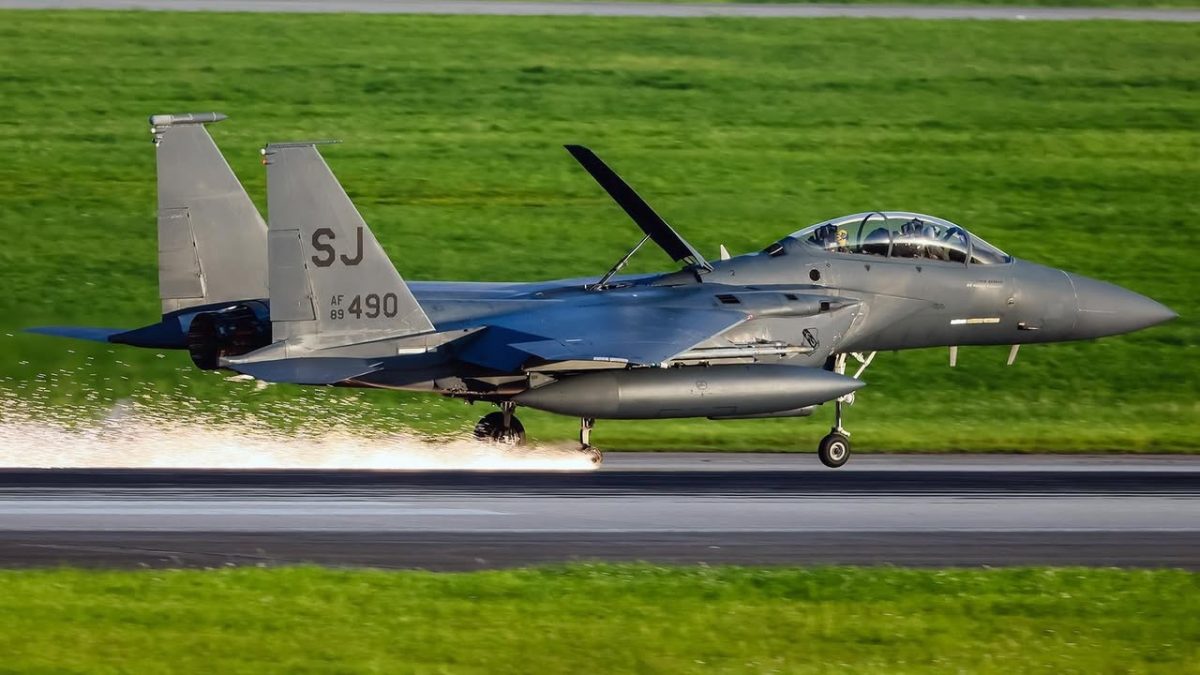
In a story that seems straight from an action thriller film, a US Air Force (USAF) F-15E fighter pilot was reportedly shot down twice in less than five weeks while flying combat missions during the Iran War.
During the opening days of Operation Epic Fury, on March 1, 2026, three F-15E Strike Eagles were shot down in Kuwaiti airspace in a suspected case of friendly fire by Kuwaiti air defenses—most likely an F/A-18C/D Hornet.
“At 11:03 p.m. ET, March 1, three U.S. F-15E Strike Eagles flying in support of Operation Epic Fury went down over Kuwait due to an apparent friendly fire incident. During active combat—that included attacks from Iranian aircraft, ballistic missiles, and drones — the U.S. Air Force fighter jets were mistakenly shot down by Kuwaiti air defenses,” the US Central Command (CENTCOM) announced in a statement at the time.
All six aircrew, including three fighter pilots and three weapons systems officers (WSOs), who successfully ejected using their ACES II seats, were recovered and were said to be in good condition after the incident.
Less than five weeks later, on April 3, 2026, another F-15E Strike Eagle was downed—this time by ground-based fire from Iran’s Islamic Revolutionary Guard Corps (IRGC). Notably, the pilot flying the Strike Eagle was almost immediately recovered, but the WSO went missing, triggering a 36-hour intense search and rescue operation.
If US media reports are to be believed, the pilot of the F-15E Strike Eagle shot down by Iranian ground-based air defenses on April 3 was the same airman who had been flying one of the three F-15Es downed in the Kuwaiti friendly-fire incident during the opening days of Operation Epic Fury.
This was first reported by national security reporter Sean Naylor in his Substack, The High Side, and has since been reported by CBS News, which cited two informed sources.
The EurAsian Times could not independently verify these claims, and neither CENTCOM nor the Pentagon has yet acknowledged the report.
Downed pilots are typically recovered quickly and undergo comprehensive medical and psychological evaluations. If cleared by a flight surgeon as physically and mentally fit, they are usually allowed to return to flying duties. However, they are not permitted to switch aircraft types. A fighter pilot who himself once ejected from a stricken jet told the EurAsian Times (on condition of anonymity).
It is, therefore, safe to assume that the more than four-week period may have been sufficient for the F-15E pilot to resume missions against Iran, especially since he was not injured in the crash caused by a Kuwaiti missile strike.
Nonetheless, if true, this dual shootdown is among the rarest of rare cases in combat aviation history. In fact, it is the first such incident involving a fixed-wing jet pilot since the Vietnam War.
Before this, Brig. Gen. James Robinson “Robbie” Risne was shot down twice in 1965 while flying F-105 Thunderchiefs. The first time, He was hit by ground fire near Vinh, North Vietnam, in March 1965, but managed to eject over the Gulf of Tonkin and was rescued. Six months later, he was shot down again while he was on a mission in September 1965, captured and held as a prisoner of war (POW) for 7 years.
It is, therefore, safe to say that the F-15E pilot escaped a brush with death twice in less than five weeks, if reports are accurate.
In both incidents, the pilot escaped without any major injuries. This historic coincidence sparked curiosity and awe among military observers and enthusiasts, with some of them remarking in jest that the pilot must be very grateful to the F-15E Strike Eagle’s ejection seat.
The F-15E Strike Eagle uses the Advanced Concept Ejection Seat II (ACES II) ejection seat system for both the pilot and Weapon Systems Officer. Manufactured by Raytheon, it is a third-generation rocket-propelled ejection seat with zero-zero capability, which means it can safely eject the crew even at zero airspeed and zero altitude.
There are two independent seats in the F-15E with trajectory-divergence rockets to push the seats apart and prevent mid-air collisions or injury from rocket exhaust to crew members. The ACES II is considered one of the most reliable ejection systems in the USAF, with a serious-injury rate of around 1%, according to publicly available information.
F-15E Shootdown
Iran shot down an F-15E Strike Eagle, callsign Dude 44, from the 494th Fighter Squadron of the 48th Fighter Wing, based at RAF Lakenheath, UK. The hit was scored on April 3, 2026, over western or southwestern Iran. At the time, the US President Donald Trump claimed that a shoulder-launched missile had hit the aircraft.
These weapons, commonly referred to as man-portable air defense weapons, or “MANPADS,” offer a low-cost, efficient way to detect low-flying aircraft.
Last week, citing informed sources, NBC News reported that Iran likely used a Chinese-origin shoulder-launched missile to bring down the Strike Eagle.
The exact weapon system suspected in the strike was not identified in the news report, and the US military has not disclosed any further information about the incident, which is currently said to be under investigation.
Responding to the questions about the alleged use of Chinese weapons, a spokesperson for the Chinese Embassy told the publication: “China always acts prudently and responsibly on the export of military products, and exercises strict control in accordance with China’s laws and regulations on export control and due international obligations. China opposes groundless smear and ill-intentional association.
It must be noted that Iran’s downing of the F-15E on April 3, 2026, proved to be very expensive for the United States, which suffered a host of cascading losses in an attempt to retrieve the downed airman from Iranian soil.
A Combat Search and Rescue (CSAR) operation was launched almost immediately, with videos of an HC-130 and two HH-60 Black Hawk helicopters flying over Iran being posted to social media. Notably, an A-10 Warthog that was reportedly providing close air support during the operation was struck by Iranian fire. However, the pilot steered the jet out of Iranian airspace and over the Persian Gulf, after which he ejected and was rescued.
The US forces lost two MC-130J transport planes when the aircraft were unable to take off from their makeshift runway in Iran during the rescue of the downed F-15E jet’s crew. The two aircraft were intentionally blown up by the US forces on the ground to prevent Iran from getting access to sensitive military technology. Additionally, the US forces are said to have lost 4 MH-6 or AH-6 Little Bird helicopters during the CSAR.
The operation was very high-risk due to hostile territory, terrain, and Iranian efforts. Iranian security forces were seen shooting at low-flying choppers to derail the CSAR operations, as previously reported by the EurAsian Times.
“The courage demonstrated by both the pilot and the weapons system officer while isolated and them evading the enemy cannot be overstated,” Joint Chiefs Chairman Gen. Dan Caine said during a briefing after the two airmen had been rescued. “Their grit and warfighting tenacity is a direct result of the absolute trust they have in our rescue forces, their training, and their will to survive and return,” he added.
- Contact the author at sakshi.tiwari13 (at) outlook.com
- Follow EurAsian Times on Google News