Russia could resort to nuclear weapons if its territorial integrity is threatened, Deputy Foreign Minister Sergey Ryabkov stated on the sidelines of the St. Petersburg International Economic Forum.
“As regards us, those hypothetical extreme situations that may trigger the use of these weapons were outlined in detail in Russia’s military doctrine and the fundamentals of Russia’s state policy on nuclear deterrence,” the diplomat said.
“To put it somewhat straightforwardly, these documents send a signal that encroachments on Russia or its territorial integrity by aggressors, including those who may possess such weapons, could prompt us to use these weapons in the worst-case scenario,” he added, according to Russian News Agency, Tass.
Interestingly, in the fifth year of the Russia-Ukraine War, Kyiv appears to be gaining momentum, and Russian gains are under serious threat. In the first three months of 2026, Russia, on average, gained nearly 2.9 km² of territory per day, as compared to 9.76 km²/day in early 2025.
In April, however, Ukraine seized the momentum.
According to the Institute for the Study of War (ISW), Russian forces lost a net 116 km² of territory under their control in April.
On May 19, the Armed Forces of Ukraine (AFU) Commander-in-Chief Syrsky informed that Ukraine has, for the first time, carried out more daily assaults than Russian forces, signaling a potential shift in battlefield dynamics.
Ukrainian long-range drone and missile strikes deep inside Russian territory, oil fields, and military depots further highlight the changing dynamics of the war. On the night of May 16, Ukraine launched over 600 drones, many striking in the heart of Moscow, where three people died.
This, coupled with rising Russian casualties and the compounding impact of the Western sanctions, has led many to believe that Russia’s Special Military Operation against Ukraine is finally running out of steam.
Another manifestation of this turning of the tide in Ukraine’s favor was this year’s Victory Day parade in Moscow on May 9. Ahead of the parade, President Vladimir Putin declared a unilateral three-day ceasefire, suggesting the Kremlin feared Kyiv had the capability to disrupt V-Day celebrations in Moscow.
Furthermore, for the first time in nearly two decades, Moscow also scaled back the display of heavy military equipment at the parade, curtailing even the symbolic projection of military power.
Besides, Ukraine’s progress in developing low-cost interceptor drones has shifted the cost curve in its favor. Till now, Ukraine has been employing million-dollar air defense interceptor missiles to down Russia’s cheap drones; however, the new interceptor drones are now downing Shahed (and Geran) drones at a fraction of the cost, typically US$1,000 to US$5,000 per interceptor, compared to US$20,000–US$50,000 for a Shahed.
According to experts, Ukraine has proven itself more nimble and technologically adaptable.
However, this Ukrainian progress on the battlefield has triggered Russia’s primal fears.
Russia is not only one of the world’s strongest military powers after the United States, but also the largest country by land area and the nation with the biggest nuclear arsenal, possessing over 5,400 nuclear warheads.
The humiliation of losing to a second-tier military power — one that possessed virtually no credible air force or navy at the start of the conflict in 2022, and which had been part of Russian territory for centuries — has thrust the nuclear question back into the spotlight: Could Moscow consider using nuclear weapons for the same reason the United States did in 1945 — to end a brutal, grinding war of attrition?
Russia Delivers Nuclear Warheads to Belarus
Russia has claimed that it has delivered nuclear warheads for Iskander-M missile systems to temporary storage sites in Belarus. According to the Russian Defense Ministry, the transfer of the warheads to the deployment area of a Belarusian missile brigade took place as part of exercises involving Russia’s nuclear forces.
“As part of nuclear force exercises, nuclear munitions were delivered to field storage points in the missile brigade’s position area in the Republic of Belarus,” the Russian Defense Ministry statement said.
Russia said Belarusian military personnel were taking part in the drills and carrying out combat training tasks.
The missile crews are practicing receiving nuclear warheads, loading them onto Iskander-M missiles, and secretly moving to designated positions to prepare for missile launches.
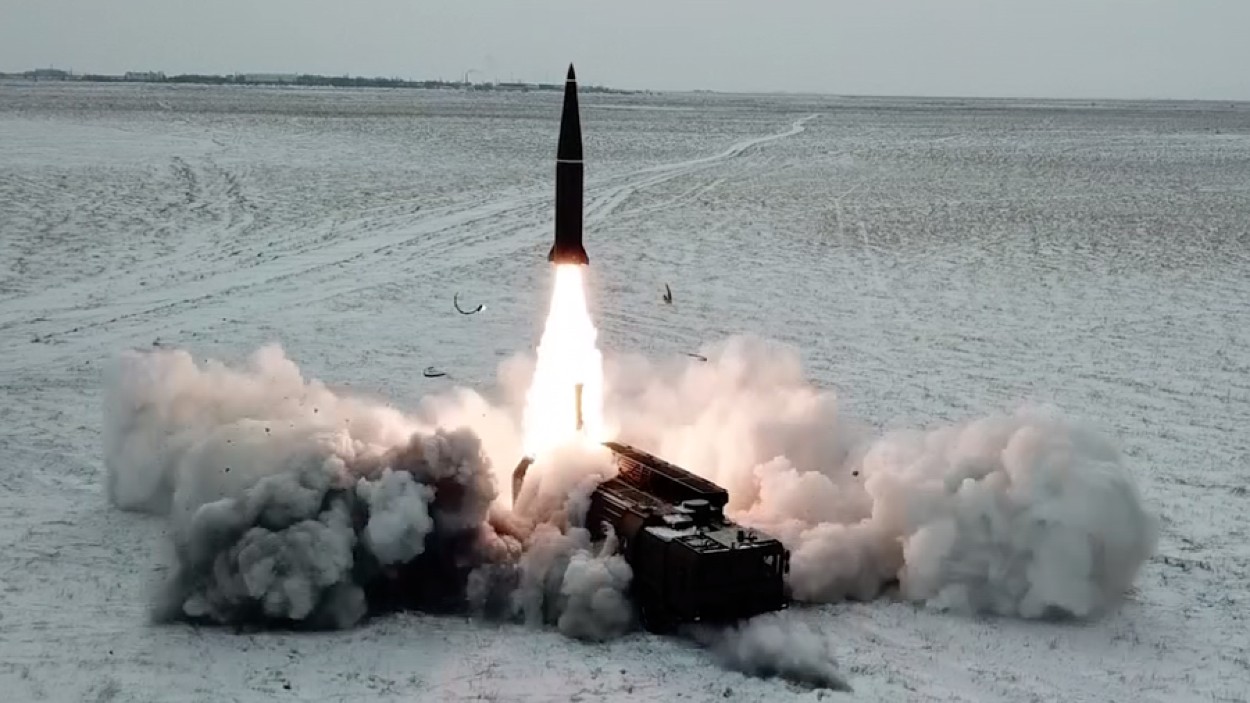
The Russian defense ministry also published videos showing military trucks leaving storage shelters and then moving through a forested area on unpaved roads.
It then shows ballistic missiles being loaded onto Iskander-M mobile launchers.
Belarus’s Defense Ministry also released videos on May 21 showing what it said were heavy equipment allegedly carrying nuclear warheads through a forest, ballistic missile submarines heading to sea training areas, and personnel mounting missiles on aircraft launchers.
Earlier, on May 18, the Ministry of Defense of Belarus announced the start of military drills involving units responsible for the use of nuclear weapons.
The exercise involves soldiers from both Belarus and Russia, practicing the transportation of nuclear warheads, their handling, and preparation for launch, as well as coordination among participating units.
Russia’s Defense Ministry announced that the exercises will involve 64,000 military personnel and 7,800 pieces of equipment, including more than 200 missile launchers, over 140 unmanned aerial vehicles, 73 surface ships, and 13 submarines, eight of them strategic submarines capable of carrying missiles.
Another focus area of the exercise is the covert movement of troops, the redeployment of units over long distances, and calculations for the use of missile and aviation strike systems.
The transfer of nuclear warheads to Belarus, even temporarily for military drills, appears to run counter to the Treaty on the Non-Proliferation of Nuclear Weapons (NPT). The treaty prohibits nuclear-weapon states from transferring control of nuclear weapons to non-nuclear-weapon states, and bars non-nuclear-weapon signatories from accepting such control.
Belarus Changing Nuclear Stance
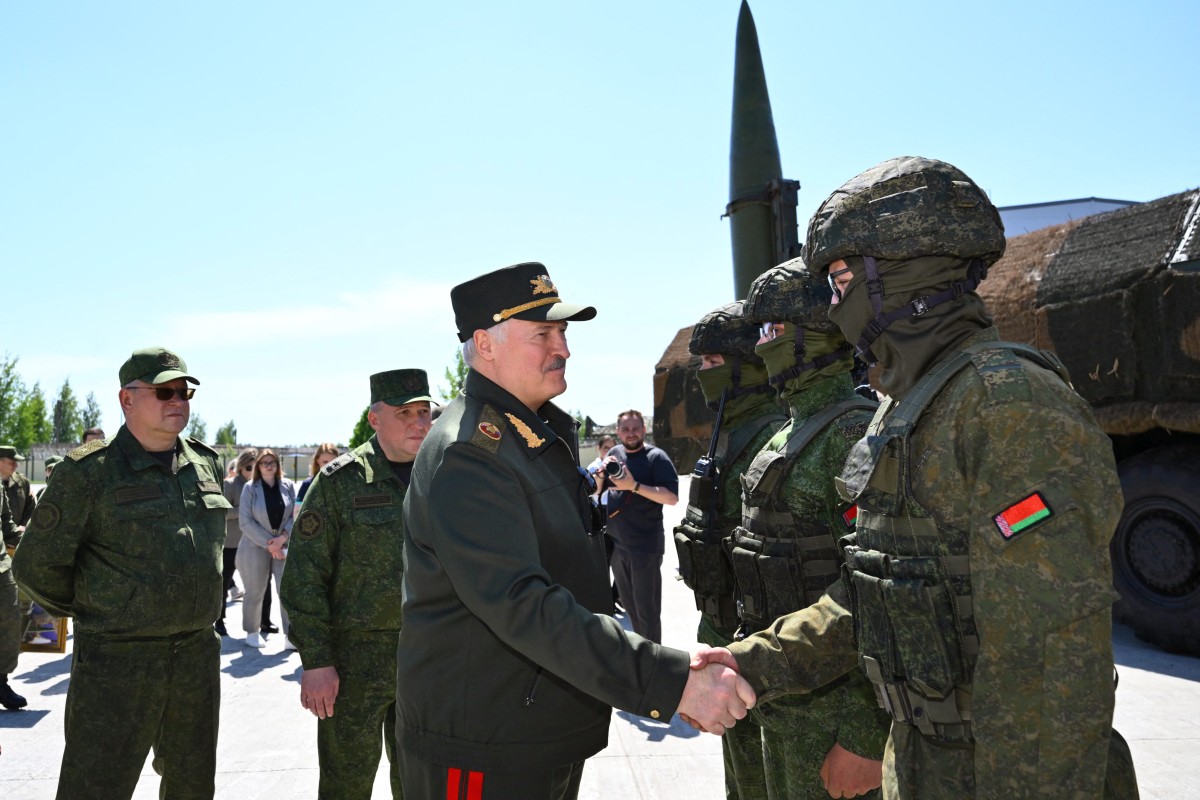
Notably, in February 2022, Belarus amended its constitution to allow Russia to deploy nuclear weapons on Belarusian territory, and in August 2022, it announced upgrades to its Su-25 fighter aircraft to carry nuclear weapons.
In 2023, Minsk received Iskander nuclear-capable missile systems from Russia.
In June 2023, Lukashenko said that he himself had asked Vladimir Putin to “return nuclear weapons to Minsk” and that he was ready to use them “without hesitation in case of aggression against Belarus”, which indicates the actual transfer of nuclear weapons to the operational control of Belarus.
“No one has ever fought against a nuclear country, a country possessing nuclear weapons. We received missiles and bombs from Russia. The bomb is three times more powerful than in Hiroshima and Nagasaki. It will kill under a million people at once,” Lukashenko said in an interview.
Then, in November 2024, President Vladimir Putin signed a revised version of Russia’s “Basic Principles of State Policy on Nuclear Deterrence.” It included the explicit protection of Belarus as part of the Union State.
The doctrine stated that Russia reserves the right to use nuclear weapons (including potentially first-use) in response to: Aggression against the Russian Federation and/or the Republic of Belarus using conventional weapons that creates a critical threat to their sovereignty and/or territorial integrity.
This was a formal expansion from previous versions, which referred more generally to “allies” without naming Belarus specifically. It lowered the threshold somewhat by shifting the threat from the “very existence of the state” to a “critical threat” to sovereignty/territorial integrity.
In early 2025, President Lukashenko said Belarus would prepare to host Oreshnik dual-capable intermediate-range ballistic missiles.
Ukraine’s Foreign Ministry said that the deployment of Russian tactical nuclear weapons in Belarus, along with joint nuclear exercises, poses an unprecedented challenge to the global security architecture.
“By turning Belarus into its nuclear foothold near NATO’s borders, the Kremlin is effectively legitimizing the spread of nuclear weapons worldwide and creating a dangerous precedent for other authoritarian regimes. Such actions must receive clear and strong condemnation from all states that respect the nuclear non-proliferation regime,” the Ministry stated.
Meanwhile, commenting on the Russian nuclear drills, NATO Secretary General Mark Rutte issued a strong warning to Moscow, saying Russia would face “devastating consequences” if it uses nuclear weapons against Ukraine. According to Rutte, Moscow is aware of the possible consequences of such a move, but NATO continues to closely monitor developments.
Can Moscow Strike From Belarus?
According to Ukrainian intelligence reports, Russia is seriously considering opening a new front in Northern Ukraine near Kyiv by launching a new offensive from Belarus.
President Zelensky said on May 20 that he had discussed a possible Russian offensive in Ukraine’s northern regions during a meeting with top military commanders.
“It is precisely from there that the Russians are considering scenarios for additional attacks against Ukraine – targeting our northern regions, our Chernihiv–Kyiv direction,” the president said.
Meanwhile, Commander-in-Chief of the Armed Forces of Ukraine Oleksandr Syrskyi stated that Russia could conduct offensive operations from Belarus. “There is a trend toward an expansion of the front line. You know the latest intelligence data and our president’s statements, as the Supreme Commander-in-Chief, regarding the threat from Belarus and possible operations in the north. This is real,” he said.
The big question is: by transferring nuclear warheads and conducting joint nuclear drills with Belarus, is Putin suggesting that he can not only open a new front from Belarus, but possibly also launch nuclear weapons if the war does not go according to his plan?
- Nitin holds a double master’s degree in Journalism and Business Management from the University of Glasgow. He has over 20 years of global experience in Marketing & Communications, Journalism, and Digital Marketing, and has worked & traveled widely across Europe, the Americas, and Asia. Nitin is the Editor of the EurAsian Times.
- THIS IS AN OPINION ARTICLE. VIEWS PERSONAL OF THE AUTHOR.
- He can be reached at editor (at) eurasiantimes.com