China is reportedly preparing to carry out its first planetary defense test by attempting to deflect a near-Earth asteroid through a high-speed kinetic impact, according to a new research paper
A new paper outlines China’s plans for its first asteroid-deflection test mission before the 2030s, which centers on crashing a very high-speed spacecraft into a near-Earth asteroid.
Li Mingtao, chief scientist from planetary defense at the China National Space Administration (CNSA), stated in the paper that Beijing is looking to alter an asteroid’s orbit relative to Earth, “or even break up its structure,” according to an SCMP report.
The paper claims that the spacecraft is expected to hit its target at more than 9 kilometers per second — about 26 times the speed of sound near sea level — during a close approach within about 7 million kilometers of Earth in 2029 or 2030. The paper is currently under peer review at the Chinese-language Journal of Deep Space Exploration.
The paper lays out the mission plan: while one spacecraft will slam into the asteroid to alter its orbit, a second spacecraft will observe the asteroid before, during, and after the impact to track changes in its orbit, surface, and shape, and to explore its innards.
According to Li Mingato and his team, the Chinese mission was designed with four objectives in mind: precisely hitting the asteroid, successfully deflecting its orbit, properly measuring the outcomes, and demonstrating that the impact did not damage Earth. The concept calls for two spacecraft to launch together and then separate shortly after departing Earth—the observer will take a longer route, including a gravity assist from Venus, while the impactor will go straight for the asteroid.
Before the impact, a small probe will be released to monitor the impact in real time, followed by the monitoring of the changes in the asteroid’s orbit, shape, surface and ejecta. The probe will be joined by ground-based telescopes for monitoring and tracking.
While the plans are ambitious, China has been working on an asteroid-deflection test for several years. Wu Yanhua, deputy director of the China National Space Administration (CNSA), first disclosed plans to build an asteroid-monitoring and defense system to track and attack asteroids to alter their orbits on the occasion of China’s Space Day 2022. At the time, though, Wu noted that Beijing planned to launch the mission by 2025.
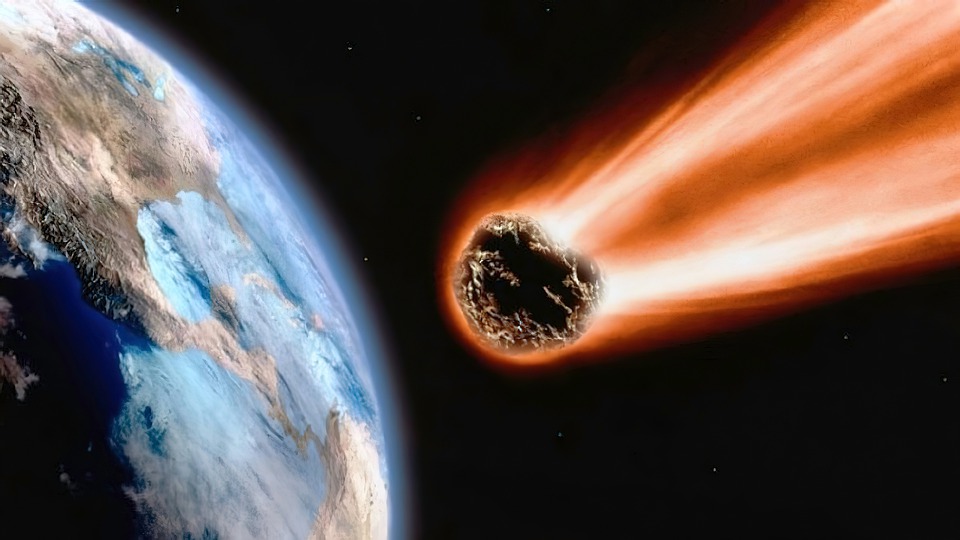
There were signs in 2023 that the object 2019 VL5 could be the target of the first kinetic impact deflection test mission, which was scheduled to launch in 2025.
Later, an article in the Journal of Deep Space Exploration (JDSE) in 2024 stated that 2015 XF261, a near-Earth asteroid with a 30-meter diameter, had been proposed as the target.
Notably, a report published by Space News in March 2026 stated that China has identified a new near-Earth asteroid—2016 WP8—for its first planetary defense kinetic test mission scheduled to launch in December 2027. This was purportedly revealed in a slide presented by Long Lehao, a senior official with the CASC, at the 2026 Commercial Aerospace Industry Development Conference in Shenzhen, South China.
Typically, the target asteroids are chosen based on several criteria, including avoiding objects deemed dangerous before or after an impact, having an orbital inclination of less than 5 degrees, favorable brightness for viewing, numerous observation opportunities, and potential scientific value, among others.
The SCMP report, citing the latest paper, lists the 2015 XF261 as the target. However, the EurAsian Times cannot independently verify at this point which target asteroid has been chosen for the mission in the absence of official information.
The researchers stated in the paper that they believe locating the target could be a significant challenge. Since its discovery, the asteroid has been seen only 74 times due to its extreme faintness, and scientists will be able to gather significant information about its size, shape, and rotation just months before impact.
A bigger challenge, however, would be to hit the asteroid precisely. According to the paper, radio signals from Earth will take too long to guide the final approach, meaning that the spacecraft intended for a kinetic collision would need to lock onto the small asteroid independently and strike it with incredible precision to make the test mission a success.
After this, the scientists would be tasked with detecting a slight alteration in the asteroid’s orbit following the collision and monitoring it to ensure the deflection was successful despite the cloud of debris created by the impact.
If successful, the upcoming test will be China’s first complete demonstration of planetary defense, integrating post-impact verification, deflection, and detection in a single campaign. This would be a major milestone in China’s space race, and a particularly big one after it blew up a satellite in its first ASAT (Anti-Satellite Test) in 2007.
China’s latest Five-Year Plan (2026–2030) includes a pledge to conduct the nation’s first planetary defense test and verification mission, as well as several goals for commercial space, reusable rockets, constellations, and deep space.
China’s planetary defense mission would make China the second country, after the US, to demonstrate asteroid deflection in space. Interestingly, though, the Chinese media portrays the test as more aspirational than NASA’s DART (Double Asteroid Redirection Test).
“Unlike Dart, a proof-of-concept that nudged one asteroid’s orbit around another, China is aiming for a more realistic planetary-defense test,” SCMP stated.
US DART Mission
NASA’s DART mission was humanity’s first full-scale demonstration of planetary defense technology, using a kinetic impactor to deliberately collide a spacecraft with an asteroid to alter its motion. It was launched on November 24, 2021, aboard a SpaceX Falcon 9 rocket and impacted the asteroid Dimorphos on September 26, 2022.
Dimorphos was a small asteroid (like a moon) that orbited a larger asteroid called Didymos.
NASA apparently chose them as targets because they did not threaten Earth, making them ideal targets for testing deflection techniques, as previously explained by EurAsian Times.
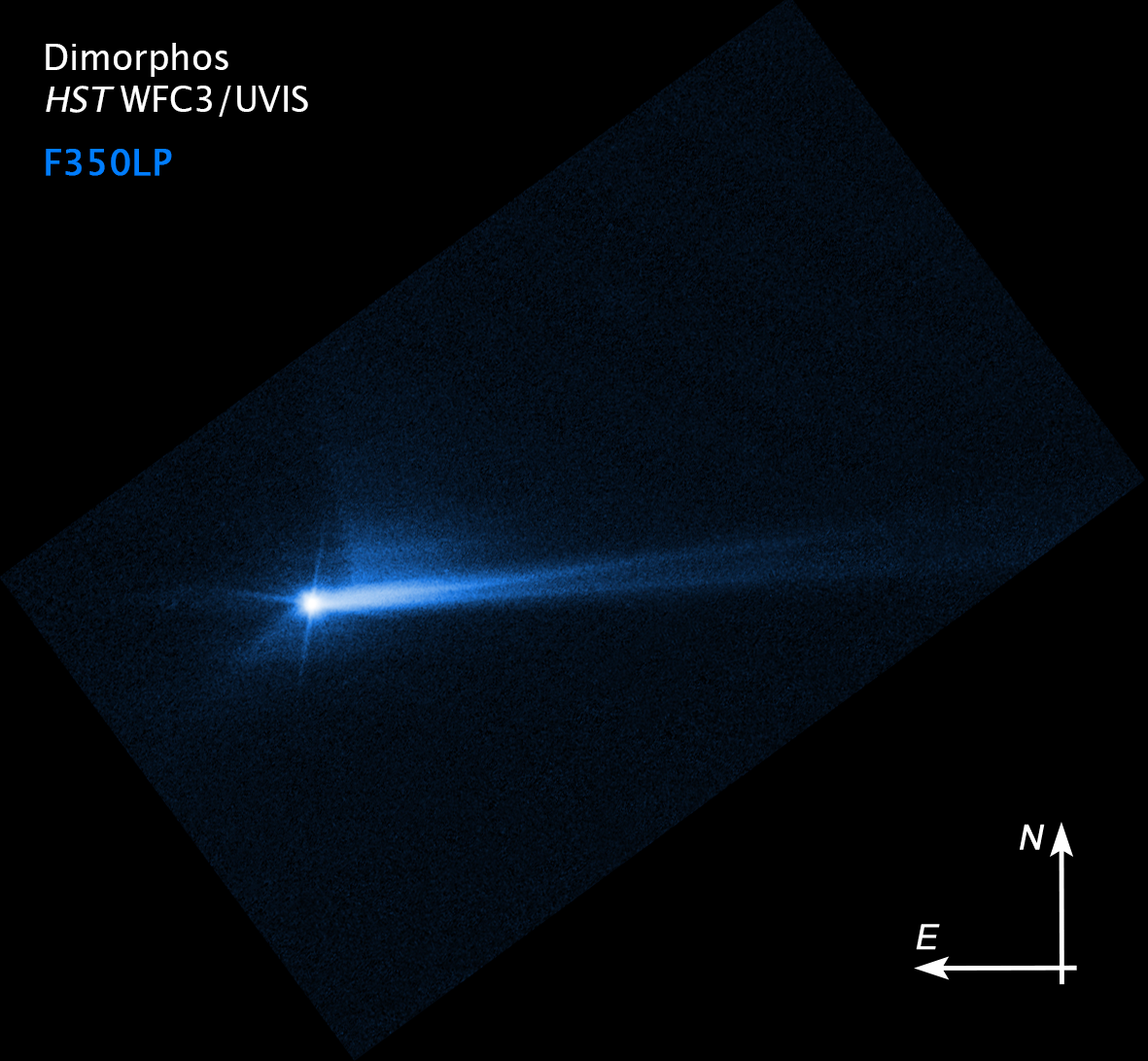
“Prior to DART’s impact, it took Dimorphos 11 hours and 55 minutes to orbit its larger parent asteroid, Didymos. Since DART’s intentional collision with Dimorphos on Sept. 26, astronomers have been using telescopes on Earth to measure how much that time has changed. Now, the investigation team has confirmed the spacecraft’s impact altered Dimorphos’ orbit around Didymos by 32 minutes, shortening the 11-hour and 55-minute orbit to 11 hours and 23 minutes. This measurement has an uncertainty of approximately ±2 minutes,” NASA stated at the time.
“Before its encounter, NASA had defined a minimum successful orbit period change of Dimorphos as a change of 73 seconds or more. This early data shows DART surpassed this minimum benchmark by more than 25 times,” it added.
NASA reportedly measured the momentum enhancement factor (β) at around 3.6, indicating that the ejected debris may have amplified the deflection effect. The impact also reportedly elongated Dimorphos and slightly altered the orbit of the Didymos system.
The DART effort basically demonstrated that kinetic impact could be instrumental in deflecting asteroids. It showed that even slight variations in velocity can eventually lead to a significant change in position, deflecting a dangerous asteroid away from Earth.
While DART changed Dimorphos’s orbit around its parent asteroid, China’s test seeks to directly alter the target asteroid’s heliocentric orbit (its path around the Sun relative to Earth) or even break the body apart. This is a step closer to an actual planetary defense scenario against a destructive extraterrestrial object.
By developing independent defense capabilities against existential threats, China will be able to enhance its global standing and narrative of technological self-reliance. But for the US, the Chinese test mission could prove alarming.
China’s asteroid deflection mission is part of its broader ambitions in space, which include achieving leadership and strategic advantages. However, mastering high-speed kinetic impact, precise deep-space navigation, dual-spacecraft coordination, and asteroid characterization may help build capabilities directly transferable to other missions, including potential anti-satellite (ASAT) technologies or rapid-response spacecraft.
Moreover, analysts have raised concerns about the dual-use potential, whereby asteroid research could inform techniques for intercepting or disrupting satellites in the event of a conflict.
At this point, though, it is merely a speculative claim made by skeptics.
- Contact the author at sakshi.tiwari13 (at) outlook.com
- Follow EurAsian Times on Google News