Australia signed a landmark defense treaty with Fiji on Monday, boosting bilateral security cooperation as Canberra increasingly focuses on limiting China’s influence across the South Pacific.
The Ocean of Peace pact elevates Fiji to one of Australia’s few treaty allies and binds each nation to come to the other’s “mutual defense”.
China sent shockwaves through the region in 2022 when it signed a secret security pact with the Solomon Islands, stoking fears that it could one day lead to a permanent military presence.
Australia has greatly upped its diplomatic efforts in response, securing deals with the likes of Papua New Guinea, Vanuatu and Tuvalu.
Prime Minister Anthony Albanese signed the pact with his Fijian counterpart Sitiveni Rabuka during a trip to the capital, Suva.
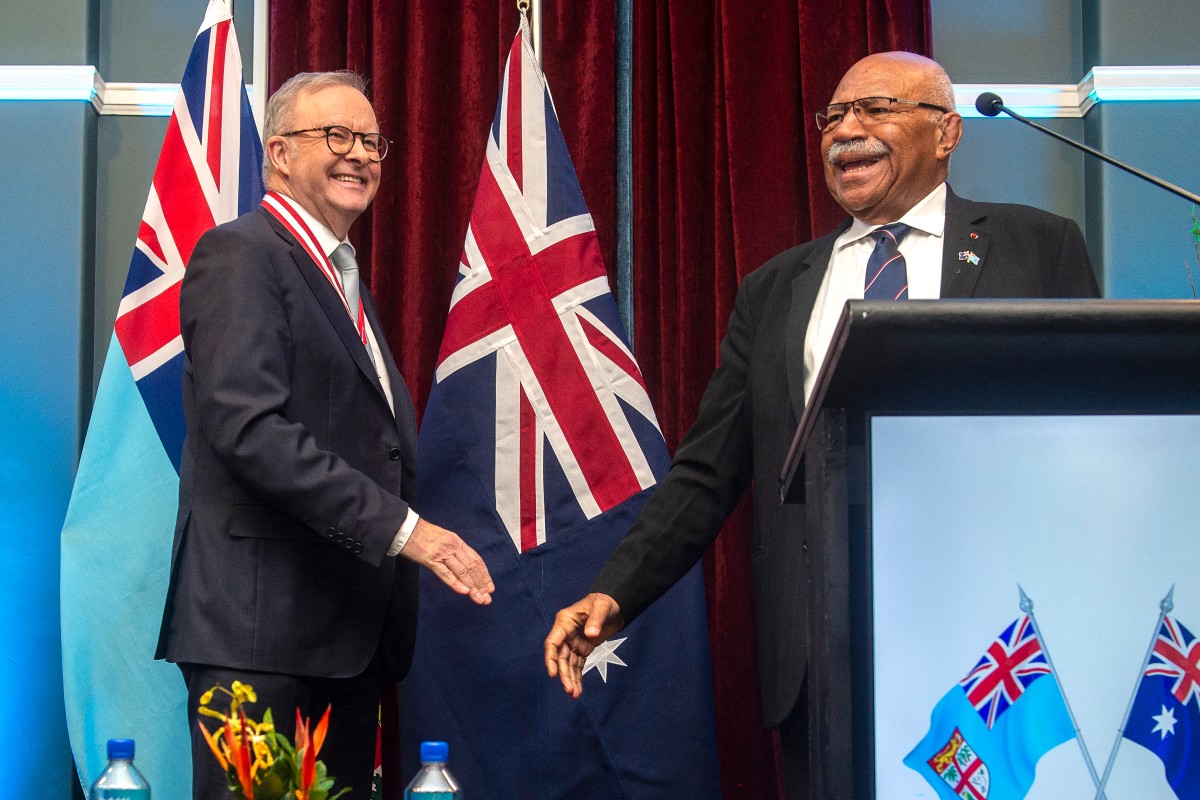
The pair also signed a second comprehensive treaty covering everything from climate action to economic cooperation.
“When it comes to security issues the Pacific family need to look after our own security,” Albanese told reporters.
“The significance of these agreements cannot be underestimated.”
Photos showed Albanese sipping Fiji’s traditional kava drink at a welcome ceremony before the pact was signed.
Fiji joins the United States, New Zealand, and Papua New Guinea as Australia’s fourth treaty-bound ally.
Under the deal, the two nations agree to consult each other over any “security-related development” that threatens their sovereignty.
Rabuka tried to quell concerns that China could see the treaty as a snub.
“I do not expect China to have any severe pushback,” he told reporters.
“I believe that they will welcome the understanding that it is between Australia and Fiji.
“It does not threaten Fiji’s relationship with China.”
Fiji grew closer to China under former prime minister Frank Bainimarama, who seized power in a 2006 coup.
Bainimarama turned to Beijing for economic support after his coup resulted in damaging trade sanctions against Fiji.
But China’s influence has waned since Rabuka took office in 2022, as Fiji has favored its traditional partnerships with Australia and New Zealand. Rabuka condemned suggestions in 2025 that South Pacific nations such as Fiji might one day host a permanent Chinese military presence.
“If they want to come, who would welcome them? Not Fiji,” he said at the time.
“And I think that China understands that well.”
The treaty between Fiji and Australia included a clause allowing other Pacific nations to join later.
Pacific affairs expert Tess Newton Cain said this was clearly aimed at Pacific nations with standing militaries such as Papua New Guinea and Tonga.
“It’s significant because it’s very much focused on the countries that have military capacity,” she said.
“It provides a very clear point of entry to have further security conversations down the track.”
Albanese will visit the Solomon Islands before returning home later this week for bilateral talks with leaders from Papua New Guinea and Tonga.
Australia’s alliance with Fiji mirrors the sweeping Pukpuk Treaty with Papua New Guinea, which is due to come into effect on Wednesday.
Australia and Vanuatu signed a security and economic agreement in June that bars the establishment of any foreign military base in the Pacific nation.
China, in response, warned Australia against playing “geopolitical games”.
Beijing has spent hundreds of millions of dollars building sports stadiums, presidential palaces, hospitals and roads in Pacific island nations.
Kiribati, the Solomon Islands, and Nauru have in recent years severed longstanding diplomatic links with Taiwan in favor of China.
By AFP