As the United States re-evaluates its support for British control of the Falklands — one of the last remaining symbols of the British Empire — Argentina is strengthening its military posture.
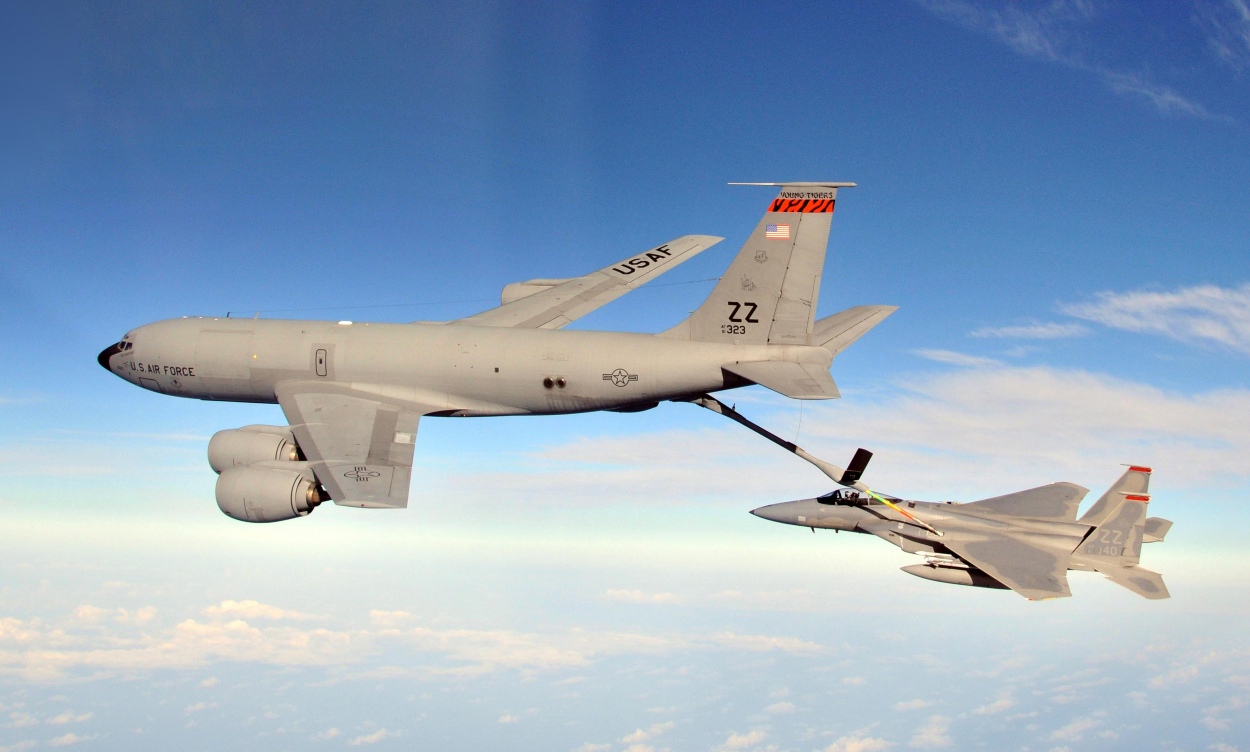
Argentina is pursuing the acquisition of two Boeing KC-135R Stratotanker aircraft to support its incoming fleet of F-16 Fighting Falcon jets, according to the country’s Air Force chief.
Besides, the country is also considering purchasing additional Embraer ERJ-140 transport planes.
The Chief of the Argentine Air Force, Brigadier General Gustavo Javier Valverde, stated that these acquisitions are part of the plan to strengthen the Air Force’s logistics and transport aviation capabilities, Argentina-based Zona Militar reported.
Valverde explained that they are working to reinforce military transport aviation “with the incorporation of a new system. The in-flight refueling component, which will include two KC-135s accompanying the F-16s, will extend the aircraft’s range …reinforcing transport aviation with Boeing and Embraer 140 aircraft…”
Notably, adding two KC-135R Stratotanker aircraft will significantly increase the combat radius of the incoming F-16 fleet for the Argentine Air Force.
This is significant in light of the recent flare-ups in tensions with the UK over the disputed Falkland Islands.
The ferry range of the F-16 is 500-550 miles (800-900 km), depending on configuration, loadout, and weapons package.
Meanwhile, the Falkland Islands are located roughly 500 km (around 300+ miles) off the coast of Argentina.
While the distance is within the maximum ferry range, a “combat radius” with a full weapons load is often lower.
Without air-to-air refueling, the Argentine F-16s would have limited time for engagement over the islands before needing to return to the mainland.
The two aerial-refueling tankers will give the Argentine F-16s a much longer combat radius, enabling them to conduct deep-penetration missions within the Falklands.
Argentina has so far received six F-16 AM/BM aircraft from Denmark, part of a 24-jet deal with deliveries scheduled to continue through 2027.
In fact, Argentina has been gradually building its military strength over the last few years. Furthermore, President Milei has used arms deals with the US to boost his relationship with President Trump.
For instance, in October 2024, the US approved Foreign Military Sale (FMS) of F-16’s weapons package, including missiles, AIM-120 AMRAAM, bombs, avionics, training, and logistics support for the 24 F-16s, valued at US$941 million.
In July last year, Argentina signed a deal with the US for Stryker 8×8 infantry armored vehicles to modernize its mechanized infantry.
It is also considering purchasing 72 units of self-propelled artillery and procuring Scorpene-class submarines from France.
These arms deals show Argentina’s strong pivot toward US/NATO-compatible equipment under President Milei.
The acquisition of two aerial-refueling tankers also comes at a sensitive time, when long-subdued tensions over the Falklands are flaring up again.
More worryingly for the UK, Argentina’s claims over the Falklands are gaining renewed momentum in the Americas.
Last month, Argentina’s claim on the Falkland Islands was backed by Uruguayan President Yamandu Orsi.
In his speech at the 9th Summit of the Community of Latin American and Caribbean States (CELAC) in April, Orsi lent support to Argentina’s sovereignty claim, echoing President Milei’s position, who has consistently called for negotiations over the future of the islands.
Orsi referred to the dispute as a “historical demand” for Latin America, framing the sovereignty issue as a matter of international law and regional solidarity.
Tensions over the Falklands flared up again after the UK government decided to proceed with the Sea Lion oil project, a major drilling project in the Falklands.
The field was discovered in 2010, and phases one and two of the operation have been approved by the Falkland Islands Government, which has granted exploitation licenses valid for 35 years.
President Milei warned in April that his government “will respond with all necessary diplomatic measures” to protect the country’s interests in the face of the scheme.
He added: “We act with determination against unilateral and illegitimate activities that seek to exploit resources belonging to the Argentine people.”
Argentina considers hydrocarbon exploration and production schemes in the waters around the British overseas territory illegal, as it believes the islands are Argentine territory.
However, the real fillip to Argentina’s claims over the Falklands came when a leaked internal Pentagon email proposed reviewing US diplomatic support for the UK’s claim to the Falklands as one option to punish NATO allies, including the UK, for their failure to support the US in the war against Iran.
The email, reported exclusively by Reuters, also suggested punishing European members of NATO by withdrawing some US troops from those countries and suspending Spain from the alliance.
The UK not only refused to join military operations against Iran but also ignored repeated calls by President Trump to help open the Strait of Hormuz.
“The policy options are detailed in a note prepared by Elbridge Colby, the Pentagon’s top policy adviser, who expressed frustration at some allies’ perceived reluctance or refusal to grant the United States access, basing and overflight rights – known as ABO – for the Iran war, said the official, who spoke on condition of anonymity to describe the email.”
The memo also included an option to reassess U.S. diplomatic support for longstanding European “imperial possessions,” such as the Falkland Islands near Argentina.
The language was significant, as it identified the Falkland Islands as an “imperial possession” of the UK.
Notably, the US State Department’s website only states that the islands are administered by the United Kingdom but are still claimed by Argentina.
The memo framed such “imperial possessions” as leverage to reduce the European “sense of entitlement.”
Argentina seized the moment. Within days, Milei posted on X, “THE MALVINAS WERE, ARE, AND ALWAYS WILL BE ARGENTINE.”
In a subsequent Neura interview, he claimed his government was “making progress like never before” and “doing everything humanly possible” to return the islands, while stressing sovereignty is “non-negotiable.”
However, the strongest statement was made by Vice President Victoria Villarruel, who told Falkland Islanders that if they feel English, they should “GO BACK TO ENGLAND.”
Notably, during the 1982 Falklands War, the US provided tactical support to the UK through intelligence and logistics.
The 1982 Falklands War was an undeclared 10-week conflict between Argentina and the UK over the sparsely populated islands.
Argentina, at that time, was ruled by a military junta, which was increasingly under pressure over a severe economic crisis and human rights abuses. The junta saw the invasion of the island as a way to boost the national sentiment.
On April 2, 1982, Argentinian forces invaded the thinly defended island and easily overran it.
They seized South Georgia the next day. Britain viewed it as an act of aggression and launched a military response.
The war lasted 74 days — from 2 April to 14 June 1982. It ended with the Argentine surrender on June 14.
In total, more than 900 people died in the conflict, 649 Argentinians and 255 British citizens.
In a significant event during the conflict, British submarine HMS Conqueror torpedoed the Argentine cruiser ARA General Belgrano, killing 323 Argentine sailors and crippling the Argentinian Navy.
The conflict ended with Argentina’s humiliating defeat. While the conflict boosted the British PM Thatcher’s popularity, it accelerated the collapse of the military junta.
However, the Falkland Islands remain disputed between the UK and Argentina.
Argentina argues that merging the Falklands with the country is part of the historical decolonization project, whereas the UK contends that the islanders have a right to self-determination.
In 2013, the Falklands government organized a two-day sovereignty referendum.
The question asked was: “Do you wish the Falkland Islands to retain their current political status as an Overseas Territory of the United Kingdom?”
Nearly 92% of people cast their votes, and over 99% voted to remain a British territory. Argentina, however, dismissed the referendum as a “publicity stunt” and “irrelevant,” refusing to recognize it.
The recent military buildup in Argentina, coming on the back of diplomatic support from Latin American countries, and a potential review of US policy towards the Falklands, are definitely a cause for concern for the UK.
- Sumit Ahlawat has over a decade of experience in news media. He has worked with Press Trust of India, Times Now, Zee News, Economic Times, and Microsoft News. He holds a Master’s Degree in International Media and Modern History from the University of Sheffield, UK.
- VIEWS PERSONAL OF THE AUTHOR.
- He can be reached at ahlawat.sumit85 (at) gmail.com