

By the time the AMCA fighter aircraft enters service around 2040, stealth drones will own the high-risk missions—India needs to focus on the underlying technologies first.
We all know it.
By the time the AMCA enters squadron service in the IAF, possibly around 2040, the operational relevance of a manned, single-cockpit stealth fighter will have diminished significantly compared to now.
Stealth drones will have taken over many of the tasks manned stealth fighters were created for, such as SEAD/DEAD (Suppression/Destruction of Enemy Air Defenses), Deep precision strikes on high-value targets, and Forward/persistent ISR in denied areas.
The combination of improved autonomy, AI, lower cost, and attritability will allow stealth drones to handle a large share of the original “high-risk penetration and sensing” missions that justified manned stealth fighters in the first place.
Manned stealth aircraft will by then be mostly deployed for: Air superiority against peer manned/unmanned threats and Complex command-and-control of drone teams
The strong support for continuing the project is best explained by the desire to master fifth-generation fighter technologies, placing India firmly on a trajectory toward defending itself with indigenously developed weapons.
In other words, we are pursuing a 5th-generation fighter aircraft development project so that we can acquire the technologies that go into a 5th-generation fighter. That doesn’t sound right, does it?
One would think it should be the other way around—build a 5th-gen fighter after you acquire most or all of the 5th-gen fighter technologies: Low Observability (low IR and RF signatures, internal weapons bays), supercruise, super-maneuverability, sensor fusion, and network-centric operations. (Note: “Stealth Observability” is redundant; “Low Observability” is the standard term).
As currently conceived, when the AMCA enters squadron service, we still won’t have acquired technologies for supercruise, super-maneuverability, and network-centric operations. In addition, we will still depend on foreign vendors for aero-engines, ejection seats, sensors, and the semiconductors that support those sensors.
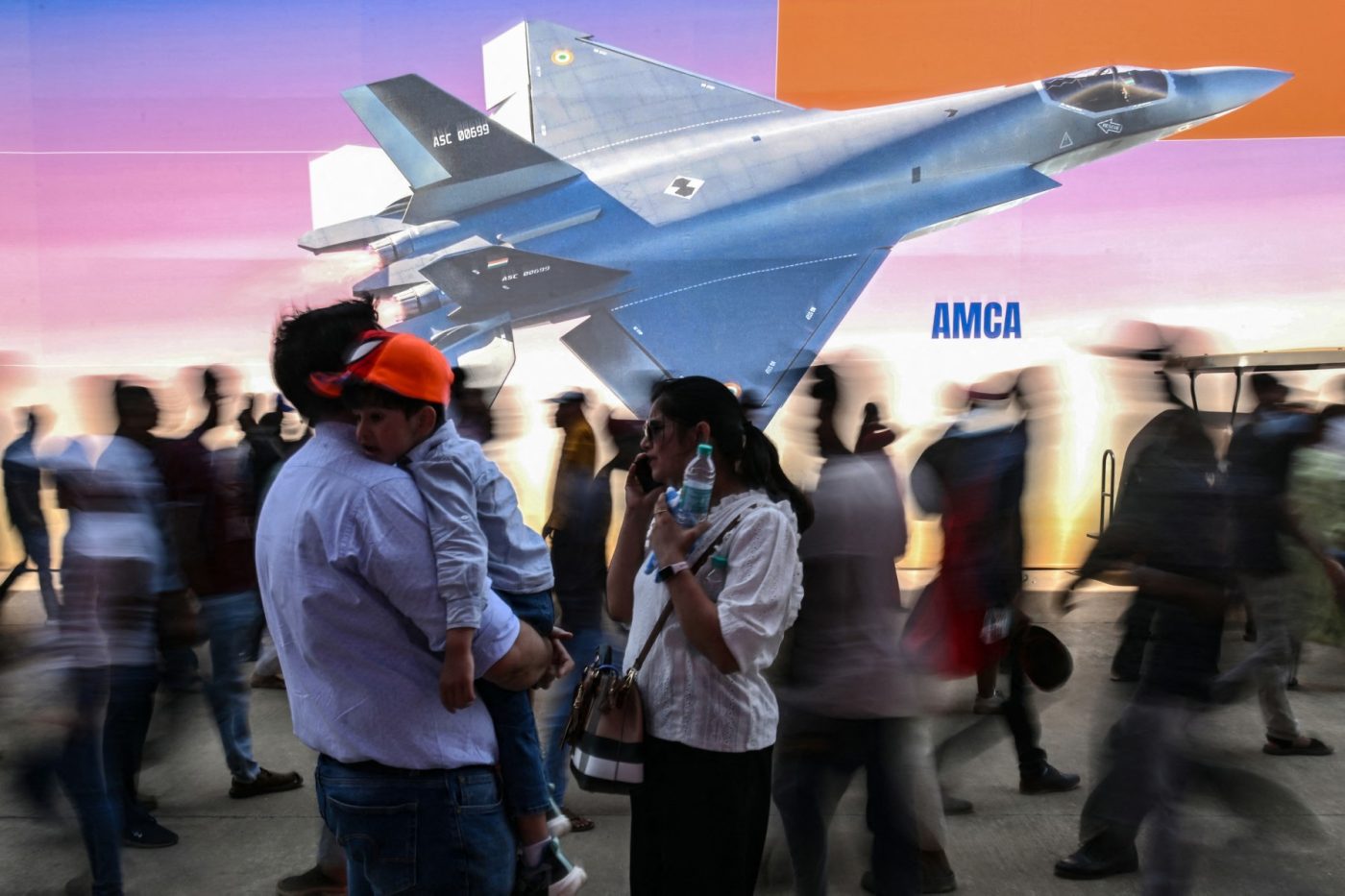
AMCA Ambition
AMCA is an ambitious and expensive project—a low-probability, high-hanging fruit. (Or: “…an expensive project: a high-hanging fruit.”) Even if successful, it will not dramatically reduce our dependence on foreign vendors for the critical technologies associated with the project.
What is incomprehensible about the AMCA project is that it is being pursued knowing fully well the initial variant will not meet qualitative requirements (QRs). Also, the trajectory to a follow-up variant that does meet QRs is highly speculative.
The AMCA has been designed around the General Electric F414 engine. The F414 is a 98-kN thrust-class engine, whereas the IAF wants the AMCA to be powered by a 110-kN-class engine.
Consequently, the F414 has been publicly described as an interim powerplant for the AMCA. The long-term intention is to replace it with a more powerful indigenous engine that is yet to be developed. The follow-up variant with the more powerful indigenous engine is to be called AMCA Mk.2.
AMCA Alternative
I personally think AMCA should be dropped in favor of several low-cost, “low-hanging fruit” projects to develop and demonstrate our grasp of LO airframe design, sensor fusion, networking, machine-vision navigation, low-latency communications, and aero-engines.
To master LO airframe design, development, and maintenance, the Ghatak drone is a strong project that needs aggressive support—something that may not happen if we continue to pursue AMCA due to funding constraints.
Beyond mastering low-observable technologies, Ghatak could also serve as a testbed for mastering network-centric operations. I will come to this later in this article.
Machine Vision and Low-Latency Networking
Pursuing machine vision, low-latency SATCOM, and mesh modem networks could dramatically increase the effectiveness of the IAF’s current fleet of combat aircraft, including the Jaguar and MiG-29UPG.
Machine-vision-capable, air-launched drones and missiles with human-in-the-loop piloting and decision-making have evolved into formidable weapons. They are typically built with low-cost materials because of the lower aerodynamic loads associated with their lower speeds and limited maneuvering capability.
Despite their lower cost, they can evade adversary detection by flying nap-of-the-earth (NOE) profiles and strike with greater precision than traditional cruise missiles, using sophisticated optical or radar image-correlation seekers.
These new-generation weapons would dramatically expand the Su-30MKI’s capabilities, allowing the aircraft to act as a weapon truck for MUM-T operations with the Ghatak. The Ghatak would find the targets in contested airspace, and the Su-30MKI would attack them.
The second pilot in the Su-30MKI could provide piloting and decision-making support to the drones.
Su-30MKI as AWACS
We could also exploit the Su-30MKI’s large inventory and dual-seating configuration by deploying it as a mini-AWACS, equipped with optical, IR, and SAR reconnaissance pods. This would require developing pods and improving the fighter’s networking capability.
Large AWACS are very expensive. They must be deployed deep within friendly territory to prevent attacks by adversary fighters using long-range air-to-air missiles.
Su-30MKIs (removed apostrophe) equipped with optical and SAR pods could substantially increase the IAF’s surveillance and intelligence-gathering capability. Developing the pods could be another low-hanging-fruit project for DRDO.
Aero-Engines
As far as engines are concerned, the DRDO, along with private-sector entities, could simultaneously work on several low-cost projects to power drones of various sizes and continuously tweak the Kaveri engine to reduce its weight and improve specific fuel consumption.
Meanwhile, HAL could continue developing reheat technology with the HTFE-25 engine. The vigorous pursuit of engine technology spanning several low-hanging projects would allow us to develop our own high-thrust, supercruise-capable engine.
If we launch ten such low-cost capability acquisition projects across the public and private sectors, and even if just five succeed, we would have plugged much of the capability gap against our likely adversaries.
Not Forgetting the AMCA
We could continue slow-paced AMCA development, provided the GoI increases the defense budget to accommodate higher R&D spending across the public and private sectors. The point is that AMCA capability development projects should take priority over the AMCA project itself.
- Vijainder K Thakur is a retired IAF Jaguar pilot, author, software architect, entrepreneur, and military analyst.
- This is an Opinion Article. Views Personal of the Author
- Follow the author @vkthakur