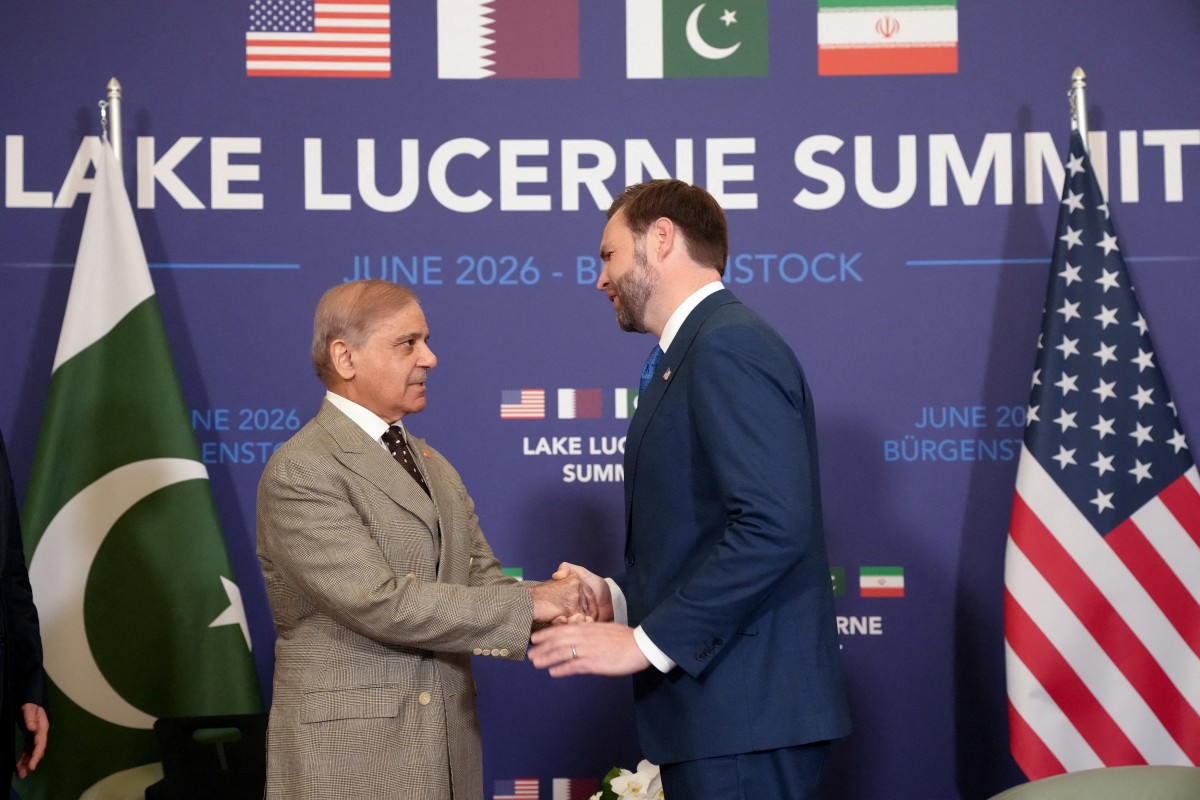
Pakistan’s PM Shehbaz Sharif and Field Marshal Asim Munir arrived in Switzerland for the Iran Peace talks. Qatar’s foreign ministry announced “the launch of the Lake Lucerne Summit and the first meeting of the high-level committee with the participation of representatives from the United States of America, the Islamic Republic of Iran, and the two mediating states, the State of Qatar and the Islamic Republic of Pakistan”.
The question is: Is Pakistan punching above its weight by leveraging its geopolitical location and nuclear weapons?
For long, Pakistan seized the initiative to attack India and began all the wars from the Kashmir War of 1948 to the 1999 Kargil War. It changed only recently, when India took the initiative after the Uri Brigade attack, the Pulwama attack, and the Pahalgam attack (Op Sindoor).
Pakistan managed to acquire technologically superior tanks and aircraft before India. Pakistan had also prepared itself in time to carry out nuclear tests just days behind India. Pakistan also out-negotiated India for the return of 93,000 prisoners of war (POW) after the 1971 Conflict in return for little concessions.
While acknowledged as the “fountainhead of global terror,” it continued to play geopolitical games with global superpowers. It helped the USA connect with China in the 1970s, supported the USA against the Soviet Union in Afghanistan, had a footprint in the 9/11 attacks, and secretly housed the most-wanted terrorist, Osama Bin Laden.
More recently, the US preferred Pakistani generals as middlemen for peace talks with Iran. For long, Pakistan has played the Islamic nuclear card and used its military to make Muslim countries dependent on it for security (Qatar, Saudi Arabia).
Yet Pakistan remains in a political and economic mess. The Army Generals continue to plunder, loot, and amass wealth and stash it in foreign lands. The homegrown terrorist meant for elsewhere is biting the hand that nurtured it and now calling the political shots. The strategic depth that Pakistan hoped for by propping up the Taliban in Afghanistan has backfired and opened another front.
Notwithstanding, there is a need to study the strategies behind the asymmetric “bang for the buck”.
Army Rules the Roost and the Mess
The Pakistan Army has a complex history marked by institutional dominance, random successes in counter-terrorism, and severe setbacks in conventional wars and internal governance. Its political supremacy is more or less formalized, while its operational focus grapples with continuous domestic security challenges.
The military dictates the nation’s political landscape, recently illustrated by the highly controversial February 2024 elections and the nullification of independent candidates’ legislative dominance. Through a constitutional amendment, the military unified command under a Chief of Defense Forces, granting the army chief significant operational control.
The Pakistan army did achieve some tactical successes in dismantling militant sanctuaries in the northwest, significantly disrupting networks during major efforts like Operation Zarb-e-Azb. Despite these operations, the Tehreek-i-Taliban Pakistan (TTP) and affiliated groups remain highly active. Recent data highlights that terrorist attacks have frequently outnumbered security operations, pointing to the limitations of eliminating the ideological and structural roots of extremism.
The army faces ongoing challenges securing the western borders, leading to localized skirmishes and tensions with Afghanistan and Iran. Historically, the Pakistan Army has faced multiple setbacks in conventional conflicts with India.
For instance, despite significant technical superiority in tanks during Pakistan’s 1965 Operation Grand Slam, poor distribution of armor and high-level leadership failures resulted in a tactical stalemate.
Significant strategic blunders, such as in the 1947 Kashmir war and 1999 Kargil conflict, where miscalculated operational scopes led to severe losses. The Punjabi-dominated Pakistan Army failed to hold East Pakistan in 1971, resulting in one of the greatest surrenders (93,000 POW).
The military’s handling of the Balochistan separatist movement remains a long-term failure. The army has struggled to establish a permanent writ, and the region continues to experience deep-seated insurgent and civil unrest. Widespread domestic disenchantment occasionally boils over into violent pushback, such as the deadly 2026 clashes between public protesters and military/rangers in Pakistan-Occupied Jammu and Kashmir.
The military is deeply embedded in the state’s economy and uses organizations such as the Frontier Works Organization to spearhead critical infrastructure projects, thereby generating leverage in defense and securing domestic economic control.
The Americans find it easier to deal with Military Dictators who tow their line. Therefore, they chose General Asim Munir to help them negotiate with Iran. Some say he was just like a “Messenger Pigeon”.
Diplomatic Successes and Mess-Ups of Pakistan
Pakistan’s diplomatic history is a complex tightrope walk dictated by its strategic location (gift of geography). Its most celebrated successes include forging an ironclad, decades-long alliance with China, negotiating a nuclear deterrent despite global pressure, and securing deep security ties with Gulf nations. Conversely, major foreign policy setbacks stem from its entanglement in proxy wars, prolonged isolation following the 1971 separation of Bangladesh, and shifting Western priorities after the Soviet-Afghan war.
Aligning with the US, Pakistan was a founding member of the Central Treaty Organization (CENTO), a Cold War-era military alliance formed in 1955 to contain Soviet influence. By formally aligning with the Western bloc, Pakistan secured crucial bilateral defense agreements with the U.S. These agreements resulted in substantial military equipment and economic assistance, helping build Pakistan’s early defense capabilities.
Recognizing the People’s Republic of China fairly early and ceding the Shaksgam Valley to China through the Sino-Pakistan Boundary Agreement of 1963 paid immense dividends. It evolved into the China-Pakistan Economic Corridor (CPEC), bringing crucial infrastructure development, sustained economic support, and a counterweight to regional adversaries. Despite intense international resistance and severe economic sanctions in the late 1990s, Pakistan successfully developed its nuclear weapons program. This established a fundamental strategic balance in South Asia.
Pakistan has masterfully balanced relations between rival regional powers, maintaining strong military and strategic ties with Saudi Arabia while simultaneously keeping diplomatic channels open with Iran. It further played a pivotal role in negotiating critical-mineral MoUs in Washington. As one of the largest contributors to United Nations Peacekeeping missions, Pakistan has consistently boosted its soft power and global standing.
Failing to manage the political aspirations of East Pakistan led to civil war and disastrous international blowback. It culminated in the 1971 India-Pakistan war and the secession of East Pakistan into the independent state of Bangladesh. Pursuing “strategic depth” by backing various Afghan factions and the Taliban ultimately alienated the international community. Following the post-9/11 “War on Terror,” this policy left Pakistan dealing with severe domestic blowback from militant groups.
Pakistan’s foreign policy has historically suffered from assuming global powers (like the US) would indefinitely bankroll the state simply due to its geographic proximity to conflict zones. This has resulted in a cyclical “roller coaster” relationship with Washington. Even China is demanding that Pakistan clear mounting circular debt and capacity payment obligations owed to Chinese independent power producers (IPPs) operating under the CPEC. Beijing has expressed growing frustration over delayed payments, putting pressure on Islamabad to secure funds.
Failing to garner consistent, binding international backing for a resolution on the disputed region of Jammu and Kashmir has locked Pakistan into a perpetual state of hostility and conflict with India.
The ‘Too Big to Fail’ Doctrine
Pakistan’s “Too Big to Fail” (TBTF) doctrine is a geopolitical and economic concept asserting that the international community and global financial institutions (like the IMF) will continually bail out Pakistan to prevent its economic collapse, regional destabilization, or the compromise of its nuclear arsenal.
The overriding geopolitical argument is that Pakistan’s collapse or a jihadist takeover of its atomic weapons is too great a global security risk to allow, necessitating international intervention.
It secures continuous financial and diplomatic lifelines from the IMF and allies like Saudi Arabia and China. Due to repeated, long-term bailouts and massive overall debt, global lenders like the IMF are heavily exposed, making Pakistan paradoxically TBTF to protect the stability of the global financial system.
Historical dependence by global powers (the U.S. and China) on Pakistan’s strategic location for regional stability, counter-terrorism, and diplomatic balancing has its dynamics. Critics (India) in international forums argue that repeatedly bailing out a prolonged IMF borrower with a poor record of fiscal reform rewards irresponsible governance.
Pakistan’s diplomatic strategy of relying on debt rollovers and foreign bailouts. Over-reliance on the TBTF doctrine creates a lack of incentive for internal economic reforms, results in recurring budget deficits, heavy reliance on subsidies, and suppressed growth. A significant portion of the economy is tied to military-linked conglomerates or influenced by the security establishment, which complicates civilian oversight, fiscal compliance, and long-term economic restructuring.
Nuclear Deterrence
Pakistan used every clandestine means to acquire nuclear weapons. Pakistan’s nuclear deterrence strategy is anchored in a policy of “Full-Spectrum Deterrence” and maintained at a credible minimum level, specifically designed to deter all forms of aggression from India.
Islamabad’s strategy explicitly rejects a no-first-use policy, reserving the right to use nuclear weapons first if conventional defenses collapse or state survival is threatened. It allows Pakistan to maintain a credible deterrent against larger adversaries without having to spend exorbitant sums on achieving conventional military parity.
Proxy and Asymmetric Operations
Low-cost, covert, or proxy assets are often utilized to project influence and tie down larger opposing forces without the astronomical costs of prolonged, direct conventional warfare. Pakistan’s proxy and asymmetric operations are foundational elements of its national security doctrine, primarily designed to counter India’s conventional military superiority. This hybrid warfare strategy utilizes state-sponsored militant proxies, cyber operations, and grey-zone tactics to inflict instability while maintaining strategic deniability under a nuclear umbrella.
The Pakistani military and Inter-Services Intelligence (ISI) have long nurtured militant outfits, such as Lashkar-e-Taiba (LeT) and Jaish-e-Mohammed (JeM), as asymmetric levers to bleed India and challenge its control over Jammu and Kashmir. By blurring the lines between war and peace, Pakistan engages in continuous covert pressure.
Tactics include utilizing low-cost technologies, cross-border infiltration, and disinformation campaigns to undermine Indian security without crossing the threshold of a full-scale conventional war. Pakistan relies on its nuclear arsenal to deter Indian conventional retaliation (such as massive military mobilization), creating an operational space where sub-conventional proxy jihad can be sustained.
A smaller conventional military budget than India’s is offset by the use of low-cost proxy fighters, effectively bogging down Indian security forces and straining regional resources. The reliance on these irregular forces is deeply structural.
This constitutes a systemic “war through asymmetric means”. The infrastructure built to sustain external proxies has increasingly turned inward. Pakistan has battled severe internal insurgencies, notably grappling with escalations that recently pushed the state to rank first on the Global Terrorism Index.
GDP and Military Budgets
India is nearly four times Pakistan’s area and 5.7 times its population. India’s nominal GDP in 2026 is approximately $4.15 trillion. Pakistan’s nominal GDP is approximately $452 billion for 2026, nearly 10 times less than India’s.
Pakistan allocated 3 trillion rupees ($10.78 Billion) for defense in the fiscal year starting July 2026, up 18% from the outgoing year. India’s defense budget for 2026-27 is $94 billion, nearly 9.5 times Pakistan’s.
Pakistan’s Many Military Acquisitions Were Aid
Pakistan first acquired the North American F-86 Sabre (102) in 1956 under the United States Mutual Defense Assistance Program (USMDAP).
The Indian Air Force (IAF) inducted the British transonic jet fighter, the Hawker Hunter, in October 1957. India acquired the Dassault Mystère IV fighter-bomber aircraft from France in 1957. The three were the most iconic first- and second-generation swept-wing jet fighters of the 1950s. While all three were subsonic in level flight, they differed heavily in design philosophy, armament, and performance.
These aircraft frequently faced off in the skies, most notably during the Indo-Pakistani War of 1965. While the Hunter had a speed and armament advantage, the F-86 Sabre could gain an edge if equipped with early heat-seeking missiles, which the Indian aircraft lacked at the time.
India acquired the MiG-21 (later made in India) in 1961, with the first supersonic fighter jets officially inducted into the IAF in 1963. Pakistan acquired the Lockheed F-104 Starfighter in 1961 under the USMDAP, making it the first non-NATO and first Asian nation to operate the Mach 2-capable aircraft.
The Pakistan Air Force (PAF) received a total of 12 F-104A interceptors and two F-104B trainers, which were assigned to the elite No. 9 Squadron based at Sargodha. During the India-Pakistan wars, engagements between the IAF MiG-21 and the PAF F-104 resulted in decisive IAF victories, with Indian MiG-21FLs recording multiple aerial kills against Pakistani F-104s.
India inducted the Dassault Mirage 2000 in June 1985 and the MiG-29 in 1987. Pakistan first inducted the F-16 Fighting Falcon in January 1983, although the pre-contract negotiations for the three were moving somewhat in parallel.
Pakistan acquired the Patton tank (M47 and M48 variants) in 1954 following the signing of the USMDAP. Over the next decade, the U.S. supplied Pakistan with roughly $800 million in military aid, including hundreds of these tanks. India acquired the legendary British Centurion battle tanks in 1953.
The Centurion served as a primary battle tank for roughly three decades. It became famously known as the “Patton Killer” during the 1965 Indo-Pakistani War when Indian Centurions decimated Pakistan’s advanced US-made Patton tanks at the decisive Battle of Assal Uttar. India first acquired Russian T-72 tanks in 1976, when the initial batch was imported directly from the Soviet Union.
India later established a licensed manufacturing facility at the Heavy Vehicles Factory. Pakistan first acquired Chinese tanks following the 1965 war, when Western weapon supply lines began to dry up. The initial imports began with the Type 59 Main Battle Tank, which subsequently led to a long-standing defense partnership.
Pakistan’s Early Force Multiplier Advantage?
Pakistan first established its dedicated Operational Radar sectors in 1962. Under the USMDAP, the PAF erected its foundational radar stations at Sakesar (Northern Sector) and Badin (Southern Sector).
These early warning stations featured American-supplied FPS-20 radar units and FPS-6 height finders, establishing the core of the country’s air defense network.
They were ahead of India. India’s Radar and Communication Project Office (RCPO) was a specialized, strategic systems engineering group under the Ministry of Defense. Established in the 1970s to manage and indigenize the Air Defense Ground Environment System (ADGES), it integrates advanced radars, communication networks, and computer systems for the IAF. Soon, India was much more advanced than Pakistan.
Pakistan acquired its first Airborne Early Warning and Control (AEW&C) aircraft in December 2009. The aircraft was a Saab 2000 equipped with the Erieye radar system. In 2010–2011 Pakistan inducted the Chinese-built Shaanxi ZDK-03 significantly boost its air surveillance and defense capabilities. India acquired three AEW&C platforms through a tripartite contract with Russia and Israel, which was signed in 2004.
These aircraft feature the Israeli EL/W-2090 radar system mounted on the Russian Ilyushin Il-76 airframe, and were delivered and inducted between 2009 and 2011. Clearly, India was thinking ahead. India today makes its own AEW&C aircraft. But PAF has 11 AEW&Cs as of date, compared to 6 with the IAF. Pakistan is also currently in the process of acquiring four advanced Shaanxi KJ-500 AEW&C from China. Thus, Pakistan remains ahead in AEW&C.
The induction of F-16s equipped PAF pilots with early secure voice capabilities (such as Have Quick I/II anti-jam frequency-hopping) for interoperability with Western systems. In the period 2009–2019, Pakistan made a heavy strategic push to secure all of its airborne communications using indigenous scrambled radios. The PAF began transitioning to secure, encrypted tactical communications (data links) around the time of Operation Swift Retort in February 2019, deploying scrambled radios built by the National Radio and Telecommunication Corporation.
The IAF has used secure, encrypted aircraft voice capabilities since the early 2010s. Since then, the IAF has continuously modernized this capability and introduced dedicated military communication satellites to provide jam-proof and encrypted SATCOM uplinks for aircraft.
More recently, upgraded Software-Defined Radios (SDRs) were rolled out for both fighter pilots and command centers to ensure robust, frequency-hopping voice encryption across the fleets. Clearly, America-supported Pakistan had a lead in this.
Pakistan-China Military Aviation Connect
The PAF’s core Chinese assets include multi-role fighters like the 36 Chengdu J-10C 4.5-generation multirole fighters; the jointly produced JF-17 Thunder (nearly 150 today) and upgraded; advanced PL-15E air-to-air missiles serving as the primary beyond-visual-range (BVR) weapon for its modern fighter jets; and airborne early warning aircraft, which have recently been supported by on-site technical assistance from Chinese engineers.
Pakistan is on track to become the first foreign operator of the Chinese J-35 fifth-generation stealth fighter, with up to 40 deliveries expected between 2026 and 2027. The PAF is acquiring and will integrate the KJ-500 AEW&C to boost its network-centric warfare capabilities alongside the J-35s. The PAF utilizes advanced Chinese-origin drones and attack assets, which have been deployed in joint exercises and overseas operations. The air force utilizes Chinese surface-to-air missile systems, including the HQ-16 and HQ-9B, to maintain layered, long-range air defense coverage.
The PAF is all set to receive the very long-range PL-17 missiles (350 km) from China. This would alter the air-combat dynamics of the sub-continent until India acquires the Russian R-37M or develops its own Astra III.
To Summarise
With the Pakistan military de facto ruling the country, the decision-making and military acquisitions can be fast-tracked. Conscious of its comparatively smaller defense budget, Pakistan is always looking for greater bang for the buck through force multipliers and newer tactics, with support from China.
Pakistan also seeks early hits in the conflict to put the other side on the defensive. PAF made the first strikes in the 1965 war. They were the first to open the war on the Western Front in 1971. India (Army and IAF) had early losses in Kargil.
Shooting down and capturing Wg Cdr Abhinandan in Operation “Swift Retort” gave them a trump card. Similarly, they tried to fire many PL-15E missiles at IAF platforms in the initial round in “Op Sindoor”. They are conscious that as the conflict progresses, they will not be able to sustain and will face heavy losses. This has been seen in all wars, including Op Sindoor.
The PAF seeks to gain an advantage over the IAF through a strategy centered on network-centric warfare, advanced BVR missile technology, and quick-response doctrines. Despite operating a smaller fleet than India’s, the PAF compensates by using Cooperative Engagement Tactics, employing advanced networking to relay targeting data from airborne early warning aircraft to its fighters.
This allows aircraft like the JF-17 Thunder and J-10CE to fire long-range Chinese-made PL-15 missiles while keeping their own radars silent, preventing Indian pilots from receiving early threat warnings. By integrating its Chinese-origin platforms, the PAF emphasizes disrupting enemy communications and command structures rather than relying solely on individual aircraft performance. The PAF trains specifically for regional conflict.
Under the strategic mutual defense agreement, Pakistan deploys 25,000 military personnel, and in return, Saudi Arabia provides an extensive financial and investment package to Pakistan, potentially worth up to $10 billion, to boost Pakistan’s energy, mining, and economic sectors.
The American military assets were in the form of aid in the 1950s and 1970s. Now the Chinese military assets are regularly made available to Pakistan at heavily discounted rates and with specialized, subsidized bilateral financing. Approximately 80 percent of Pakistan’s defense requirements are sourced directly from China.
Notwithstanding the above, the ordinary Pakistani is mired in poverty and high prices. Its advantages, geographical location, and willingness to “run with the hare and hunt with the hounds” will keep it strategically relevant and be a thorn for India.
- Air Marshal Anil Chopra (Retired) is an Indian Air Force veteran, fighter test pilot, and ex-director-general of the Center for Air Power Studies. He has been decorated with gallantry and distinguished service medals during his 40-year tenure in the IAF.
- He can be reached on X: @Chopsyturvey
- Follow EurAsian Times on Google News