“Amateurs talk strategy, professionals talk logistics. Infantry wins battles, logistics win wars.” This is a well-known adage of modern-era warfare. Widely attributed to Second World War General Omar Bradley, it emphasizes that while strategy (the big plan) is important, execution hinges on logistics.
It underscores that even great plans fail without practical, detailed planning for resources, supply chains, and operational hurdles.
However, it seems that only one Air Force in the world has internalized this learning.
For any Air Force, no matter how large and modernized, global force projection is possible only with a large fleet of aerial refueling tankers.
Aerial tankers are the unsung enablers of modern airpower: without them, fighter jets, irrespective of their generation, stealth features, sensor fusion, or firepower, are tethered to their own bases, and their combat range is limited to a maximum of 700 nautical miles.
While bombers and fighter jets hog the limelight and fascinate aviation enthusiasts, aerial refueling tankers are the silent enablers of global force projection. Tankers, not fighters, ultimately determine whether an air force can project power beyond its borders.
However, despite their criticality in aerial combat, the global imbalance in the tanker fleet is mind-boggling.
Global Aerial Refueling Tanker Fleet
Not surprisingly, the US Air Force has the largest aerial refueling tanker fleet. However, the USAF’s absolute dominance of the tanker fleet could surprise even hardcore aviation geeks.
In fact, the U.S. military accounts for 75% of the global “active” service tanker fleet. According to Global Firepower, the USAF has an active fleet of 610 aerial refueling tankers.
Even after accounting for operational losses in the recent Middle East War, the USAF still has an active fleet of nearly 607 tankers.
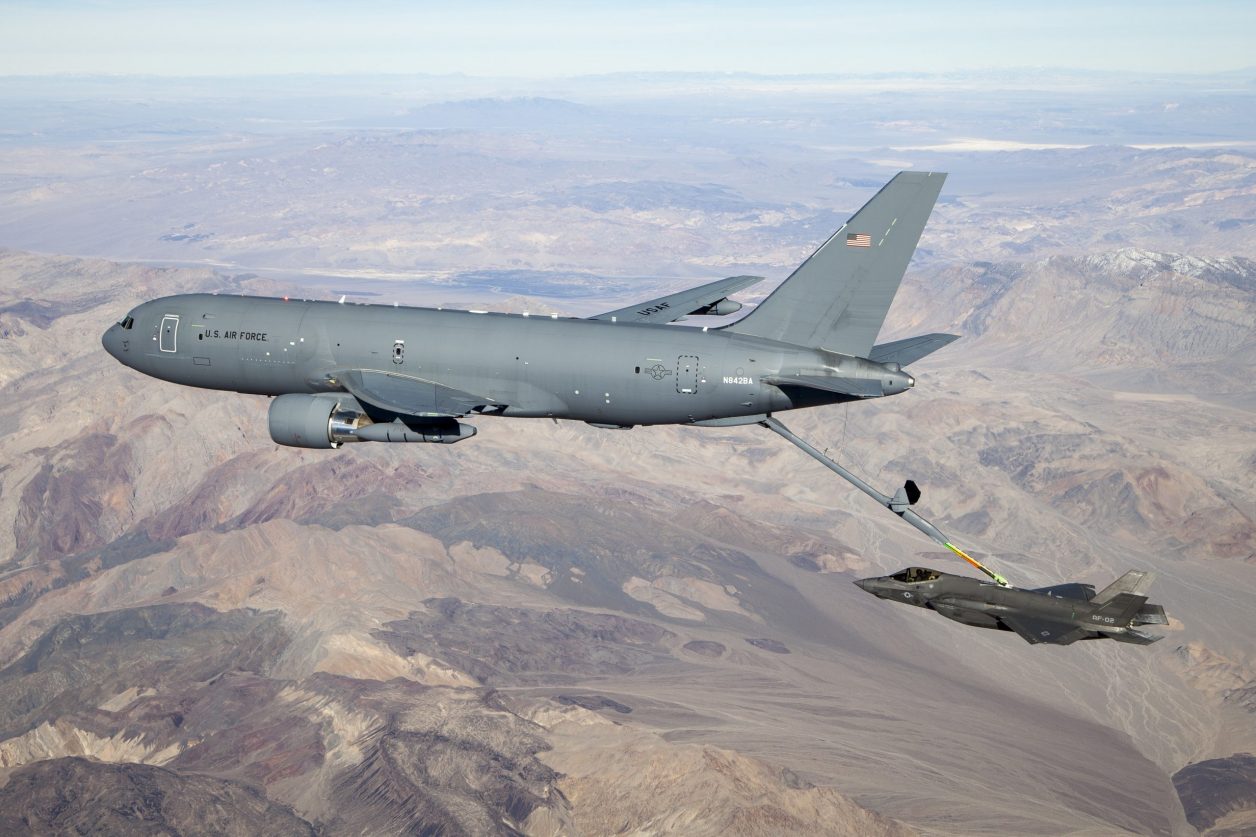
These include aging but battle-proven KC-135 Stratotankers; the US has 396 of these in service.
Notably, the US lost a KC-135 Stratotanker in western Iraq on March 12 during Operation Epic Fury, killing all six crew members on board.
The US also has over 100 newer KC-46 Pegasus platforms. The USAF has ordered 263 KC-46 Pegasus aircraft in total to replace the aging KC-135 Stratotankers.
The modern KC-46A is also equipped with many more self-defense systems, enhanced situational awareness, and sensors, making it more survivable than legacy KC-135s. This allows them to operate closer to the front line in somewhat contested environments.
Besides, the USAF fields KC-130 variants for Marine Corps operations. The KC-130 is a modified tanker version of the Lockheed Martin C-130/C-130J Hercules/Super Hercules family of tactical turboprop airlifters.
The USAF fleet enables everything from long-range bomber strikes to fighter deployments halfway across the globe.
The USAF is mandated to maintain a minimum strength of 502 tankers at all times.
This capability has been a crucial part of American power projection. In the aftermath of the September 11 attacks on New York and Washington, for instance, aerial refueling allowed B-2 bombers based in the continental US to fly missions over Afghanistan without having to land once – a 44-hour bombing run.
Similarly, during Operation Midnight Hammer in June last year, the seven USAF B-2 bombers flew non-stop for 37 hours to bomb Iranian nuclear sites, thanks only to aerial refueling.
Surprisingly, the next country with the second-largest tanker fleet is not Russia, China, or even India, but Saudi Arabia.
Riyadh has a fleet of 22 aerial refueling tankers.
Next on the list is Russia, with a fleet of 18 aerial refueling tankers.
Russia has 18 Il-78 Midas tankers (including Il-78M variants). These are primarily tasked with extending the range of Tu-95 and Tu-160 strategic bombers for Arctic patrols and nuclear deterrence.
The Russian fleet is hampered by maintenance woes, sanctions-induced parts shortages, and limited production.
These limited numbers of tankers are not sufficient for sustained expeditionary campaigns or global outreach.
China, which has in recent years bridged the technological and numerical gap with the US military in many critical areas, such as naval fleet strength and the fielding of two fifth-generation stealth aircraft, has a fleet of just 9 aerial refueling tankers.
Now consider this: the US has 589 more tankers than Russia and 598 more aerial refueling tankers than China, two countries considered near-peer military competitors of the US.
However, China has some dual-use aircraft, such as heavy-lift and transport aircraft that can also serve as tankers. This will bring China’s tanker fleet to 35 aircraft, a mix of old Russian planes (IL-78 Midas), converted H-6 bombers (H-6U, H-6DU), and newer tankers derived from its Y-20 transport plane (YY-20A).
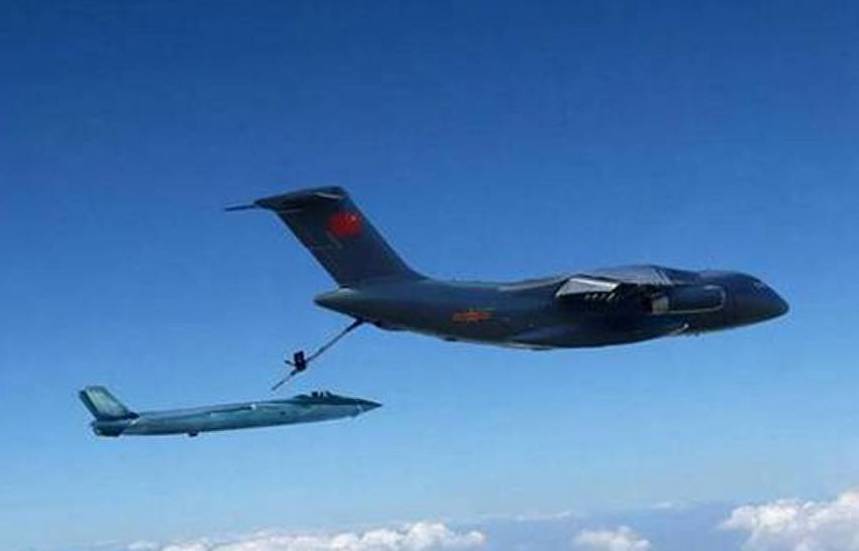
China has historically relied on ex-Soviet Il-78s for tanker roles; however, Beijing is developing the Y-20U (a Y-20 tanker variant). Reportedly, up to 30 Y-20 tankers can enter the PLA Air Force by the end of this year.
The Y-20 is officially called “Kunpeng” after a mythical Chinese bird and nicknamed “Chubby Girl” for its appearance.
These tankers are capable of transferring up to 75 tons of fuel.
The Y-20’s superior endurance and greater fuel transfer capability will extend the PLA Air Force’s range beyond the first island chain, a string of islands encumbering the seas around China.
The first island chain comprises islands such as Taiwan, Okinawa, and the Philippines, which China considers its first line of defense. The “second island chain” in the Western Pacific runs from south-eastern Japan to Guam and south to Indonesia.
For the PLA to truly transform itself into a “world-class” military, as Xi Jinping has repeatedly stated is the intention, the PLAAF’s tanker capability must more closely match that of the US.
The US advantage in tanker fleet becomes even more decisive if it combines its tanker assets with those of its allies. France, for instance, a NATO member and US ally, has a fleet of 15 aerial refueling tankers.
Israel, the strongest US ally in the Middle East, has 13 aerial refueling tankers.
Singapore, another US ally in the South China Sea, has 11 aerial refueling tankers.
Japan, which hosts US military bases and is a critical US ally in the Pacific, has 10 aerial refueling tankers.
The UK, another NATO member, has 9 aerial refueling tankers, the same as China. Italy, also a NATO member, has 8 aerial refueling tankers.
The Indian Air Force (IAF) operates just six tankers, acquired in the early 2000s.
The rest of the world collectively operates around 80 tankers.
According to these numbers, the United States accounts for roughly 75% of the world’s military tanker fleet.
However, these numbers tell only half the story.
Measuring tanker fleet strength is not merely counting heads. Too many nuances complicate any simplistic reading of tanker aircraft numbers.
These include: Contractor-operated refueling aircraft, multi-role aircraft with secondary tanker capability, “Buddy” refueling by combat aircraft, compatibility of different refueling systems (Probe-and-drogue vs. flying boom), and varying doctrines on how tankers are actually used.
However, even with all these caveats, the situation remains the same. When it comes to the tanker fleet, nothing matches the USAF’s strength.
The USAF’s unmatched tanker strength allows it to project force anywhere in the world. The USAF is, without doubt, the only air force in the world capable of sustaining large-scale, long-range air operations at a global level.
To match the USAF’s capabilities, Beijing must field an equally large and capable tanker fleet.
- Sumit Ahlawat has over a decade of experience in news media. He has worked with Press Trust of India, Times Now, Zee News, Economic Times, and Microsoft News. He holds a Master’s Degree in International Media and Modern History from the University of Sheffield, UK.
- VIEWS PERSONAL OF THE AUTHOR.
- He can be reached at ahlawat.sumit85 (at) gmail.com