ARTICLE REPUBLISHED
As the US-imposed naval blockade of Iran enters full force, security experts are divided on how successful the blockade will be in forcing Tehran to the negotiating table.
However, if history is anything to go by, the naval blockade has the potential not only to put pressure on Tehran but also to effect regime change in the country.
Nearly seven decades ago, in 1952, the US and the UK imposed a naval blockade of Iran, which took Iranian oil out of the global crude market.
Apparently, the naval and economic blockade of Iran was so successful that it ended with a CIA-sponsored regime change in Tehran and opened Iranian oil resources once again for Western oil companies.
According to the US Central Command (CENTCOM), the current naval blockade applies to all Iranian Gulf ports and coastal areas.
“The blockade will be enforced impartially against vessels of all nations entering or departing Iranian ports and coastal areas, including all Iranian ports on the Arabian Gulf and Gulf of Oman,” CENTCOM said in a statement.
— U.S. Central Command (@CENTCOM) April 12, 2026
“CENTCOM forces will not impede freedom of navigation for vessels transiting the Strait of Hormuz to and from non-Iranian ports,” it added.
The U.S. military sent the following message to seafarers providing more details of the blockade: “Any vessel entering or departing the blockaded area without authorization is subject to interception, diversion, and capture.”
According to the Wall Street Journal, currently, “more than 15 U.S. warships” are involved in the Iranian naval blockade.
Meanwhile, reporting on the status of the blockade, maritime data and intelligence company Lloyd’s List Intelligence said “all traffic” through the strait had indeed stopped after Trump announced the blockade.
However, the New York Times reported that ship-tracking data showed several vessels, including some docked at Iranian ports, had moved through the strait despite the naval blockade. Among them were at least two Chinese ships.
Amid the blockade, security analysts are divided on how successful the naval blockade could be in pressuring Tehran to return to the negotiating table.
Dana Stroul, a former senior Pentagon official, now at The Washington Institute for Near East Policy, told Reuters, “Trump wants a quick fix. The reality is that this mission is difficult to execute alone and is likely unsustainable over the medium- to long-term… Over the long run, this will need to be resolved through diplomacy and international political will.”
Similarly, Sidharth Kaushal, a naval power expert at the Royal United Services Institute (RUSI), said that the naval blockade “will prove difficult for the U.S. to enforce.”
However, this is not the first US-imposed naval blockade of Iran.
Nearly seven decades ago, the US, along with the UK, enforced the first naval blockade of Iran. Incidentally, that time the US and the UK were wildly successful in their objectives.
The blockade, coupled with the total economic boycott of Iranian oil, starved Tehran of oil revenues, led to mass lay-offs in the oil sector, triggered an economic recession in the country, and ended with a coup in Tehran, which paved the way for the return of the Shah of Iran, Mohammad Reza Pahlavi, and opened Iran’s lucrative oil sector once again for Western companies.
In fact, the 1953 CIA-sponsored Iranian coup was also the cause for the Anglo-Iranian oil company becoming British Petroleum (BP) and the US getting a 40% share in the oil company.
However, the US intervention also became one of the trigger points for the 1979 Islamic revolution in Iran and decades of anti-Americanism in the country.

Operation Ajax
In 1908, oil was discovered in Southwestern Iran by geologist George Bernard Reynolds. This was the first major oil discovery in the Middle East.
In 1909, the Anglo-Persian Oil Company (APOC) was formed in London as a subsidiary of Burmah Oil to develop the oilfields. The Abadan refinery (later the world’s largest) also began construction that year.
By 1915, the Abadan refinery was producing oil at a massive scale. The British government bought a majority stake in APOC.
In 1935, when Persia was officially renamed Iran, the company changed its name to the Anglo-Iranian Oil Company (AIOC). In April 1951, Mohammad Mosaddegh became the Prime Minister of Iran. At the time, the country was going through a severe economic crisis.
Mossadeq’s immediate concern was the struggle for control of the Anglo-Iranian Oil Company (AIOC). By 1950, the British oil concession in Iran, which the Shah had renewed in 1949, had become a sore point in relations between the two countries.
In 1951, just three days after becoming Prime Minister, Mossadeq nationalized Iran’s oil industry and created the National Iranian Oil Company (NIOC).
AIOC’s nationalization brought Iran into immediate conflict with Britain. The British government owned 51% of AIOC’s stock and did not intend to allow Mossadeq to nationalize its assets without adequate compensation, as required under international law.
When it seemed clear that Tehran had no intention of compensating London for AIOC’s assets, the British mounted a multi-pronged effort to reassert control over the company.
In September 1951, Britain imposed an embargo on shipments of steel, sugar, iron, and oil—processing equipment to Iran—that is, on almost anything the Iranians could exchange for dollars.
This embargo led to a gradual chokehold on the Iranian oil trade. Simultaneously, Britain organized military drills in the Persian Gulf to put military pressure on Mossadeq.
Britain also considered a covert operation to overthrow Mossadeq. However, London realized that it could not do so without Washington’s support.
In 1952, Mossadeq opened a new front against the king, Mohammad Reza, curtailing his powers.
The US needed British support in the fight against the Soviet Union, to stop the spread of Communism, in the Korean War, and to strengthen NATO, which was just taking shape.
To enforce a regime change in Iran, the US and the UK launched Operation Ajax.
CIA and MI-6 funded agents fomented unrest among the masses, the Iranian Army, religious leaders, and Mossadeq’s opponents.
Simultaneously, the UK and the US organized a total naval and economic blockade of Iran. The sustained economic blockade brought Iran’s oil industry to a standstill. Government’s revenues dropped, and there were mass lay-offs in the oil sector.
As unrest spread, the Shah fled Iran with his family.
On August 19, 1953, a faction of the Iranian Army loyal to the Shah, the royalists and religious conservatives, fought pitched battles with the supporters of Mossadeq on the streets of Tehran.
Hundreds of people died in these clashes; however, the Army’s support for the Shah proved crucial. By the evening, Mossadeq had surrendered to the army. The coup was successful.
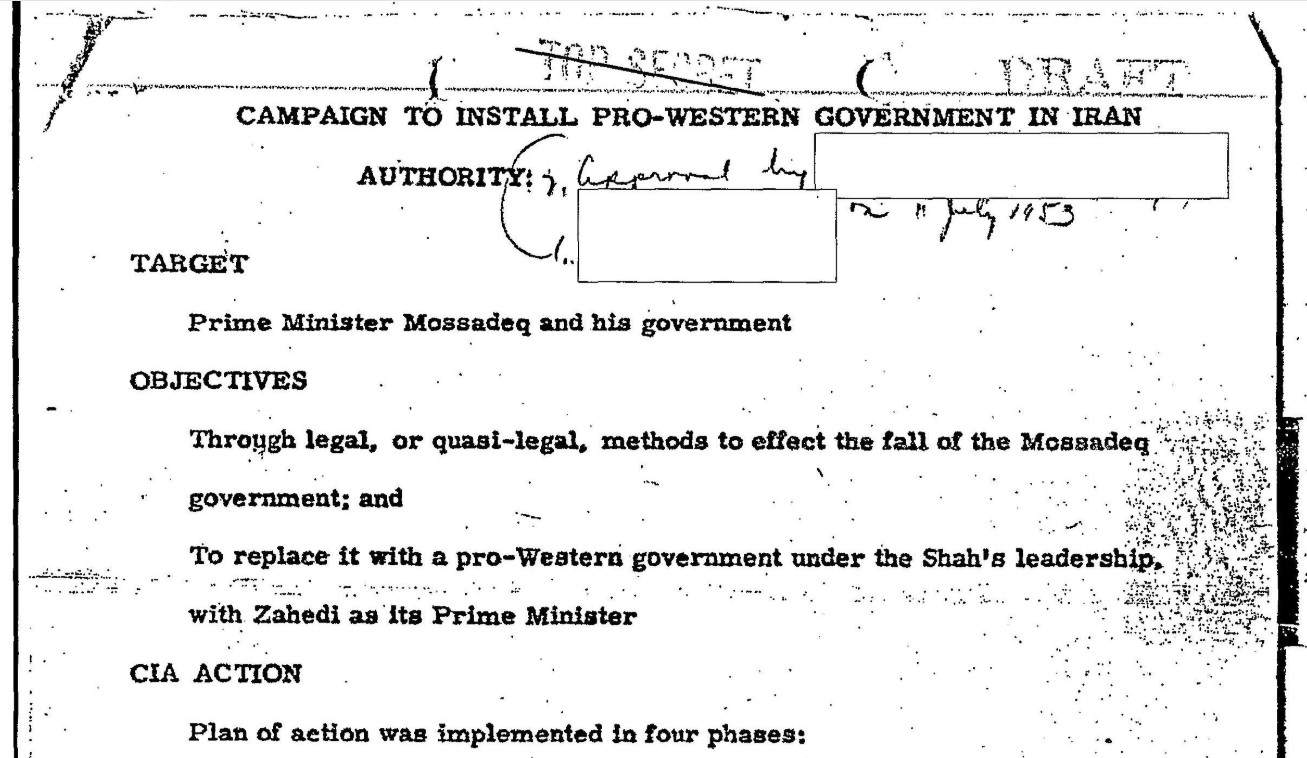
Initially, there was debate on the role of the CIA in the protests. However, in 2017, the CIA released documents revealing that the networks established by British intelligence services had been used to run a campaign of propaganda and paid-for protests, resulting in the rapid destabilization of the nation.
The Shah, who was staying in Italy, returned to Tehran and assumed power once again.
Mosaddegh was arrested, tried, and originally sentenced to death. But on the Shah’s personal orders, his sentence was commuted to three years’ solitary confinement in a military prison, followed by house arrest until his death.
Following the coup, the Shah ordered the end of the AIOC’s monopoly on Iranian oil. Iranian oil fields were opened for five American oil companies. According to documents released by the CIA years later, Operation Ajax was sanctioned by President Eisenhower himself.
In 1954, a new international oil consortium agreement was signed, under which the former AIOC was renamed to The British Petroleum Company (BP).
The UK retained 40% stake in the new company, whereas five major American oil companies (Standard Oil of New Jersey/Exxon, Socony-Vacuum/Mobil, Standard Oil of California, Texaco, and Gulf Oil) together received 40% shares in BP.
The remaining 20% was split between Royal Dutch/Shell (14%) and the French Compagnie Française des Pétroles (Total, 6%).
Thus, the Iranian oil resources were once again opened for Western companies.
This arrangement lasted until the 1979 Iranian Islamic Revolution.
Therefore, the 1952 naval and economic blockade of Iran was wildly successful.
However, this time the situation is entirely different.
Firstly, the UK has refused to participate in the naval blockade.
Secondly, Iran has substantial military options at its disposal, as it has already shown during the war with the US and Israel.
Thirdly, Iran is receiving active diplomatic and economic support from China and Russia.
Therefore, the US can not hope to replicate its 1952 success by imposing a naval blockade of Iran.
- Sumit Ahlawat has over a decade of experience in news media. He has worked with Press Trust of India, Times Now, Zee News, Economic Times, and Microsoft News. He holds a Master’s Degree in International Media and Modern History from the University of Sheffield, UK.
- THIS IS AN OPINION ARTICLE. VIEWS PERSONAL OF THE AUTHOR
- He can be reached at ahlawat.sumit85 (at) gmail.com