Two E/A-18G Growler Electronic Attack fighter jets collided midair during a demonstration in Idaho on Sunday, with all four crew safely ejecting from the aircraft.
A statement posted to the Gunfighter Skies Air Show’s website confirmed “an aircraft incident has occurred at Mountain Home Air Force Base” about “two miles northwest of the base.”
“Emergency responders are on the scene, an investigation is underway, and more details will be released as they become available,” the statement said.
Dramatic video of the mishap captured one EA-18G Growler closing in from behind before slamming into the lead aircraft, its nose striking the rear from above. The two jets became entangled, tumbling nose-up then nose-down in a violent spin before plunging toward the ground. Moments later, four small explosions marked the ejection seats firing, sending all four crew members clear of the falling aircraft.
The Idaho Statesman reported the air show, where aircraft perform tricks and flyovers for an audience, was the first such event since 2018, when a hang glider pilot died in an accident.
Footage of the mid air collision between a pair of Navy Super Hornets/Growlers during the Gunfighter Skies Air Show at Mountain Home Air Force Base moments ago. pic.twitter.com/yQqPavmSWk
— OSINTtechnical (@Osinttechnical) May 17, 2026
Commander Amelia Umayam, a spokesperson for the Naval Air Forces US Pacific Fleet, told KOMO that the E/A-18-G Growler jets are based in Whidbey Island, Washington. The crash led to the cancellation of the air show and a lockdown on the base as emergency responders secured the scene and began an investigation.
Umayam released the statement: “On May 17, 2026, two U.S. Navy EA-18 G assigned to Electronic Attack Squadron (VAQ) 129 from Whidbey Island, Washington, collided in mid-air while performing an aerial demonstration involving four air crew for the Mountain Home Air Force Base Gunfighter Skies Air Show, near Mountain Home Air Force Base at about 12:10 p.m. MDT.
Boeing EA-18G Growler
The Growler is a US Navy carrier-based electronic warfare aircraft, a specialized version of the Boeing F/A-18F Super Hornet. It provides tactical jamming and electronic protection to US military forces and allies worldwide.
The Growler shares more than 90% of its characteristics with the standard Super Hornet. The E/A-18G replaced the Northrop Grumman EA-6B Prowlers in service with the US Navy.
The E/A-18G Growler is considered among the most advanced airborne electronic attack platforms and is the only one still in production today. Industry and the US Navy continue to invest in advanced Growler capabilities to ensure it protects all strike aircraft during high-threat missions for decades to come.
The Growler brings fighter aircraft speed and maneuverability to an electronic attack aircraft. It also provides critical electronic intelligence, surveillance, and reconnaissance (ISR) data to other joint force aircraft.
The Growler’s ability to self-protect against adversarial aircraft includes using its two AIM-120 Advanced Medium-Range Air-to-Air Missiles (AMRAAM), enhanced radar image resolution, targeting and tracking range through its APG-79 Active Electronically Scanned Array (AESA) radar system, uninterrupted radio communications in a heavily jammed environment using its INCANS Interference Cancellation System, unequaled aircrew situational awareness and head-up control of aircraft targeting systems and sensors using its Joint Helmet-Mounted Cueing System, and its ability to locate, record, playback and digitally jam enemy communications over a broad frequency range using its ALQ-227 Communications Countermeasures Set.
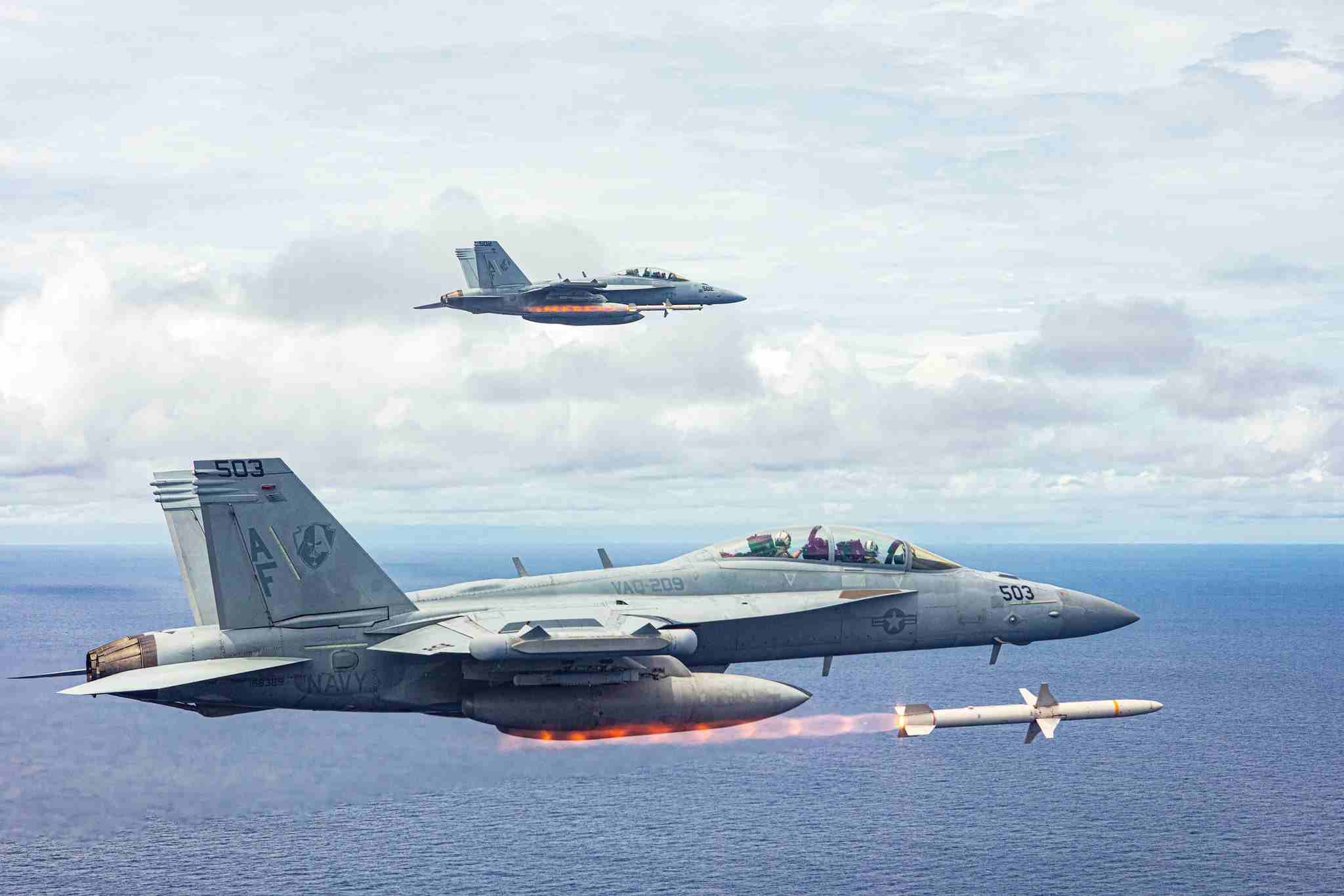
It provides advanced survivability and electronic protection for ground, air, and maritime combat forces with high reliability and lower operating costs. Two crew members are required to take on a much higher cockpit workload.
The aircraft has AN/ALQ-218 wideband receivers on the wingtips and ALQ-99 high and low-band tactical jamming pods. The two combined form a full-spectrum electronic warfare suite capable of detecting and jamming all known surface-to-air threats. Work is underway to develop pods to address emerging threats. The aircraft could even carry two AGM-88 HARM missiles instead of AMRAAM.
The Growler is the initial platform for the Next Generation Jammer (NGJ), which uses Active electronically scanned array (AESA) technology to focus jamming power exactly where needed. The NGJ was to be implemented on the F-35.
Three Growlers networked together can generate targeting tracks for hostile radio-frequency sources in real-time. Using faster data links, the Growler could use its EW pods to accurately locate signal sources.
In a group of three planes, when one detects a signal from a source such as a cell phone, the other two can also listen for the same signal. All three measure the time it takes for transmissions to travel from the source to each aircraft, enabling triangulation of the location to “a very, very small area”, IAF Veteran Air Marshal Ani Chopra (retired) explained in his article for EurAsian Times.
- By ET Online Desk
- Mail us at: editor (at) eurasiantimes.com