The Indian Army (IA) has reportedly initiated a procurement proposal worth around Rs 2,500 crore ($300 million) to induct 120-km strike-range Pinaka rockets. The proposal will be considered for approval by the Defence Acquisition Council (DAC) soon.
Jane’s Defense reported in January 2025, quoting a source at Munitions India Limited (MIL), that the Indian Army has given DRDO the go-ahead to develop advanced rockets for its Pinaka Multi‐Barrel Rocket Launcher System (MBRLS), with maximum strike ranges of 120 km and 300 km, respectively.
DRDO’s Armament Research and Development Establishment (ARDE) will develop the rockets, and MIL will manufacture them under a transfer of technology (ToT) agreement with the DRDO.
The Chief of the Army Staff (CAS), Upendra Dwivedi, during his annual press briefing, confirmed that the DRDO, which had developed Pinaka unguided rockets with an extended 45-km range, and Pinaka guided rockets with 75 km range, has now been tasked with further extending MBRLS rocket range, first to 120 km and then to 300 km.
He indicated that the Army would drop plans for other longer-range weapons if the DRDO could deliver longer-range Pinaka rockets.
General Dwivedi said, “As soon as we get longer ranges, we might drop plans for other alternate long-range weapons we are looking at and concentrate on it (Pinaka 3).”
The IA has also expressed interest in acquiring long-range kamikaze drones. It is likely that General Dwivedi was referring to them when he alluded to dropping other alternate long-range weapons.
Current Pinaka System
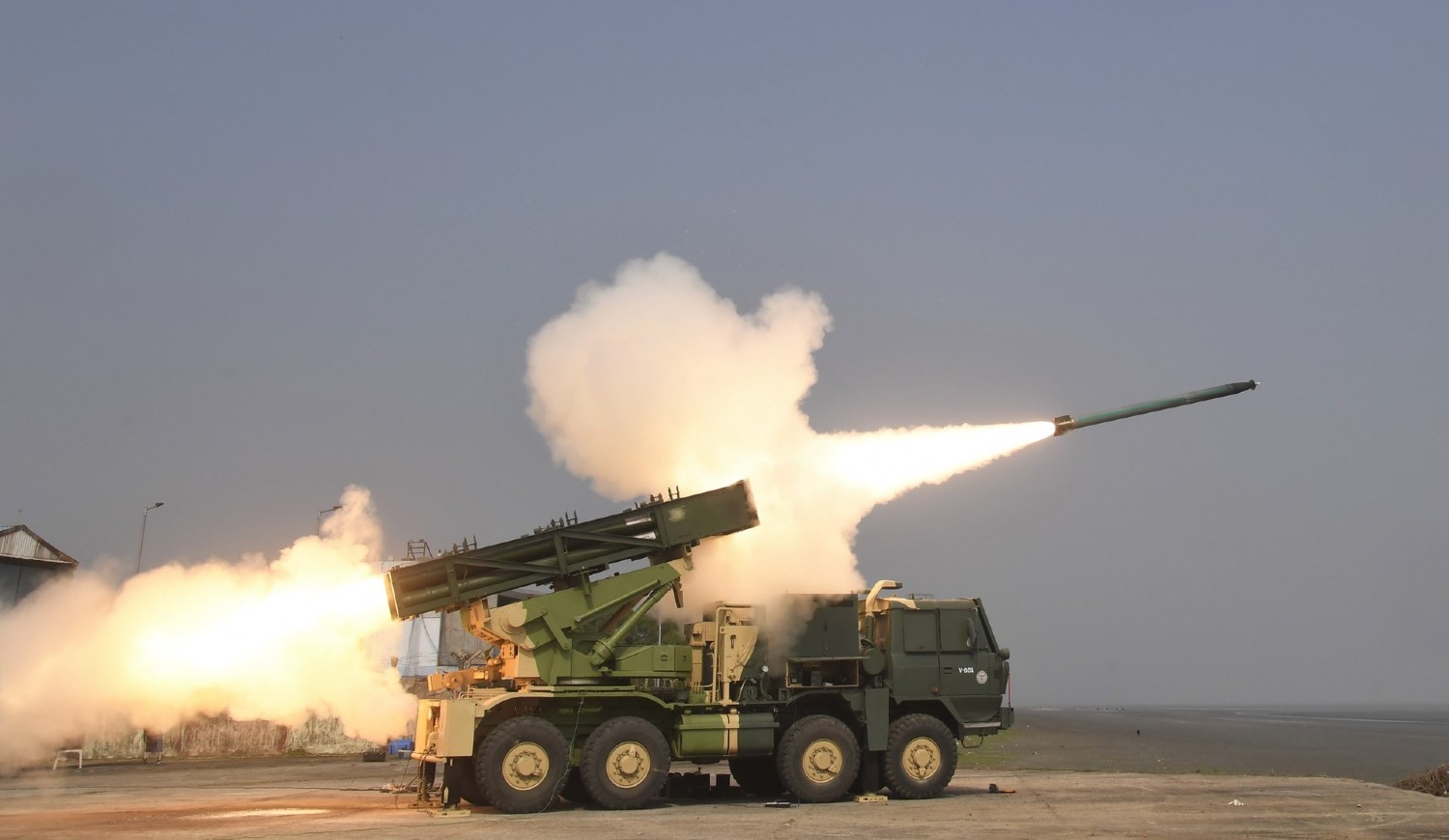
The most advanced Pinaka MBRLS variant currently operated by the Indian Army – Pinaka Mk. 2 Guided Pinaka Rocket System – can engage targets from 20 km to 80 km range with an accuracy of 30 m.
The Pinaks Mk.2 is a 214 mm calibre system. It can launch unguided rockets with a max range of either 40 km or 60 km, as well as Guided Pinka rockets with a max range of 80 km.
Guided Pinaka rockets, aka Enhanced Pinaka rockets, feature a 250 kg warhead, canard-based aerodynamic control, and guidance using a combination of Inertial Navigation System (INS) and Satellite Navigation (SATNAV).
The rocket’s SATNAV has been integrated with the Indian Regional Navigation Satellite System (IRNSS) – the Indian version of the US Global Positioning System (GPS).
With the help of trajectory lofting and aerodynamic glide provided by the canards, the Guided Pinaka rocket can achieve a range of 80 km.
The Guided Pinaka was developed jointly by ARDE Pune, RCI Hyderabad, and DRDL Hyderabad.
Pinaka Accuracy
DRDO claims that during trials, Guided Pinaka rockets have shown an accuracy of up to 10m.
The claimed accuracy and range for the Guided Pinaka put it in the league of the US Army’s M270 Multiple Launch Rocket System (M270 MLRS).
The proposed 120-km range Pinaka rockets will reportedly conform to the 214 calibre. The Pinaka system, capable of launching 120-km-range rockets, is referred to as Pinaka Mk. 3.
300-km Range Rocket Pinaka System
The proposed 300-km-range Pinaka rockets are expected to use a 300-mm calibre format to accommodate a larger propellant mass.
The IA already operates a 300 mm-caliber MLRS (Multiple Launch Rocket System), the BM-30 Smerch-M, acquired from Russia through a $500 million deal signed in the mid-2000s. These systems have a max range of 90 km.
Besides Smerch, Russia has a 120-km range 300mm MLRS known as Tornado-S, which employs precision-guided rockets that use a combination of strapdown inertial navigation systems (INS) and GLONASS satellite navigation for terminal guidance to achieve high accuracy.
Recent videos of the Tornado-S striking bridges suggest that it may have terminal guidance – optical or SALH.
Conclusion
Long-range rockets with 120 km ranges, such as the US M270 MLRS and the Russian Tornado-S, have proven highly effective for interdiction and area denial.
MLRS systems with 300 km range rockets, capable of striking airbases, industrial plants, and infrastructure deeper in the interior, have strategic capabilities.
However, there are challenges associated with developing long-range MLRS systems that the DRDO would need to adequately address during development.
These include:
1. Target detection and geo-location
2. Accurate and EW resilient guidance
3. Evasion of counter-battery fire
Target detection and location require persistent surveillance using drones and satellites. India’s Ministry of Defence would need to acquire them in larger numbers than currently available.
Long-range rockets must be able to accurately strike bridges and hardened shelters. Typically, this requires accuracies of less than 10 m CEP.
The combination of INS + SATNAV-based terminal guidance is usually not enough. Rockets need to be equipped with semi-active laser homing with an overhead drone marking the strike point with a laser. Another option is optical terminal guidance.
Adversary EW systems can compromise the accuracy of both SATNAV and INS. The INS system on the rockets needs to be hardened against EW, and SATNAV needs to be made more resilient by using multiple antennas.
Finally, to evade counter-battery fire, the MLRS systems need to be highly agile and capable of rapidly changing location after launching rockets. The IA would need high-mobility vehicles, such as the one used with the US ATACMS system.
The IA’s move to acquire longer-range MLRS systems needs to be commended. Indigenous manufacture of MLRS systems and rockets will ensure that IA can sustain its operational capabilities during a prolonged conflict. Also, it would benefit from technological advances through periodic upgrades.
In the future, MLRS systems are expected to be able to launch rockets that deploy reconnaissance drones for laser target marking, enabling semi-active laser homing (SALH) guidance.
- Vijainder K Thakur is a retired IAF Jaguar pilot, author, software architect, entrepreneur, and military analyst.
- This is an Opinion Article. Views personal of the Author
- Follow the author @vkthakur