As it awaits Rafale-M jets from France, the Indian Navy has issued an Expression of Interest (EoI) to defense firms for the design, development, and production of indigenous 80mm air-to-ground rockets for its MiG-29K carrier-based fighters, in a fresh push to reduce dependence on foreign munitions amid global supply chain uncertainties.
A workhorse of the Indian Navy’s carrier wings, the MiG-29K is a multirole fighter that carries a diverse mix of Russian, indigenous, Israeli, and American-origin weapons. However, in recent years, the service has been making concerted efforts to indigenize its weapons suite in line with the country’s flagship “Aatmanirbhar Bharat” initiative.
To that end, the Naval Armament Inspectorate of the Indian Navy recently issued an Expression of Interest (EoI) inviting local defense companies to participate in the design, development, and production of 80mm rockets for the MiG-29K/KUB fighters, as reported by Indian media. The move is aimed at bolstering the MiG-29 K’s overall combat capability whilst also boosting indigenization.
If there is one lesson the Indian Navy may have learned from recent global wars, it is that high-tempo conflicts can rapidly deplete exporting countries’ stockpiles and unpredictably pause arms shipments, impairing an importing country’s ability to fight.
A fighter jet is only as good as the weapons it can fire to neutralize hostile targets, and inadequate ammunition supplies can drastically lower a fighter’s effectiveness in combat. Therefore, by acquiring rockets from Indian companies, the Navy hopes to bolster India’s defense sector and guarantee a more reliable supply chain.
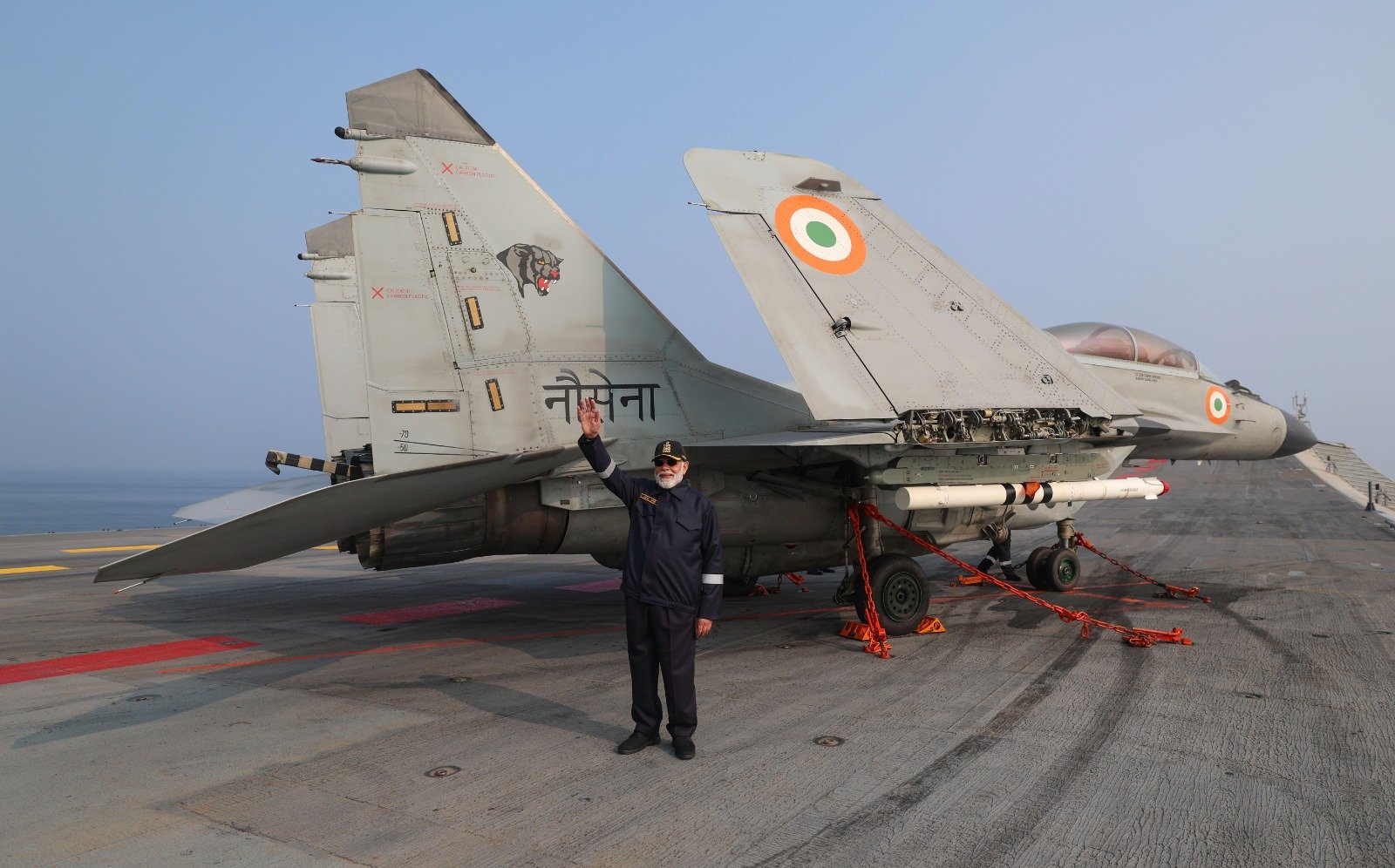
As of now, the Indian Navy is the largest operator of the MiG-29K outside Russia and, arguably, the largest single operator of the type overall. Additionally, the service is set to become the first and only international operator of the French Rafale-Marine, with an agreement that India signed in 2025. The carrier-borne Rafales will replace the MiG-29Ks.
What Does The EoI Say About Local 80mm Rockets?
The EoI issued lays out the specific technical and operational requirements for the indigenous rocket. It states that the rocket should be roughly 1.54 meters long, weigh about 11.3 kilograms, and reach a speed of 600 meters per second. The weapon must have a minimum 15-year service life and operate over a temperature range of -60 to +60 degrees Celsius, allowing deployment in a variety of geographical settings, from tropical marine regions to high-altitude, freezing conditions. The rocket must have an effective range of 1.3 to 4 kilometers.
The EoI further states that when detonated, the 0.9-kg explosive payload should be able to pierce 400 mm of armor at a straight angle and produce at least 400 metal fragments, each weighing around 3 grams.
The Navy states that the rocket be licensed for use from aircraft flying up to 17,500 meters in altitude and completely sealed for missions up to 20,000 meters. The Navy intends to purchase 2,400 practice rounds and 273 actual rockets once a prototype is successfully developed and tested. It has established 2026-2027 as a provisional induction schedule.
To facilitate pilot training, the Navy has also requested a practice version of the rocket with the same flying characteristics but without a warhead.
The EoI asserts that there is currently no domestic source for the ammunition and that the Navy’s current stock of 80-mm rockets has been acquired from foreign original equipment manufacturers (OEMs). However, the requirement states that there should be no reliance on foreign OEMs for the development of this 80mm munition and that all rocket subassemblies must also be manufactured domestically.
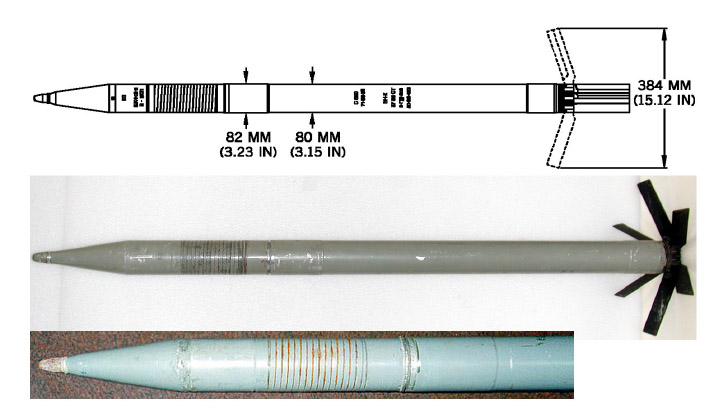
Moreover, it states emphatically that companies interested in the program must have the financial resources, testing and proof-firing facilities, and research and development capabilities needed to design and develop military-grade aero and ground-based rockets.
It is important to understand why the Navy is placing such an emphasis on 80mm rockets, even though it has some of the world’s most killer missiles in its inventory.
Unlike sophisticated missiles, the 80mm rockets are small, unguided air-to-ground rockets fired from pods beneath a fighter’s wings. They typically have a diameter of about 80 millimeters and are intended to attack ground targets, such as enemy troop concentrations, bunkers, lightly armored vehicles, radar stations, and logistics hubs.
These are formidable assets because they can carry different warheads depending on the mission, such as high-explosive warheads for attacking troops, light vehicles, and buildings; anti-armor warheads for engaging armored vehicles; and smoke warheads for screening or marking targets.
Unlike advanced guided missiles that locate targets using GPS, radar, or infrared seekers, these 80mm rockets depend on the pilot’s and firing strategy and could be very useful in close combat. Moreover, they are much cheaper than guided missiles and can be used against targets that do not justify the expense of a sophisticated missile.
The 80mm rockets can be carried by the aircraft in greater numbers than sophisticated missiles, and the MiG-29K can launch many rockets in a single sortie. This is significant because aircraft carriers are expected to continue operations for extended periods, often far from shore-based logistics networks, making readily available, easily transportable 80mm rockets a formidable weapon.
Indian Navy Operates Foreign Fighter Jets
The Russian-origin twin-engine MiG-29K/KUB aircraft are the backbone of the air wings aboard aircraft carriers INS Vikramaditya and INS Vikrant.
Designed for air superiority, precision strikes, and anti-ship/anti-submarine warfare, the MiG-29K enables Indian aircraft carriers to project power, defend the carrier battle group (CBG), and engage diverse threats. The MiG-29K’s ability to carry up to 5,500 kilograms of ordnance and operate at a combat radius of 700-900 kilometers extends the carrier’s strike range, allowing it to target threats far from the carrier group.
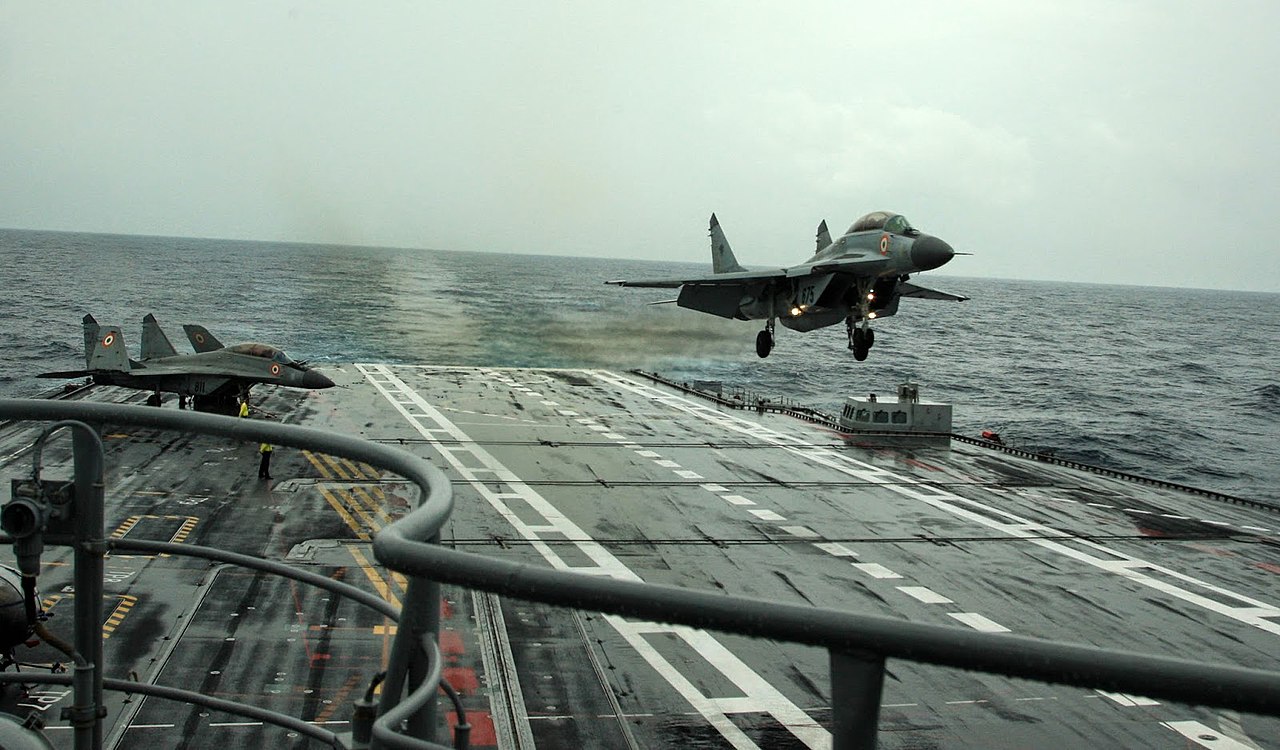
The aircraft’s thrust-vectoring engines and robust design allow it to take off and land on the carrier’s deck, enabling rapid deployment in combat scenarios. In fact, during the 2025 India-Pakistan conflict, the MiG-29Ks on Vikrant were positioned to strike targets such as Karachi, underscoring their role in deterrence and power projection in the Arabian Sea.
While the aircraft entered service with the Indian Navy in 2010 and has experienced a host of problems, such as engine issues, low serviceability, and structural defects, it is expected to remain operational for several years, at least until the Rafale-M starts arriving.
As previously reported by EurAsian Times, Dassault Aviation’s Rafale-M (Marine) edged out Boeing’s F/A-18E/F Super Hornets for the Indian Navy contract.
The Indian Navy chose Rafales due to their compatibility with the Rafales of the Indian Air Force (IAF). Due to the aircraft’s “buddy-buddy” aerial refueling capability, interoperability will benefit both the Indian Navy and the IAF. The fighters can stay in the air longer because one jet with a refueling pod can serve as a fuel tanker for another, which may be incredibly useful during combat.
The Indian Navy has ordered four twin-seater variants of the aircraft for training purposes, and deliveries are expected to begin in 2028. It is pertinent to note that India ordered only 26 Rafale-M jets because it treats the acquisition as a stopgap until the indigenous TEDBF is ready.
The Twin Engine Deck-Based Fighter program, led by the Aeronautical Development Agency (ADA) with Hindustan Aeronautics Limited (HAL) as the manufacturer, remains active, and an updated model was displayed at Aero India 2025, generating public interest. However, it has been grossly delayed, with cynics often predicting the project will never take off.
The Original targets of conducting the first flight by 2026 and production by 2031 have slipped significantly due to issues including design refinements, funding/approval delays, and the complexities of carrier-based development. According to revised estimates, the first flight is now expected around 2028–2030, and the aircraft is expected to enter service no sooner than 2038, with some critics calling it a very risky gamble.
According to reports, the focus is now on completing the Critical Design Review (CDR), with discussions ongoing between ADA and the Indian Navy.
Despite the delays and the criticism, the Indian Ministry of Defence and the Indian Navy remain committed to developing an indigenous carrier-based fighter. Although that dream is at least a decade away, the Navy is doing what it does best at the moment: indigenizing weapons for its imported jets.
- Contact the author at sakshi.tiwari13 (at) outlook.com
- Follow EurAsian Times on Google News