The F-35 Joint Program Office (JPO) has confirmed that the US Marine Corps (USMC) has accepted six F-35 fighters without their designated AN/APG-85 radars.
The Commander of the F-35 JPO, Marine Corps Lt. Gen. Gregory Masiello, told the Senate Armed Services Committee earlier this week that the service has accepted the six radarless F-35s, without disclosing the variant of the aircraft. The aircraft were apparently delivered with a ballast in place of radars in their nose cones.
The USMC primarily operates the F-35B, but it has also integrated the F-35C aircraft. Reports circulating in the media suggest that the USMC has received six radarless F-35Bs.
Notably, the JPO Commander’s confirmation comes months after reports surfaced in February 2026 that the US military was receiving F-35s without radars. At the time, reports went so far as to say that Lockheed Martin had been delivering F-35 fighters to the US military without radars since June 2025, although the allegations couldn’t be confirmed.
The AN/APG-85 radar is a key element of the F-35’s larger Block 4 upgrade package. The F-35s equipped with this advanced radar were expected to arrive in 2025, but its development and production have been delayed, and the first units are now projected to arrive no sooner than 2028.
According to the latest reports, the US Air Force and the US Navy will also have to follow the USMC’s lead and receive radarless F-35s later this year.
The APG-85—a Gallium Nitride-based AESA radar—is a significant upgrade over the older AN/APG-81 and is expected to deliver higher power output and improved performance, as earlier explained in detail by the EurAsian Times.
However, these enhancements also require significantly more electrical power and advanced cooling systems, which have purportedly created substantial technical hurdles. As a result of these challenges, the radar’s certification and testing timelines have expanded dramatically, far exceeding the rapid certification process used for the APG-81 that is currently mounted on all variants of the stealth fighter.
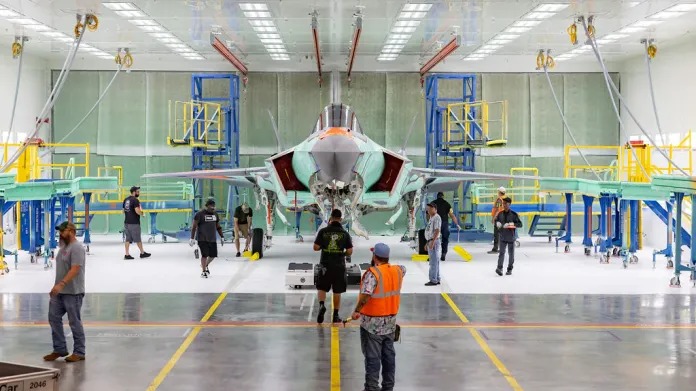
It is worth noting that the new F-35 fighters cannot be equipped with the APG-81 radar as a stopgap solution until the AN/APG-85 is read due to structural incompatibility. The F-35 jets from the Lot 17 production batch have been built with a modified nose bulkhead, and the internal structure has been optimized specifically for the APG-85’s size, mounting, and performance needs.
Therefore, in the absence of the designated radars, the jets just roll off the line with an empty nose section filled with ballast weights to achieve proper weight or balance and optimal flight characteristics.
The government purchases the radars separately; thus, Northrop Grumman, the radar manufacturer, is to blame for the delay rather than the prime contractor, Lockheed Martin, Air and Space Forces Magazine noted in a recent report.
However, the JPO has admitted that Pentagon, Lockheed Martin, and the services pursued an aggressive “highly concurrent” approach, ramping up aircraft production while simultaneously developing advanced Block 4 upgrades, including the APG-85. “This decision was made with full understanding of the risk of having production aircraft ready ahead of the capabilities,” a JPO Spokesperson told the Air and Space Forces Magazine.
The original goal of this concurrent approach was to deliver new F-35s to the fleet more quickly. However, delays in the AN/APG-85 radar mean these aircraft are being accepted without their primary sensor. While they can still be used for basic flight training, they lack the full combat capability needed for operational missions or advanced training.
Notably, “Block 4” is the most extensive modernization program for the F-35, representing a major evolution designed to maintain the jet’s technological edge against advancing threats, such as improved enemy air defenses, stealth aircraft, and electronic warfare systems, through the 2030s. However, the upgrade has been plagued by delays and cost overruns despite attempts to reorganize and expedite certain components.
The radarless deliveries of the world’s most expensive fighter jet do not augur well for the program’s reputation, which has taken a major hit amid recurrent delays in the TR3 (the core component of Block 4) upgrades and dismal combat readiness.
F-35 Readiness & Reputation Takes A Steep Dive
The tri-variant F-35’s “full mission capability rate”, which is the percentage of fighters that can complete all assigned missions, dropped from 38% in fiscal 2021 to 25% in FY25, states the report published by the Government Accountability Office (GAO), the US Congress watchdog, on June 11, 2026.
During the same period, the mission-capable rate of these stealth fighters, which is determined by an aircraft’s ability to perform one of its assigned roles, decreased from 67% to 44%. According to GAO, the US Air Force’s F-35A variant achieved the highest full mission-capable rate of the three F-35 variants, almost twice that of the Marine Corps F-35Bs and Navy F-35Cs, but it was still an abysmal 28.5%.
Although the F-35 Joint Program Office (JPO) has publicly disagreed with GAO’s approach to determining FMC after the June 11 report, it has not directly challenged the figures.
Moreover, the JPO officials informed auditors that the F-35 program and the US military prioritized acquiring more aircraft early in the program’s life cycle rather than developing crucial depot and repair capability, “historically underinvesting in sustainment.”
Additionally, they cautioned that the F-35’s already-poor sustainment structure will deteriorate as the fleet expands unless major adjustments are made.
The GAO report also noted that the Pentagon is seeking an additional $13.7 billion to boost sustainment of the Lockheed Martin F-35.
Furthermore, it highlighted that the F-35 Joint Program Office initiated a “Global Support Solution Reset” last year to improve the readiness of these jets. The additional billions of dollars in anticipated spending envisioned by the initiative would be distributed between FY26 through FY31, although the GAO discovered that “multiple risks” existed.
For example, the military services that fly the aircraft will have to pay for the plan. Although the Air Force informed GAO that it could “probably afford the costs associated with the GSS Reset” for its F-35As, representatives from the Navy and Marine Corps, which operate F-35Bs and F-35Cs, informed the watchdog that “competing priorities” may “limit the extent” of their respective resources.
Furthermore, GAO discovered that, with the exception of the Marine Corps F-35C, the projected yearly cost of operating the aircraft out in the mid-2030s—known as the program’s “steady state,” when fleets will be even larger and upgraded—increased over previous estimates, partly due to a higher number of anticipated flight hours. The financing for each service “may be expected to meet requirements,” it stated, but “long-term affordability will remain a challenge” and “potentially” jeopardize sustainability efforts.
It is hardly a secret that the F-35 program has been beset by readiness issues for years, with the F-35 Joint Program Office continually working to increase the availability rates, while GAO auditors have flagged ongoing concerns.
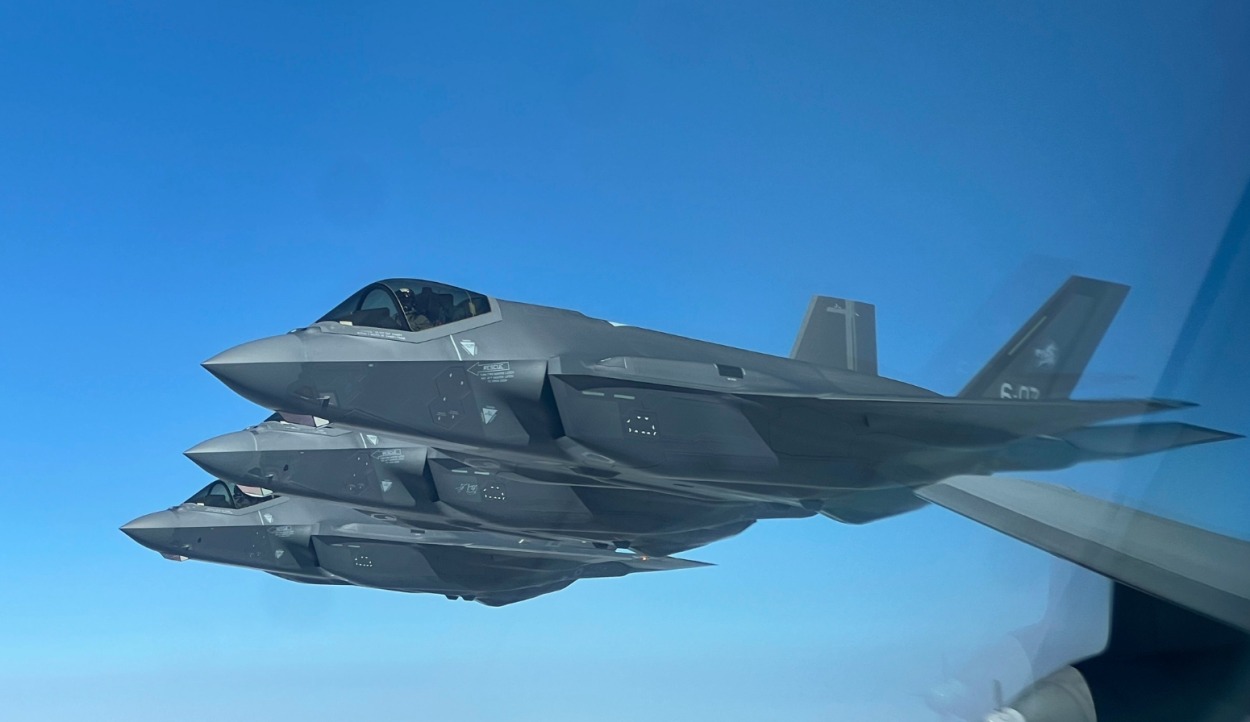
For example, a GAO report published in October 2024 found that readiness fell short of expectations even though the USAF increased operations and maintenance budgets over the last six years to maintain its F-35A aircraft. It noted that the USAF’s F-35A “did not meet its mission capable goals in any of the years we reviewed.” Meanwhile, the USMC and Navy’s F-35B and F-35C also lagged behind their objectives throughout the six years.
In September 2025, the GAO report stated that the F-35 was struggling with reliability, costs, and political baggage, and that nations across Europe and Asia were, as a result, turning to alternative, proven, battle-tested platforms.
The report stated that most F-35s delivered in 2023 by Lockheed Martin and engine maker Pratt & Whitney were late, arriving an average of 61 days behind schedule. The problem apparently worsened in 2024 as every F-35 delivered was late, with an average delay of 238 days. The delays were attributed to delays in the Technology Refresh 3 (TR-3) upgrade—a suite of hardware and software upgrades at the heart of the Block 4 modernization.
In fact, the delays in fielding TR-3 and, by extension, the Block 4 upgrades have persisted for years. This was also highlighted in last year’s FY2024 Annual Report for the Office of the Director, Operational Test & Evaluation (DOT&E). The report stated that the program showed no improvement in meeting schedule and performance timelines for developing and testing software designed to address deficiencies and add new capabilities.”
“DOT&E assesses that dedicated operational testing of these aircraft will not occur until mid to late FY26, approximately two years after the configuration began delivery to the field,” it stated. Additionally, it noted that “challenges added with the TR-3 avionics upgrades, both in development and testing, have caused additional delays to the planned schedules for delivering capabilities in Block 4 for the aircraft in the TR-2 configuration.”
Initially, all 66 capabilities under Block 4 were scheduled for full deployment by 2026. This timeline was later pushed to 2029. The Government Accountability Office report in September 2025 warned that Lockheed would not be able to deliver the Block 4 upgrade, even with only a “subset of the original 66 … capabilities,” by 2031.
This does not augur well for the US military and its allies operating the jet, particularly as adversaries such as China continually upgrade their offensive capabilities.
It is worth underlining that while upgrades are delayed, the cost of the F-35 has risen to unprecedented levels—its lifetime cost, including sustainment, exceeds $2 trillion.
And if that wasn’t enough, the unpredictability of the Trump administration has turned many prospective buyers of the aircraft, such as Canada, Portugal, and Spain, away.
It seems to be a long road for JPO and Lockheed to make amends and bring the situation under control, but for now, the radarless F-35s are bad news for the aircraft’s reputation.
- Contact the author at sakshi.tiwari13 (at) outlook.com
- Follow EurAsian Times on Google News