China appears to have reinvigorated its export campaign for the J-10 CE multi-role fighter, highlighting that the aircraft “shot down multiple hostile aircraft with zero losses” in the Indo-Pakistan conflict last year and subtly hinting that it may be poised for further upgrades.
On May 7, 2026, Chinese state media aired an interview with Zhang Heng, an engineer from the Aviation Industry Corporation of China’s (AVIC) Chengdu Aircraft Design and Research Institute, which produces the J-10C fighter. Zhang and his colleagues admitted to providing technical support to Pakistan during the war, including for the J-10CE, as EurAsian Times reported in detail.
As India and Pakistan mark the one-year anniversary of their intense hostilities that shook up the South Asian subcontinent, China appears to have adopted a two-pronged strategy.
First, the Chinese media has deployed all its media resources to amplify Pakistan’s claims about downing the IAF Rafales using PL-15 long-range missiles fired from the J-10C during the intense four-day conflict, in an attempt to promote its aircraft as a world-class military platform. For instance, Chinese journalist Li Zexin published a video of the J-10C on X, reiterating the claims for wider global consumption.
The video was originally posted to the Chinese internet by the aircraft’s manufacturer.
One year ago (May 7, 2025), Pakistan’s Chinese-made J-10CE shot down India’s Rafales.
On the first anniversary, the official Douyin account of J-10CE maker released the video:
"Take a close look at the J-10CE, our pride that rose to fame in the battle on this day last year!" pic.twitter.com/EzKQCMfOB5
— Li Zexin 李泽欣 (@XH_Lee23) May 8, 2026
For its part, India has not accepted any combat losses, although one Rafale allegedly crashed during the hostilities due to a technical malfunction, not a kinetic strike.
China’s second strategy appears to be to exploit the opportunity and push the aircraft into the export market. It has, in fact, linked the aircraft’s surge in popularity to the rising global interest in Chinese fighter jets, particularly the J-10CE, the export variant of the jet currently operated only by the Pakistan Air Force (PAF).
As part of that push, China’s English-language daily newspaper, China Daily, reported on May 8 that the J-10CE will be getting new upgrades to make the aircraft more lethal.
Chengdu Is Promoting The J-10C…Again
Citing Li Jun, a senior researcher at the Chengdu Aircraft Design and Research Institute and the principal designer of the J-10C, the report stated that AVIC would continue upgrading its advanced fighter jet to meet the requirements of foreign operators and prospective buyers.
He was speaking at a news meeting in Chengdu on May 8, which was organized as part of an open-house event at the institute and the Chengdu Aircraft Industry Group.
Li Jun said that the J-10CE will have a feasible service and market life of at least two to three decades, but there is still ample room for development. “We are willing to export the aircraft to any friendly country that identifies with our development path and whose procurement requirements comply with the relevant laws and regulations of our country.”
“The J-10CE can adapt to customers’ needs, including air superiority and strike against ground targets, and can be customized based on the environments and mission requirements of different users. We can also offer optional payload packages to clients,” Li said, positioning the aircraft as a viable option for countries looking to upgrade their fleet.
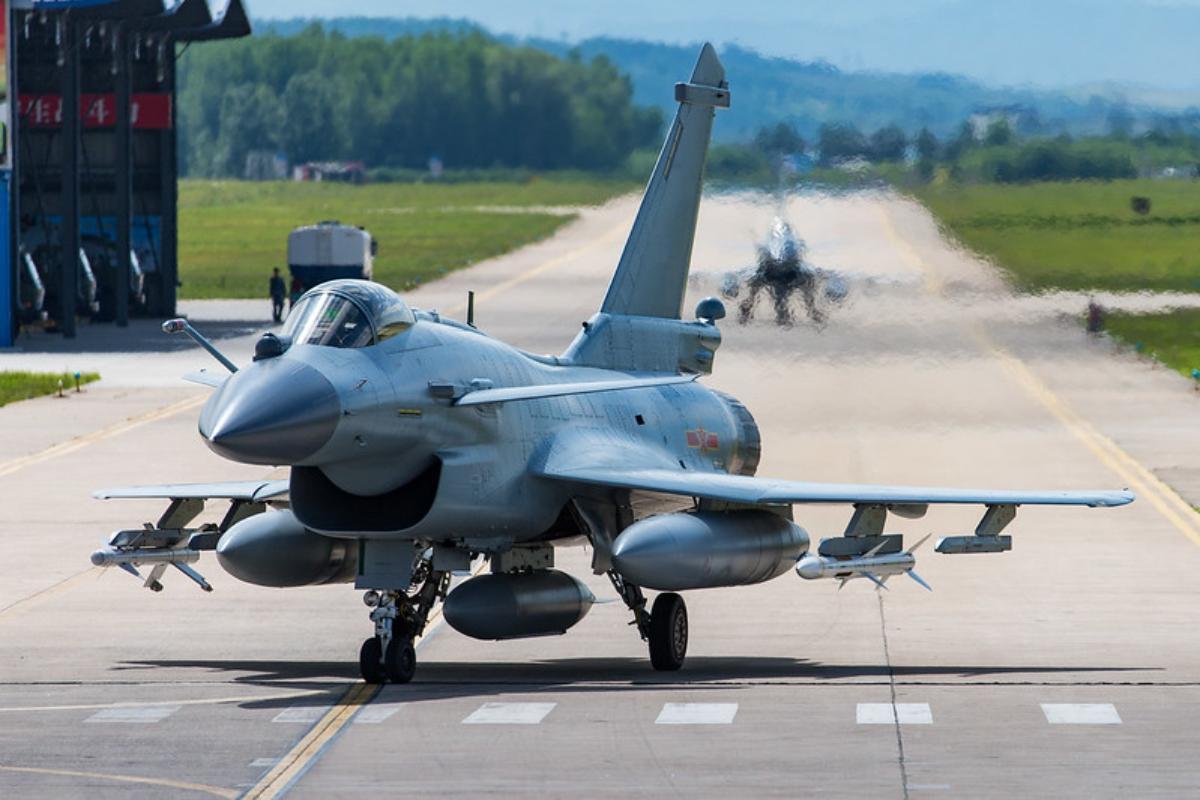
The principal designer claims that the J-10CE has achieved a generational upgrade to its combat system, making it a platform with all-around operational capability compared to its predecessors in the J-10 family, such as the J-10A and J-10B. According to Li, the J-10CE can carry dozens of weapons for air-to-air, air-to-ground, and air-to-sea combat operations, in contrast to the early J-10 versions, which could carry only about 10 types.
You can read a detailed EurAsian Times report on the evolution of China’s J-10-class combat aircraft here. The J-10C is classified as a 4.5th-generation aircraft by Beijing and is now powered by the indigenous WS-10B Taihang turbofan jet engine.
“The aircraft’s avionics system has received a generational upgrade. Its Active Electronically Scanned Array radar system can rapidly detect and track targets, far outperforming traditional mechanically scanned radars,” Li highlighted at the event. “The jet boasts powerful features, including network-centric cooperative combat, beyond visual range multiple target engagement in intense electromagnetic scenarios, and multimodal precision strikes. It can also prevail in medium- and low-altitude dogfights,” he added.
J-10C’s AESA radar offers superior multi-target tracking, jamming resistance, and range compared to earlier PESA systems.
Interestingly, Li heaped praise on the J-10C’s capabilities and adaptability, but stopped short of disclosing any planned upgrades by the institute.
However, open-source reports indicate that planned future enhancements may include GaN-based upgrades for greater power and efficiency.
According to some unverified reports, newer batches of the J-10C may incorporate radar-absorbing material (RAM) coatings, refined panel and edge treatments, and surface treatments to reduce radar cross-section (RCS) and make the aircraft harder to detect. Additionally, efforts may be underway to reduce infrared (IR) signature via engine nozzle or exhaust modifications and coatings.
However, the EurAsian Times cannot verify the claims.
Li underlined that AVIC doesn’t just deliver the J-10C but a full combat system with early warning, command and control, and electronic warfare.
Chinese analysts have frequently highlighted that the J-10C is evolving into a network-centric node, noting that recent People’s Liberation Army drills have demonstrated tighter integration with KJ-500 AEW&C aircraft, ground air defenses, and other platforms to share targeting data and enable cooperative engagement in contested environments.
It is likely that China is using real-time combat experience from the India-Pakistan war to further plan upgrades to its most potent 4+-generation combat aircraft.
Li also took the opportunity to emphasize the aircraft’s combat performance in the Indo-Pakistan conflict. “The J-10CE’s combat record of shooting down multiple hostile aircraft with zero losses in actual combat is a clear testament to the advantages of its platform and the systems behind it,” he was quoted as saying.
Meanwhile, Zhang Xuefeng, a military hardware observer and retired officer in the People’s Liberation Army Air Force (PLAAF), told China Daily that China’s cutting-edge fighter jets, exemplified by the J-10, are changing the global defense industry landscape.
“Chinese fighter jets offer high cost-effectiveness. Compared with Western fighter jets, which usually cost hundreds of millions of dollars each, our products are more affordable yet offer comparable performance. China can also tailor packages at different price points to buyer-specific circumstances, meeting the needs of various countries,” Zhang said.
It is pertinent to note that in an attempt to establish itself as the best non-Western exporter, China has positioned the 4.5th-generation J-10C as a better alternative to the US F-16, the European Eurofighter Typhoon, and the French Rafale. It has been trying to capitalize on the cost-competitiveness of its aircraft, with each unit costing around US$40–50 million compared to approximately $90-100 million for the above-listed Western jets.
Moreover, China has made concerted attempts to exploite three variables to promote its aircraft in the export market: the stringent export controls associated with US equipment that make it difficult to procure and independently operate the aircraft, Pakistan’s claims about superior combat performance against Rafales in real aerial combat, and the demise of Russia as the largest arms exporter due to its preoccupation with the Ukraine war and strained arms industry. The J-10C’s cost-effectiveness is the cherry on top.
It is worth noting that these claims have resulted in China’s AVIC Chengdu Aircraft Co’s revenue jumping 15.8% to 75.4 billion yuan ($11 billion) in 2025, and its profit rising 6.5% to 3.4 billion yuan, marking the company’s highest-ever increase, as recently reported by the EurAsian Times. In fact, there is fair reason to believe that the combat debut of Chinese weapons in last year’s wars may be driving profits.
As Lt Gen Rahul R. Singh, Deputy Chief of Indian Army Staff – Capability Development & Sustenance, said in July 2025, “China is using Pakistan like a live weapons laboratory… If you are to look at statistics, in the last five years, 81% of the military hardware that Pakistan is getting is all Chinese… China is able to test its weapons against other weapons.”
However, even though several nations, including Egypt, Iran, Uzbekistan, Indonesia, and Bangladesh, have shown active interest in the aircraft in recent times, all of those talks appear to be in abeyance in the absence of deals. Some recent reports, however, indicate that Pakistan may be considering adding more J-10CEs to its inventory.
Earlier, the French intelligence alleged that China had attempted to sabotage Rafale sales following the conflict between India and Pakistan. Similar accusations were made by the US-China Economic and Security Review Commission.
Despite that, the Rafale seems to have escaped this information warfare unscathed, with sustained buyer interest in the French aircraft. Meanwhile, China continues to run a J-10C export campaign that looks promising but has yet to generate actual sales.
- Contact the author at sakshi.tiwari13 (at) outlook.com
- Follow EurAsian Times on Google News