A Ukrainian political figure has claimed his country’s military successfully hit a Russian A-50 AEW&C (airborne early warning and control system) aircraft and an Ilyushin Il-22M radio relay aircraft over the Sea of Azov on Sunday.
If true, this would be a massive blow to Russia’s airborne operations, given its long-running weakness in having many such planes. Ukraine already claimed to have damaged an A-50 in February 2023 by releasing footage from a drone that landed on its radar disc and presumably exploded at the Machulishchy air base in Belarus.
Ukraine Celebrates A-50 Shootdown
“Around 9:00 pm, Ukrainian units fired at two Russian Air Force aircraft, namely the A-50 DRLO (airborne early warning) aircraft and the Il-22 bomber, which were over the waters of the Sea of Azov,” Deputy Chairman of the Committee on National Security, Defense, and Intelligence in the Verkhovna Rada, Yuriy Mysiagin, said on Telegram. It is to be noted that the description of the Il-22 as a “bomber” aircraft is incorrect.
The A-50 was downed while the Il-22 “was in the air and tried to reach the nearest airfield, but it disappeared from the radar after the descent began, in the Kerch area,” Mysiagin said. He subsequently updated his post to describe the Il-22M as “a radio-relay” plane.
“According to information from sources within the Ukrainian Defense Forces, it has been revealed that a military aircraft of the Russian Aerospace Forces, A-50, was shot down, and an Il-22M11 with registration number 75106 was damaged,” Ukraine’s RBC media outlet said.
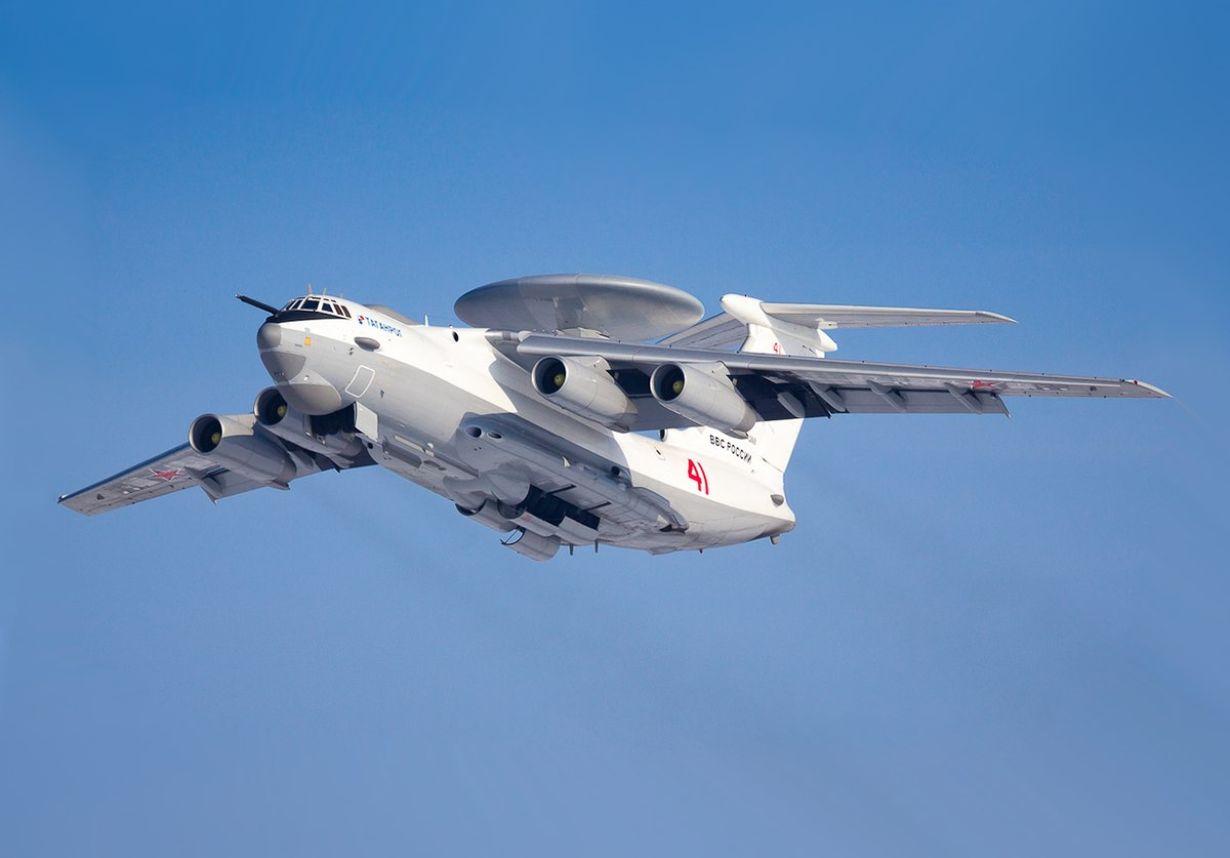
The A-50 “was downed immediately upon entering the patrol zone near Kyrylivka, around 9:10 pm to 9:15 pm on January 14. The A-50 disappeared from radars and ceased responding to tactical aviation requests. Subsequently, the pilot of a Russian Su-30 aircraft detected a fire and the descent of an unidentified airborne vehicle.”
The Il-22M11 was patrolling the Strilkove area and was eventually hit along the coast of the Azov Sea at around 9 pm on January 14. “After being hit, the aircraft intended to make an emergency landing in Anapa, requesting evacuation and calling for ambulance and firefighting services.”
The outlet also released supposed communications between the stricken Il-22M and the Anapa airport. The aircraft planned to land in Anapa and requested emergency services like an ambulance and a fire truck.
Possibly, the Il-22 crew communicated on open frequencies after being hit. The Ukrainian defense ministry later officially claimed the shootdown. “The Ukrainian Air Forces destroyed the enemy A-50 long-range radar detection and control aircraft, worth US$330 million, and the Il-22 enemy air control center.”
Russia Silent?
While the Russian Ministry of Defense (RuMoD) has not officially commented on the issue, leading pro-Russian Telegram channels seem to confirm the incident. “For the Il-18/22, the situation has already become clear; the plane has landed, but there are casualties,” the Colonelcassad Telegram channel wrote.
The A-50 is built upon the Ilyushin Il-76MD four-engine strategic transport plane by mounting a rotating radar disc on its upper fuselage. Like every Airborne Early Warning (AEW) aircraft, it provides long-range aerial surveillance against enemy fighters, cruise missiles, and command and control services to other fighter aircraft. These are the Su-35S or the Su-30 variants (SM and SM2), the mainstay of Russian air dominance operations.
A previous EurAsian Times report reported how the A-50 was also fused with the S-400 to shoot down Ukrainian jets, affecting the most extended possible range of the AD system. Another analysis noted the plane’s utility in shooting down the F-16 fighters Ukraine would soon receive by marrying the A-50 and the S-400 systems’ ultra-long-range (400-km) 40N6 missile.
However, Russian officials and defense commentators have pointed to the lack of AEW aircraft in its fleet as a glaring weakness in its capabilities. RIA Novosti reported Defense Minister Sergei Shoigu’s statement on July 3 last year, where he called for accelerating the induction of more such planes. Russia is assessed to be possessing ten such units.
“Two questions are submitted for consideration. The first concerns the fulfillment by the Taganrog Aviation Scientific and Technical Complex, named after GM Beriev, of the state contract to repair and modernize the A-50 aircraft.
“These flying radars are used in special military operations. Timely modernization of the fleet of these aviation complexes will significantly increase the effectiveness of groupings of troops in solving the tasks they face,” Shoigu said in a conference call with senior Russian military officials.
Why Does Russia Lack AEW&C?
The lack of a large, ready AEW&C fleet may also have contributed to many tactical successes achieved by Ukrainian-launched Storm Shadow/SCALP-ER air-launched cruise missiles (ALCMs). A-50Us can detect low-observable (LO) land-strike missiles, tip-off ground-based radars, or other airborne fighters.
The upgrades the current A-50U needs are likely to be primarily advanced non-analog digital electronics, avionics, and microprocessing systems. The A-50 still uses Soviet and Cold War-era circuitry and computing systems, according to discussions on many Russia-affiliated Telegram channels.
EurAsian Times has noted in earlier reports that Russia has long lagged behind China in domestic computer and electronic hardware manufacturing. The West had prevented the flow of such technologies during the Cold War.
At the same time, the economic and social crisis following the collapse of the USSR further neglected the core technology sector. Additional US and European sanctions beginning the 2014 Donbas War and the February 2022 war with Ukraine further restricted Moscow’s imports of such Western devices.
It is a different matter that US and European electronics continued being found in Russian cruise missiles and Geran-2 kamikaze drones. This was due to loopholes in international commerce and weak enforcement of trade and industrial sanctions, which Russia may have exploited to continue accessing the devices.
However, Russian planners know the unsustainable practice of circumventing Western sanctions. They are pursuing a sweeping industrial effort to galvanize its technology sector to be self-reliant.
This techno-industrial situation can be said to have impacted the modernization of its AEW&C fleet. Modern AEW&C systems need new electronics, powerful computing, and greater data processing capacity to track a new generation of cruise missiles, stealth/low-observable (LO) aircraft, and enemy ground-launched air-defense missiles, and to coordinate with friendly fighters via data links while incorporating satellite updates.
Conclusion
The immediate beneficiary of Russia’s electronics import-substitution efforts appears to be its domestic drone industry, where private technology companies, state-owned research institutions, and academia have steadily introduced homegrown UAV components and hardware.
The capability to manufacture the full range of computer electronics and microprocessors is likely to take time to develop. The possible shooting down of the A-50U AEW&C and the lack of such planes should be seen against this broader industrial and technological backdrop.
- The author can be reached at [email protected]
- Follow EurAsian Times on Google News