In mid-1988, as Soviet tanks began withdrawing from Afghanistan and crossing to the north side of the Amu Darya (River), a mustached Afghan man was in Moscow training for a space mission.
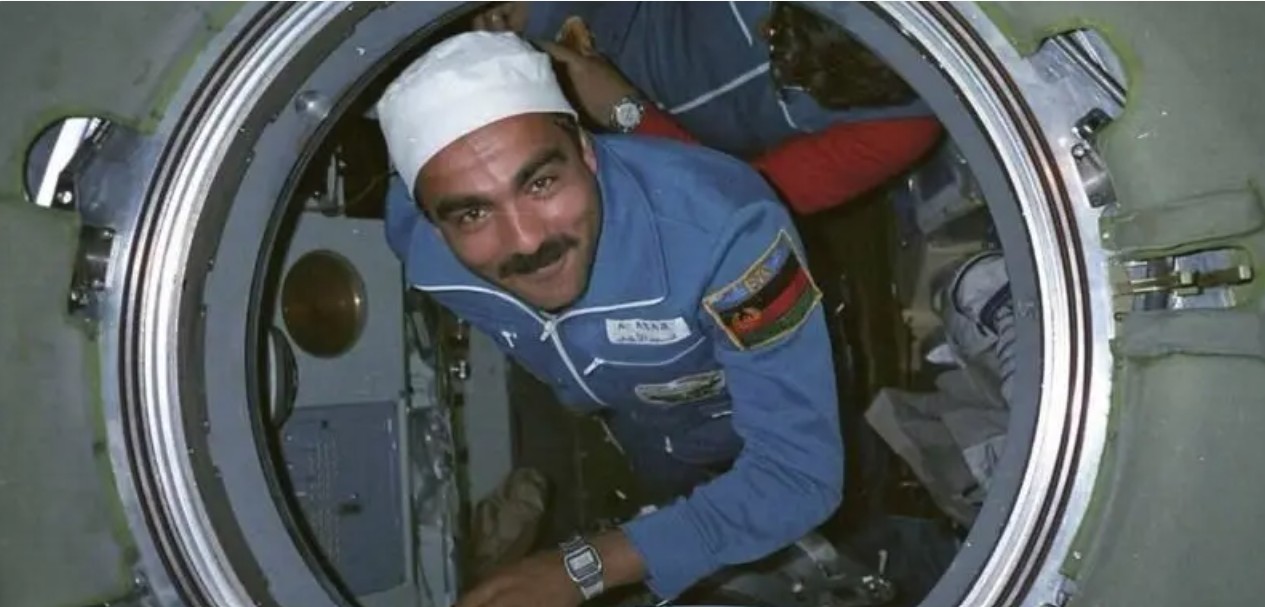
In August 1988, Afghan fighter pilot Abdul Ahad Momand, who had flown bombing missions against the Mujahideen, became the first Afghan in space.
He also took a copy of the Quran with him, becoming the first person to recite it in space and the first to speak Pashto from space.
Momand passed away on June 21 in Germany at the age of 67, leaving behind a contested legacy.
According to a family member, Momand had been suffering from cancer and passed away after a period of illness. He had been living with his family in Stuttgart, Germany, since 1992.
Despite his extraordinary achievements, he is hardly celebrated, or even remembered, in his home country, which is once again ruled by radical Islamists, led by the Taliban.
His spaceflight became a powerful symbol of Soviet propaganda at a time when the USSR was losing ground in the Cold War and facing growing domestic discontent over its disastrous military intervention in Afghanistan.
The Kremlin promoted Momand’s mission as proof of Soviet-Afghan scientific and technological cooperation, even as mujahideen forces were rapidly gaining strength across Afghanistan and threatening the Soviet-backed communist government of President Najibullah in Kabul.
Momand’s flight illustrated how space programs were weaponized for propaganda, diplomacy, and geopolitical advantage throughout the Cold War.
The First Afghan in Space
Momand was born in 1959 in Ghazni Province. He completed his early education in Afghanistan.
He studied at the Polytechnic Institute in Kabul for two years, then went on to pursue aviation and aerospace studies in the former Soviet Union.
After returning to Afghanistan, he joined the Afghan Air Force and served as a fighter pilot at Bagram Air Base from 1981 to 1984.
Notably, the Soviet Union had already intervened in Afghanistan in support of the Afghan communist government in its conflict with anti-communist Muslim guerrillas.
During his time in the Afghan Air Force, Momand himself flew bombing missions against mujahedin fighters.
He then reportedly studied at Gagarin Air Force Academy from 1984 to 1987.
During this time, he also participated in the qualification exams for space flights.
After the exam, he was shortlisted for a space flight.
Back home in Afghanistan, the Soviet Union had started withdrawing from the country after nine years of military intervention.
The Soviet withdrawal from Afghanistan began in May 1988, leaving the embattled Najib-led Communist government in Kabul to fend for itself.
However, even as the Soviet Union was withdrawing from Afghanistan, it sought to convey that it was not betraying the Communist government in Kabul and would continue to support it.
It also wanted to demonstrate that its intervention in Afghanistan was also bringing some tangible benefits to Kabul beyond war and destruction, which has come to symbolize Soviet intervention in Afghanistan.
Sending an Afghan national to space was seen as a powerful tool to convey all this, showcase Soviet generosity, and expand its leadership in the Global South.
Notably, by this time, the Kremlin had perfected the art of using space programs for propaganda, alliance-building, and to advance its geopolitical interests.
Whether it was Sputnik (1957) or Gagarin’s first space flight in 1961, the Kremlin framed its space successes as proof of socialist superiority.
Further, it used the success of its space programs to court neutral nations into the Communist bloc.
For instance, in 1978, Czechoslovakia’s Vladimír Remek became the first non-Soviet/non-US person in space.
In the coming years, many nationals from Soviet-allied countries, such as Poland, East Germany, Bulgaria, and Hungary, were sent into space on Soviet rockets.
In 1984, the Soviet Union sent the first Indian, Rakesh Sharma, into space on a Soyuz T-11 rocket.
The space visit strengthened India-Soviet friendship.
While the Kremlin used the occasion to portray the Soviet Union as a brotherly nation helping countries in the Global South advance in science, India used the visit to boost the government’s popularity.
Therefore, by the mid-1980s, this tradition of using space programs and space visits for propaganda and for alliance-building was well established.
Momund’s planned space visit fell into this pattern.
Momand began his space flight to the Mir Space Station on August 29, 1988, and returned to Earth on September 7.
He also carried a Quran to space, and became the first Afghan in space, the first to recite the Quran in space, and the first to speak Pashto in space.
All this was rich in symbolism and was meant to boost Afghan pride.
By speaking Pashto, the Afghan government tried to discredit mujahedin fighters, who mostly came from a Pashto background and claimed to be fighting for restoring Pashto pride and sovereignty.
Further, since the mujahedin fighters often tried to discredit the Communist government in Kabul as atheist and anti-Islamic, reciting the Quran was meant to convey that the government was not anti-Islamic.
Momand’s space flight, however, was not without twists.
The mission was scheduled to last eight days, but due to technical difficulties, it was extended to nine days.
During the flight back to Earth, the ship’s computer malfunctioned.
Momand noticed that the computer was preparing to jettison its fuel and batteries. He stopped the countdown and thereby saved himself from spending the rest of his life spinning around the Earth until his air ran out and the capsule burned up in the atmosphere.
“He was literally one of half a dozen astronauts who thought their way out of dying,” says James Oberg, a space historian.
Momand was awarded the prestigious title of Hero of the Soviet Union on September 7, 1988, for his historic 9-day mission aboard the Mir space station.
In Afghanistan, he was welcomed as a national hero, and he even served as deputy minister of aviation and tourism.
However, his fame in Afghanistan did not last long.
Soon after, the Soviet Union disintegrated. Najibullah resigned in April 1992, shortly after the Afghan mujahideen’s takeover of Kabul. Four years later, Najibullah was hanged publicly in Kabul, along with many of his allies.
Momand, as a former member of his cabinet and as a former fighter pilot who flew bombing missions against mujahideen fighters, knew his life was not secure in Afghanistan.
In 1992, he fled to Germany with his family, never to return.
He lived in Stuttgart, where he worked at the Institute for Cosmological Research at the University of Stuttgart and for a private company in the city.
His life symbolizes the tragedy of millions of Afghans.
Notwithstanding his extraordinary achievements, he was forced to live as a refugee in Germany.
His tragedy was repeated in Afghanistan in 2021.
Just as thousands of Afghans who served in the Najibullah government fled the country after the mujahideen captured Kabul in 1992, history repeated itself after the U.S. withdrawal in 2021.
Once again, thousands of Afghans, now labeled collaborators or agents of foreign occupation, were forced to flee their homeland.
Though his passion was flying and space, he lived a very different life in Germany and worked as an accountant in the latter part of his life.
He lived an unassuming life, and few of his neighbors knew about his achievements.
- Sumit Ahlawat has over a decade of experience in news media. He has worked with Press Trust of India, Times Now, Zee News, Economic Times, and Microsoft News. He holds a Master’s Degree in International Media and Modern History from the University of Sheffield, UK.
- He can be reached at ahlawat.sumit85 (at) gmail.com