The 48th Fighter Wing at RAF Lakenheath in the United Kingdom recently unveiled an F-15E Strike Eagle in the paint scheme once used by the US Air Force (USAF) F-111 bomber, which took off from the same base to conduct a bombing campaign against Libya forty years ago.
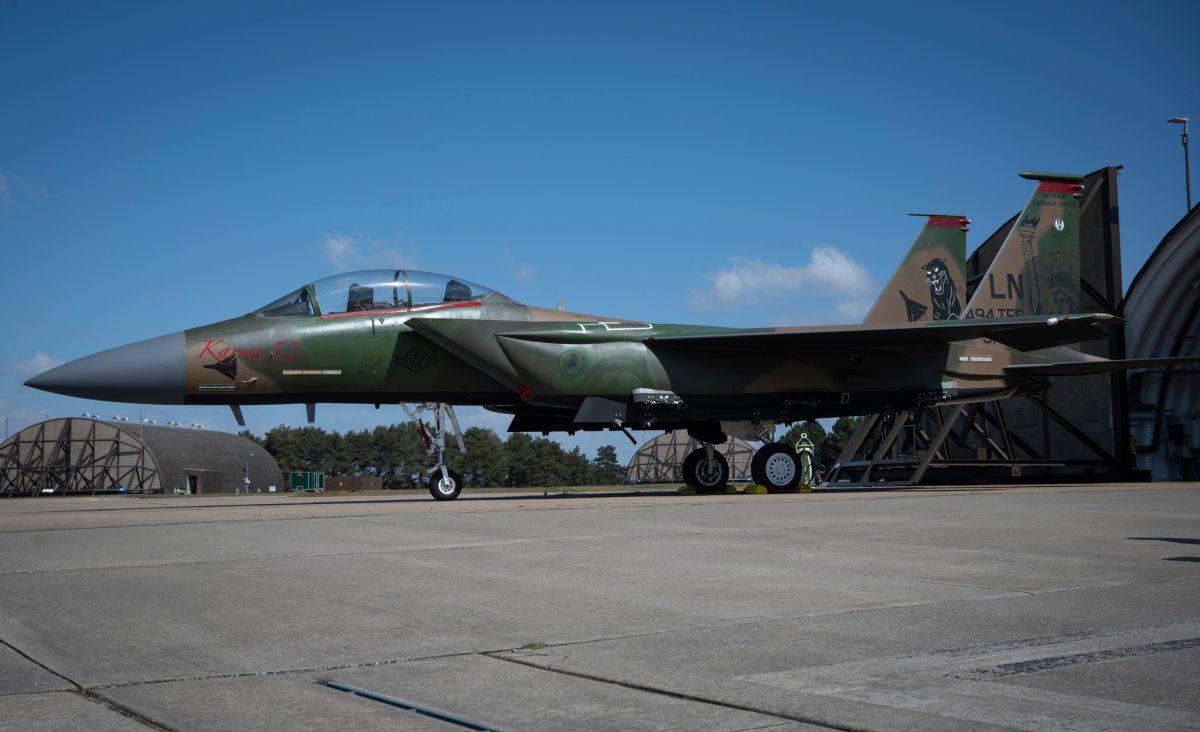
A Boeing F-15E Strike Eagle, serial number 91-0311, was showcased at RAF Lakenheath, Suffolk, on April 28, 2026, sporting a new paint scheme to mark the 40th anniversary of “Operation El Dorado Canyon” against Muammar Gaddafi’s Libya on April 15, 1986, which is also popularly recognized as the “First US strike against terrorism.”
The paint replicates the tan-and-two-tone-green camouflage of the F-111Fs of the 48th Tactical Fighter Wing, which flew long-range night missions from the UK. The wing, a premier United States Air Forces in Europe (USAFE) unit, is now the 48th Fighter Wing, and RAF Lakenheath was used by American jets as recently as during the Iran War.
The repainted Strike Eagle aircraft features special markings, including “Karma 52” nose art in honor of an F-111 crew that was downed during the bombing in Libya, and older squadron markings on the tail. Additionally, the red band of the 494th TFS and the words “40 years El Dorado Canyon” could be seen on the top.
The 48th FW’s “Statue of Liberty” symbol could be seen extending from the bottom to the top, whereas the 494th FS’s symbol is painted on the inside of the vertical twin tails, which are shaped like an F-111 and a Panther.
The Period Of Warm Ties Between The US & Libya
Libya was an Italian colony until World War II, during which time it saw heavy fighting. However, in 1943, American military forces captured the former Italian Mellaha Air Base near Tripoli, which was later renamed to Wheelus Air Base.
After the war ended, the US supported Libyan independence on December 24, 1951, with pro-West Idris I as king of the newly unified Kingdom of Libya.
The Wheelus Air Base, located near Tripoli on the Mediterranean coast, was the largest US overseas air installation at the time and at the core of the US-Libya relationship. However, the relationship expanded as US companies invested in oil exploration in Libya and Libya also received substantial per-capita US aid.
During this period, the monarchy was often associated with corruption, and wealth distribution was uneven, but the relationship stayed on track. King Idris viewed ties with the US and UK as essential for regime security and development, and the US saw Libya as a stable, anti-communist partner in a volatile region.
However, things started to change in the 1960s, particularly after the Six-Day War fought between Israel and the Arab states. This was a period of growing Arab nationalist sentiment, an expansion of pan-Arab ideas, and a regionwide resentment over foreign bases. This created underlying friction.
Chaos befell the King Idris regime as the people in Libya grew frustrated with the income inequality in the country and the pro-Western policies of the king. The regime was seen as conservative, inefficient, and out of step with rising pan-Arab nationalism inspired by Egypt’s Gamal Abdel Nasser.
The young and junior officers in the military from modest backgrounds resented the monarchy’s conservatism and its lack of support for Arab causes. So, they formed the secretive Free Officers Movement, or Free Unionist Officers, modeled after Nasser’s 1952 Egyptian coup. Then came the coup.
In the early hours of September 1, 1969, a small group of about 70 young officers and supporting enlisted men led by Muammar Gaddafi seized key installations in Benghazi and Tripoli. It was a bloodless coup, following which, Gaddafi broadcast a radio address declaring the end of the “reactionary and corrupt” monarchy and the birth of the Libyan Arab Republic. The new regime promised to fight imperialism, corruption, and underdevelopment while pursuing Arab unity.
The US Animosity Toward Gaddafi’s Libya
Gaddafi’s revolutionary government quickly took an anti-Western, pan-Arabist direction.
The ties between the US and Libya strained as Gaddafi demanded the closure of US and British bases, including the large Wheelus Air Base, which was handed over in 1970. Additionally, the regime partially nationalized foreign oil companies to gain greater control and revenue, a move that did not sit well with Washington.
“Blending Islamic orthodoxy, revolutionary socialism, and Arab nationalism, Gaddafi established a fervently anti-Western dictatorship in Libya. In 1970, he removed U.S. and British military bases and expelled Italian and Jewish Libyans. In 1973, he took control of foreign-owned oil fields. He reinstated traditional Islamic laws, such as the prohibition of alcoholic beverages and gambling, but liberated women and launched social programs that improved the standard of living in Libya,” notes history.com.
Gaddafi aligned more with radical Arab causes, supported Palestinian groups, and gradually warmed to the Soviet Union— all of which was a red line for the United States. However, things came to a head when a mob attacked and burned the US embassy in Tripoli amid broader anti-US sentiment linked to the Iranian hostage crisis, which resulted in the US designating Libya a state sponsor of terrorism.
Notably, tensions exploded under US President Ronald Reagan, who viewed Gaddafi as a major sponsor of international terrorism. At the time, Libya was accused of funding and training terrorist groups, including Palestinian factions, the Irish Republican Army (IRA), among others, providing safe havens, weapons, and logistical support.
During the 1980s, the West blamed Libya for numerous terrorist attacks in Europe, such as the attacks on Rome and Vienna airports in December 1985, which were allegedly conducted by terrorists funded by Gaddafi. However, the immediate trigger for the US campaign against Libya was the bombing of La Belle discotheque in Berlin, which was reportedly a popular place with US servicemen. The attack apparently killed two US soldiers and a Turkish woman, and injured over 200 others, including several Americans.
US President Ronald Reagan immediately blamed Libya for the attack, citing intercepted contacts between the Libyan embassy in East Berlin and Tripoli, Libya. And, he ordered American airstrikes on Libya.
Operation El Dorado Canyon
“In the predawn darkness of 15 April 1986, the sky along the Libyan coast suddenly erupted in blinding fire and dense smoke. U.S. Navy attack aircraft from carriers in the central Mediterranean and US Air Force fighter-bombers based in England had begun their attacks on terrorist facilities and military installations in or near the cities of Tripoli and Benghazi. President Ronald Reagan had ordered the operation—code-named El Dorado Canyon,” states the US Naval Institute in one of its archives.
The operation was a joint US Air Force and Navy effort under US European Command (USEUCOM), with Vice Adm. Frank B. Kelso as overall tactical commander. The 48th Tactical Fighter Wing (TFW) at RAF Lakenheath, UK, which was equipped with F-111F Aardvarks, was selected for the Tripoli strikes due to its night precision-strike expertise.
At approximately 2 a.m. on April 15, the F-111s that had flown from RAF Lakenheath and refueled began the attack. They were subsequently joined by 27 Navy aircraft, including A-6E Intruders, A-7 Corsair IIs, and F/A-18A Hornets that took off from the USS America (CV-66) and USS Coral Sea (CV-43).

The US military forces had circled out five targets across Libya in their counter-terrorism operation: Bab al-Aziziyah barracks (Tripoli), which allegedly housed a terrorist command centre; Murat Sidi Bilal training camp (near Tripoli), which was accused of training naval commandos and terrorist frogmen; Tripoli military airfield, which was allegedly used for Soviet Il-76 Candid transports used for terrorist support; and Benghazi Jamahiriyah barracks, which was alleged to be an alternate terrorist command center and MiG assembly or storage; and Benina airfield (Benghazi), which housed MiG-23 interceptors.
The US Air Force chose the F-111 because it offered long-range, low-level, all-weather/night precision-strike capability unmatched by other tactical aircraft at the time for this mission. Moreover, its terrain-following radar (TFR) enabled low-altitude penetration (as low as 200 feet) to evade Libyan air defenses, which was crucial to the operation’s success, as the Libyan forces were armed with potent surface-to-air missiles such as the Scuds.
Further, the F-111’s AN/AVQ-26 Pave Tack electro-optical or laser targeting pod enabled accurate delivery of laser-guided bombs at night, which was critical given the targets’ proximity to civilian areas and the stated desire to minimize collateral damage.
The mission became the longest combat fighter mission in history at the time, a roughly 6,400–7,000-mile round-trip from the UK, as Spain and France denied overflight permission.
Due to technical malfunctions and some of the most stringent rules of engagement, only 11 of the 18 F-111s were able to drop bombs, although all of them reportedly hit their designated targets. The service later noted that while some aircraft fired parachute-delayed bombs on Il-76 cargo aircraft at the Tripoli airport, others used GBU-10 laser-guided bombs on ground infrastructure.
One F-111, callsign Karma 52, piloted by Capt. Fernando Ribas-Dominicci with Weapon Station Officer (WSO) Capt. Paul Lorence went down, likely after sustaining missile fire. Neither the crew nor the wreckage was ever found.
The United States praised the F-111’s capabilities in long-range, precise strikes when it returned to the UK, while also highlighting the aircraft’s maintenance issues and the difficulties of lengthy sorties without GPS or standoff weapons.
The aircraft, which carried out a risky, technically challenging night-precision raid from bases distant from the target area, was acknowledged as the backbone of the operation. Therefore, it only makes sense that the F-15E was painted in the F-111’s colors.
- Contact the author at sakshi.tiwari13 (at) outlook.com
- Follow EurAsian Times on Google News