Rarely in history has there come a moment when one of the world’s most impenetrable glass ceilings is shattered not through incremental gains, but in one decisive blow. That moment arrived at SAHA 2026.
Turkey has stunned the world earlier with its lightning-fast rise in military technology, particularly in the domain of drone warfare; still, nothing prepared the aerospace elite for Güçhan.
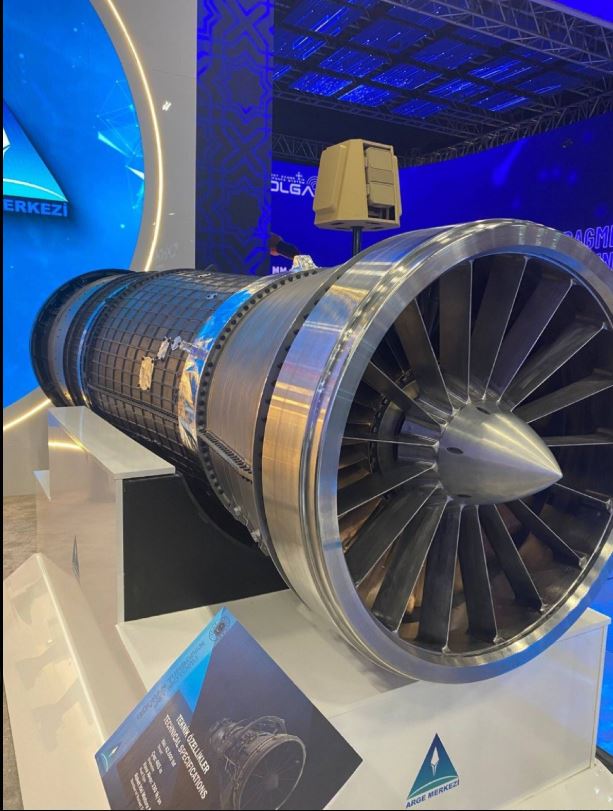
Unveiled at SAHA 2026 by the Turkish Ministry of National Defense R&D Center, this monstrous 42,000 lbf-class turbofan engine is no incremental step forward. It is a full-blown coup in jet propulsion, with the potential to catapult Turkey from a fighter-jet-importing country into the ultra-exclusive club of nations capable of developing high-thrust fighter engines for fifth- and sixth-generation fighter jets.
So far, this has been an exclusive club, dominated by a handful of nations: the US, China, and Russia. Even European nations capable of producing high-thrust engines, such as the UK and France, have not achieved the holy grail of delivering turbofan engines with over 40,000 lbf of thrust.
In fact, even Russia and China, established aerospace powers, have only recently entered this exclusive club after decades of struggle.
However, Turkey seems to have reached that milestone in only a few years.
With six units already produced and qualification tests starting this year, Güçhan doesn’t just extend Turkey’s string of defense breakthroughs; it shatters the ceiling. Designed to rival the F-35’s engine performance and power next-generation platforms like the KAAN, this engine signals the arrival of a bold new player that can no longer be ignored.
The message to the old guard is crystal clear: their monopoly on high-thrust jet engines is over.
Turkey Unveils 42,000 lbf Güçhan at SAHA 2026
During the ongoing SAHA 2026 defense expo in Istanbul (May 5-May 9), Turkey publicly unveiled the new 42,000-lbf-class Güçhan turbofan engine.
If these specifications are correct, this will catapult Turkey into the same league capable of developing high-thrust engines.
In fact, there is currently only one jet engine in the Western world capable of producing this level of thrust.
The Pratt & Whitney F135, an advanced afterburning turbofan engine that powers all three variants of the Lockheed Martin F-35 Lightning II, produces over 40,000 lbf of thrust (nearly 43,000 lbf).
Even the F-22 Raptor is powered by two Pratt & Whitney F119-PW-100 turbofan engines, which deliver over 35,000 lbs of thrust.
The Russian Saturn AL-41 turbofan engine, which powers the Su-57 fighter jet, also produces nearly 35,000 lbf of thrust.
However, it is only considered an interim, stage-one engine. The final, long-awaited engine designed specifically for the Su-57 is the next-generation Izdeliye 30 (sometimes referred to as the AL-51F-1), which is designed to provide greater efficiency, supercruise capability, and improved stealth. It can produce up to 40,000 lbf of thrust.
The Chinese Shenyang WS-15, designed for the Chengdu J-20, is also capable of delivering nearly 40,000 lbf of thrust.
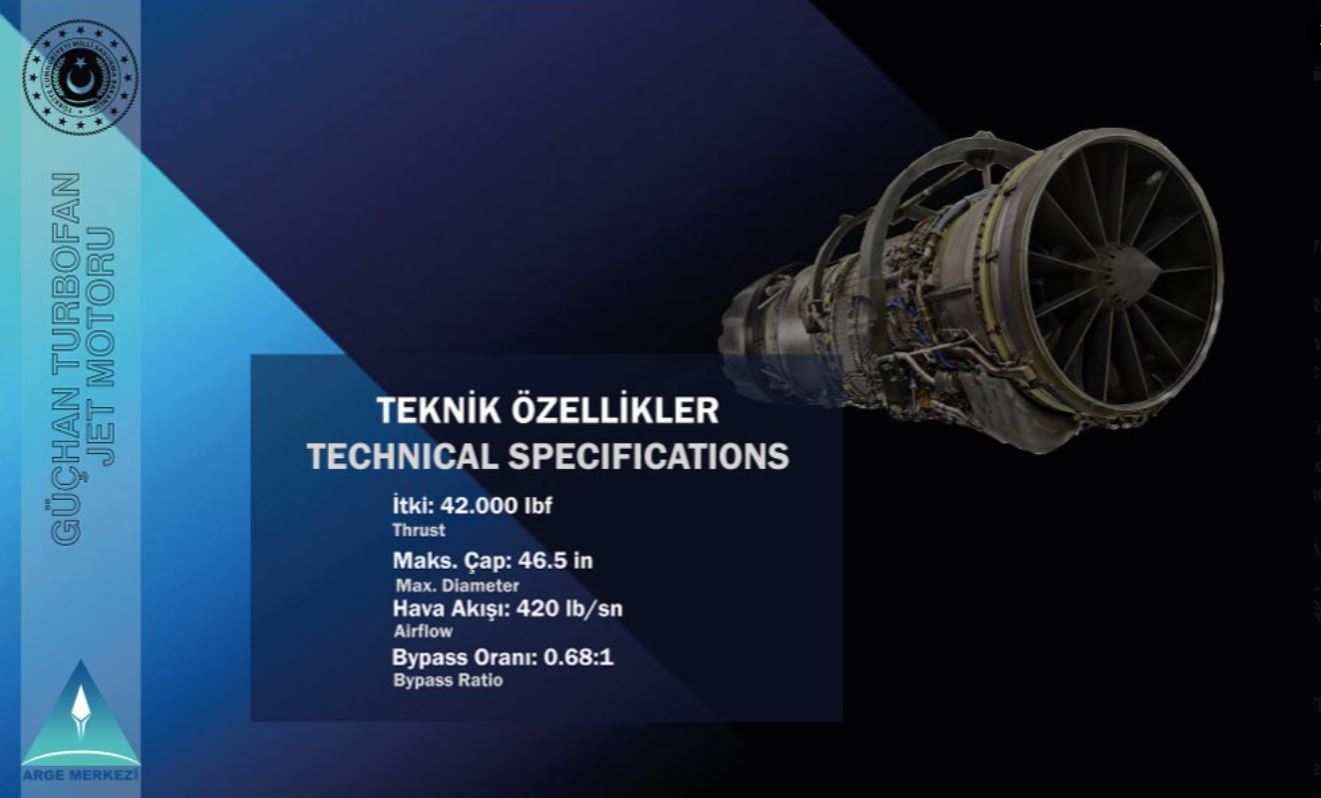
The Güçhan’s announced 42,000 lbf output sits only marginally below the 43,000 lbf afterburning thrust of the F-35’s F135 and above the F-22’s F110-GE-129.
However, high thrust is not the only benchmark where Güçhan claims to match F-135’s specifications.
Its maximum diameter was presented as 46.5 inches, closely matching the 46-inch diameter of F135-PW-100 and F135-PW-400 variants used across the F-35 fleet.
Airflow was identified at 420 lb/sec, indicating a high-mass-flow core architecture associated with high-thrust fighter turbofan engines. It also claims a 0.68:1 bypass ratio, suggesting a military propulsion engine optimized for a compact airframe, high exhaust energy, and sustained afterburning operation.
Though Turkey did not specify the aircraft for this engine, collectively these specifications suggest that the engine could be used in a fifth-generation manned aircraft, or even a sixth-generation unmanned fighter jet.
Such high-thrust engines also produce extremely high turbine inlet temperatures, sufficient to melt any metal within seconds.
Therefore, developing a high-performance jet engine requires not only top-notch engineering but also advanced metallurgy.
In fact, the biggest engineering barrier that many countries trying to develop jet engines run into is metallurgical science. The only technology that can withstand this heat is single-crystal turbine blades with a perfect atomic arrangement.
These single-crystal turbine blades are also called the holy grail of fighter jet engines.
Thermal management and cooling of turbines, therefore, is as important as propulsion.
The public unveiling of Güçhan in the 42,000-lbf category suggests that Turkey has overcome this metallurgical bottleneck.
The Elephant in the Room: Is the Engine Operational or A Mock-Up
The public unveiling of Güçhan raises more questions than it answers.
For instance, Turkey did not disclose dry thrust output, turbine temperature limits, compressor pressure ratio, endurance cycle data, or mean time between overhauls.
In the absence of this data, it is impossible to gauge the engine’s maturity.
As mentioned earlier, designing a jet engine capable of producing over 40,000 lbf of thrust has been one of the most impenetrable glass ceilings in combat aviation, one that only a select few countries have broken through after years and decades of struggle.
Take, for instance, Russia. As an established combat aviation superpower for the last seven decades, Moscow has only recently produced an engine capable of exceeding the 40,000-lbf barrier.
France, another established combat aviation superpower since the 1950s, has still not broken this barrier.
Furthermore, the engine appeared without earlier prototype unveiling, contract disclosure, flight-test announcements, or industrial rollout chronology.
These gaps led many to question whether the engine on display at SAHA 2026 is operational or just a mock-up, meant to announce Turkey’s ambitions in jet engine design.
However, according to Nilüfer Kuzulu, Director of the Ministry of National Defense (MoND) R&D Center, the engine displayed is not a mock-up.
He further said that so far, six units of this engine have already been produced and that qualification tests for these units will begin later this year.
Kuzulu also announced that the single-crystal blades used in the GÜÇHAN engine were cast and produced entirely in Türkiye, with its own resources.
Furthermore, he said that instead of copying existing engines like the F110 or F135, the MoND R&D Center designed the system from scratch.
The compressor architecture providing the engine’s air intake and the compression ratios were shaped entirely by the original calculations of Turkish engineers, he added.
Kuzulu said that the six prototype engines show they have already passed the design stage and will soon enter the physical validation stage.
In these tests, the engines will be run at maximum speed for thousands of hours, subjected to extreme heat and cold, and tested for durability in scenarios such as bird strikes they might encounter in the air.
After successfully passing these ground tests, these prototype engines will enter the flying-test stage with “Flying Test Beds.”
Only after that will these engines enter the production stage.
However, if all these tests are passed, Turkey will achieve true sovereignty in its fighter jet program.
Many countries have designed their own airframes, radars, avionics, and weapons, such as India, South Korea, Israel, and Sweden; however, without indigenous jet engines, no aircraft program is completely sovereign.
Only full sovereignty over aircraft engines determines whether a country truly controls aircraft exports, software integration, modernization options, and long-term sustainment schedules.
Furthermore, dependence on aircraft engine imports means the entire aircraft program could be held hostage by export restrictions or by delaying engine deliveries.
India’s Tejas fighter jet program is a good example. Despite a legal contract with General Electric, engine delivery is running two years behind schedule, delaying India’s fighter aircraft modernization timeline.
An indigenous jet engine, therefore, is crucial not only for fighter jet development but also for operational autonomy, sanctions resilience, and independent export capability.
- Sumit Ahlawat has over a decade of experience in news media. He has worked with Press Trust of India, Times Now, Zee News, Economic Times, and Microsoft News. He holds a Master’s Degree in International Media and Modern History from the University of Sheffield, UK.
- VIEWS PERSONAL OF THE AUTHOR.
- He can be reached at ahlawat.sumit85 (at) gmail.com