A Saudi official said Friday that the joint defense pact signed with Turkey and Pakistan was not linked to “any nuclear ambitions” and was not a threat to any country in the region.
“The agreement does not represent an effort to establish a military axis or a sectarian bloc. Nor is it linked to any nuclear ambitions or arms race; rather, it is focused on building sustainable capabilities,” said Deputy Minister for Public Diplomacy Rayed Krimly in a post on X.
He said the deal “does not constitute a threat to the security of any country in the region, nor does it represent an escalation of tensions between any two states”.
Meanwhile, Turkey insisted on Friday that its joint defense pact signed with Saudi Arabia and Pakistan amid the US-Iran war was “not aimed at any particular country”.
“The Mecca Agreement, which is not aimed at any particular country, will strengthen the shared security and collective deterrence of the three nations… thereby making significant contributions to the preservation of peace and stability in our region,” Burhanettin Duran, the Turkish presidency’s communications director, posted on X.
Saudi, Turkey & Pakistan Sign Defense Pact
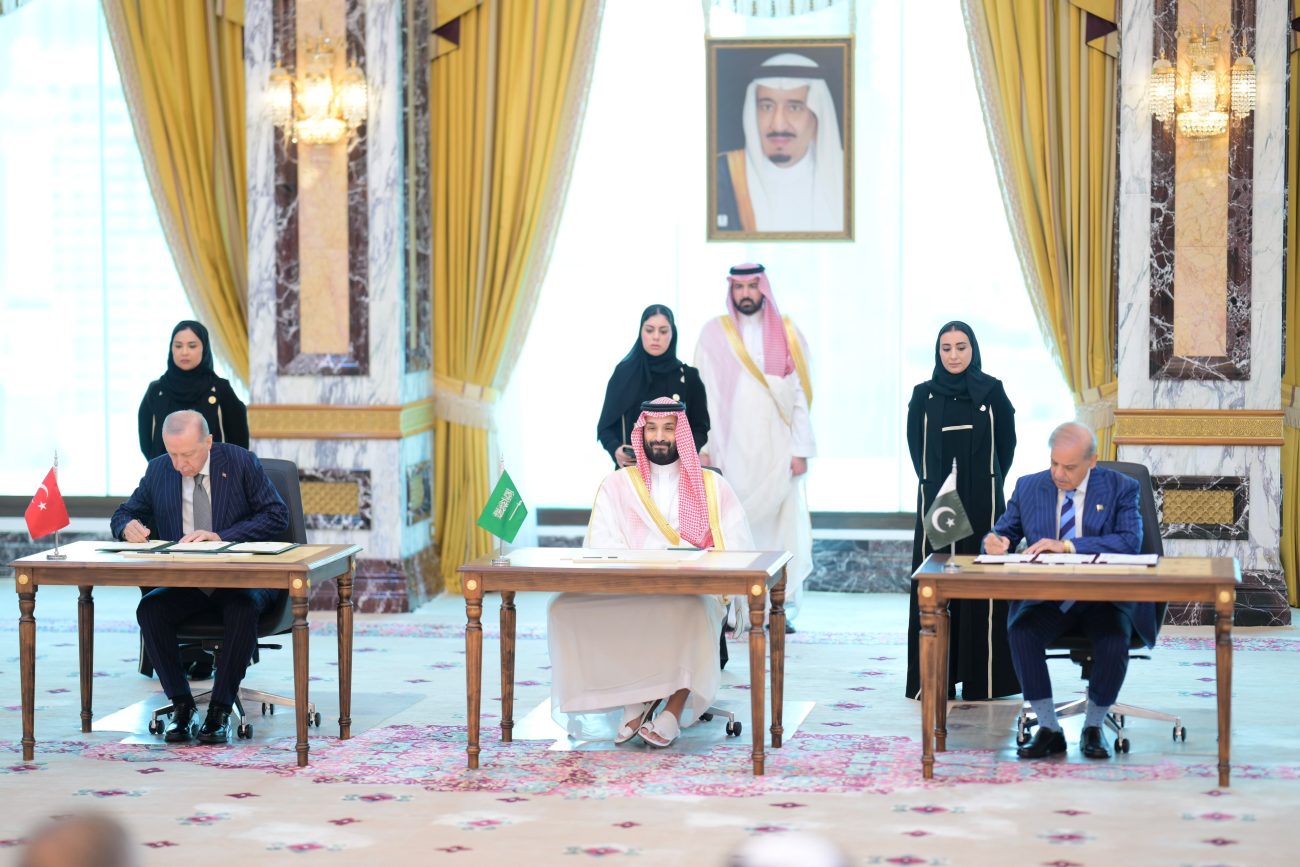
Saudi Arabia, Turkey and Pakistan signed a joint defense pact amid the US-Iran war.
Riyadh is looking to strengthen its security ties against the backdrop of war between the United States and Iran, which has drawn in surrounding nations and disrupted shipping through the Strait of Hormuz and Red Sea.
The war has emboldened Iran and its Houthi allies in Yemen, both of which have attacked Saudi Arabia, while analysts say Washington is now seen as an increasingly unreliable partner.
In a joint statement published by the official Saudi press agency and Pakistan’s foreign ministry, the three countries announced the signing of the “Mecca Joint Defence Agreement”.
They declared a “shared commitment to further strengthening their collective security and to promoting peace, security and stability in the region and beyond”.
The Pakistani foreign ministry said the pact meant an attack on any member would be regarded as an attack on all, adding it was “intended to strengthen collective deterrence”.
Since the onset of the regional war, Saudi Arabia has grown closer to Turkey, Egypt and Pakistan, which have been pushing for mediation and a resolution to the conflict.
Umar Karim, an expert on Saudi foreign policy at the University of Birmingham, called the deal a “highly significant development”.
The alignment “is clearly oriented towards Iran and meant to address Iran’s new strategic approach which is geared towards dominance of the broader Gulf region”.
The fact that Turkey and Pakistan border Iran means they could “exercise a different kind of leverage” on Tehran, he added.
A source close to the Saudi military and government told AFP before the signing that although the agreement had been under discussion for a long time, “the latest developments in the region expedite it”.
Andreas Krieg of King’s College London said the deal showed a clear desire to diversify alliances beyond the United States.
“Saudi Arabia, Turkey and Pakistan are not trying to replace the United States. They are building the capacity to protect their interests when Washington cannot or will not do so.”
Riyadh, in particular, he said, “wants several layers of security rather than one American umbrella”, after the shock of the Iran war.
The deal will support Saudi Arabia’s ambitions to become an organizer of regional security and diversify its defense umbrella, while Turkey and Pakistan gain political clout and access to potential Saudi investments, he said.
Turkish President Recep Tayyip Erdogan met Saudi Crown Prince Mohammed bin Salman in Mecca on Friday, the Turkish presidency said on X, sharing an image of the meeting.
Pakistani Prime Minister Shehbaz Sharif and army chief Asim Munir also traveled to the Gulf kingdom for the signing.
“Although taking place against the backdrop of heightened tensions in the Gulf, the visit will carry significance beyond the immediate crisis and short-term considerations,” Pakistani foreign ministry spokesman Tahir Andrabi said on Thursday.
The deal reflects closer ties between the three Muslim-majority nations.
Saudi Arabia and Pakistan had already announced a mutual defense pact in 2025, a move that drew attention because Pakistan is the Muslim world’s only nuclear-armed state.
Pakistan has also sought to mediate efforts to end the US-Iran war, while Turkey has played a diplomatic role in negotiations aimed at ending the war in Gaza.
Renewed Houthi attacks
The deal also comes as a truce between Riyadh and the Houthi rebels in neighboring Yemen has broken down, with the Houthis launching attacks on Saudi soil and declaring a maritime blockade against Saudi Arabia, which they have attempted to enforce by attacking Saudi tankers.
The Houthis, backed by Iran, have added pressure to Gulf energy exporters, who are already under strain from Tehran’s blockade of the Strait of Hormuz, by threatening Red Sea shipping — another key route for oil exports.
Saudi Arabia has led a military coalition in support of Yemen’s internationally recognized government against the Houthis since 2015.
A truce was agreed four years ago which largely held until hostilities broke out again in recent weeks.
On Thursday, the Houthis killed at least 58 Yemeni government troops in missile and drone attacks, a military source said, in one of the deadliest days in the conflict for years.
Yemen’s civil war has killed hundreds of thousands of people and triggered a major humanitarian crisis.
By AFP