India’s air force chief said on Saturday that the U.S. has made no formal offer to sell India F-35 stealth fighters, and added that American personnel have not even allowed Indian officers near the stealth aircraft.
Air Chief Marshal Amar Preet Singh made the comments at a press conference marking the end of the multinational Exercise Tarang Shakti-2026 in Jodhpur, while seated alongside U.S. Pacific Air Forces commander Gen. Kevin Schneider.
“Your people don’t even let us go near the aircraft, and you are talking about selling it to us,” Singh said.
Six U.S. Air Force F-35As, accompanied by more than 200 personnel, participated in Tarang Shakti. This was the first time the American stealth fighters had drilled against Indian jets on Indian soil.
Singh also said the Indian government has not yet decided whether the air force should evaluate Russia’s offer of the Su-57.
“Once the decision is conveyed to us (by the government), we will evaluate how well it meets our requirements,” he said.
Earlier in 2025, U.S. President Donald Trump said, during Indian Prime Minister Narendra Modi’s visit to Washington, that the United States would pave the way for India to acquire the F-35.
Later, Vice President J.D. Vance reiterated the offer during his visit to India in April 2025, saying, “We, of course, want to collaborate more. We want to work together more. And we want your nation to buy more of our military equipment, which we believe is best-in-class. American fifth-generation F-35s, for example, would give the Indian Air Force the ability to defend your airspace and protect your people like never before.”
Earlier, as EurAsian Times reported, Lockheed Martin CEO Jim Taiclet discussed selling the F-35 to India and raised the prospect of selling the F-21, a highly sophisticated F-16 derivative.
“I think the F-16 also has strong legs, if you will, and more and increasing interest as we go forward from several countries that aren’t quite ready for F-35,” Taiclet said. There are “some countries that could see F-21 or F-16, for India, for example, as a stepping stone to F-35.”
The sale of the F-35 is subject to rigorous U.S. export controls under the Arms Export Control Act, which requires approval from the State Department, the Pentagon, and often Congress. The White House maintains strict policies on technology transfers, regional stability, and the internal politics of the potential recipient state to safeguard its sensitive technology.
The U.S. hesitation is straightforward: sharing it with other countries could put sensitive technology in the hands of enemies, especially if the recipient country has ties to countries like China or Russia, which would try to exploit or reverse-engineer it.
Earlier, writing for EurAsian Times, Air Marshal Anil Chopra (retired) said: The F-35 soft pitch faced almost immediate limitations due to subsequent tariff frictions and India’s core push for technology transfer for domestic manufacturing of its AMCA fifth-gen warplanes and aero-engines.
GE Aerospace has faced immense delays on its 2021 contract to supply 99 F404-IN20 engines to Hindustan Aeronautics Limited (HAL) for the Tejas Mk1A fighter program. Only six out of the promised engines have been delivered instead of the targeted 12-plus a year, prompting HAL to invoke contractual penalty clauses.
Tariffs on “friend” India and delayed engines for AMCA have badly weakened Indo-US ties.
India also operates Russian-supplied S-400 systems, a factor that previously caused friction between the U.S. and Turkey.
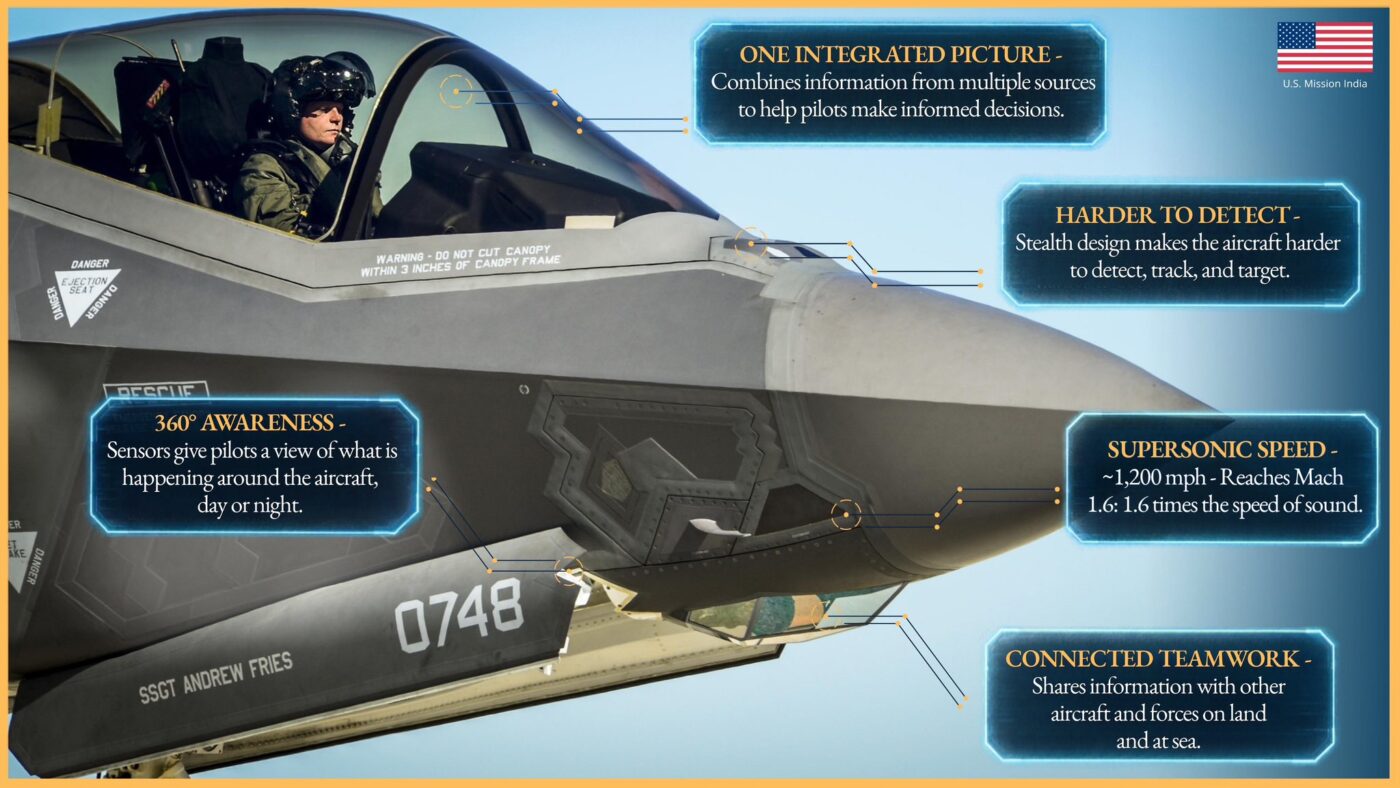
India already operates the Russian-origin S-400 AD System. The U.S. fears these networks could compromise classified F-35 stealth data. The jet relies on the U.S.-controlled Operational Data Integrated Network for software and logistics.
The U.S. may already be accessing such data through many other American platforms on Indian soil.
Meanwhile, introducing a complex new Western platform adds severe maintenance challenges to an already diverse military fleet. Even in the U.S., very few airbases can service stealth coatings.
Buying foreign fifth-generation jets risks diverting funds from India’s indigenous AMCA project. Putting too many military aviation eggs in the unreliable U.S. basket is also a risk. Americans can be “very unreliable” when it comes to imposing sanctions and freezing spares and maintenance support.
Operationally, the F-35 could offer major strategic advantages for the IAF, but any deal involves deep geopolitical, logistical, and financial complexities. Acquisition costs range from $80 to $110 million per jet, plus very high hourly operating expenses, creating budgetary challenges for New Delhi.
After two decades of stable ties, the last two years have seen distrust between the world’s largest and oldest democracies.
While many hope this is a transitory phase, it is becoming clear that the U.S. is not interested in India’s rise as a global power. U.S. Deputy Secretary of State Christopher Landau stated at the last Raisina Dialogue in New Delhi that Washington will not repeat its past approach (read: mistake) with China by granting India unfettered market and tech access that could lead to strong commercial competition.
The U.S. wants India strong enough only to serve as a bulwark against China, not to become an independent power center or a technology and economic power.
The U.S. seems keen only to supply platforms to India through large contracts. Even for aero-structures and smaller components, it prefers make-in-India “Build to Print” over significant technology sharing.
Even the proposed India-USA deal to co-produce GE Aerospace F414 engines with HAL faces major hurdles. The main complications include a nearly threefold cost surge, intense disputes over sensitive hot-end technology transfer, and the risk of delays to India’s Tejas Mk2 and AMCA programs.
Many Indians wonder whether we have invested too much in a partner with a high trust deficit and a vacillating foreign policy. U.S. is known to have “dumped” friends and allies for immediate national interests. The Trump administration’s recent public threats and admonishments to its NATO allies further strengthen Indian concerns.
The U.S. has already deepened its ties with India’s airborne platforms, supplying transport aircraft (C-17, C-130), maritime patrol aircraft (P-8I), UAVs (MQ-9), and helicopters (Chinook, AH-64 Apache, and MH-60R).
For a long time, the U.S. was trying to sell the F-16 ‘Viper’ (renamed F-21) and the F-18 Super Hornet as part of India’s Multi-Role Fighter Aircraft (MRFA) proposal. Later, it offered the F-15EX. The U.S. never officially offered the F-35.
Despite being the oldest democracy, the U.S. finds it easier to deal with dependent military Generals, and West Asian Sheikhs, rather than growing democracies. The U.S. has a poor opinion of India’s “Non-Alignment” and “Strategic Autonomy.”
Washington continues to prefer Pakistan, which helps it connect with China and West and Central Asia, and is willing to toe the American line for a few bucks. This Pakistan connection further erodes India’s trust.
Most analysts feel that letting the USA into India’s fighter-aircraft ecosystem is not a great idea. Any F-35 deal, like other aircraft deals, will be only a supply-and-support contract. There will be no technology transfer and no “Make-in-India” element.
While India pushes its own AMCA program, the Su-57 may still be the better choice for an interim fighter.
- By ET Online Desk and Air Marshal Anil Chopra
- Mail us at: editor (at) eurasiantimes.com