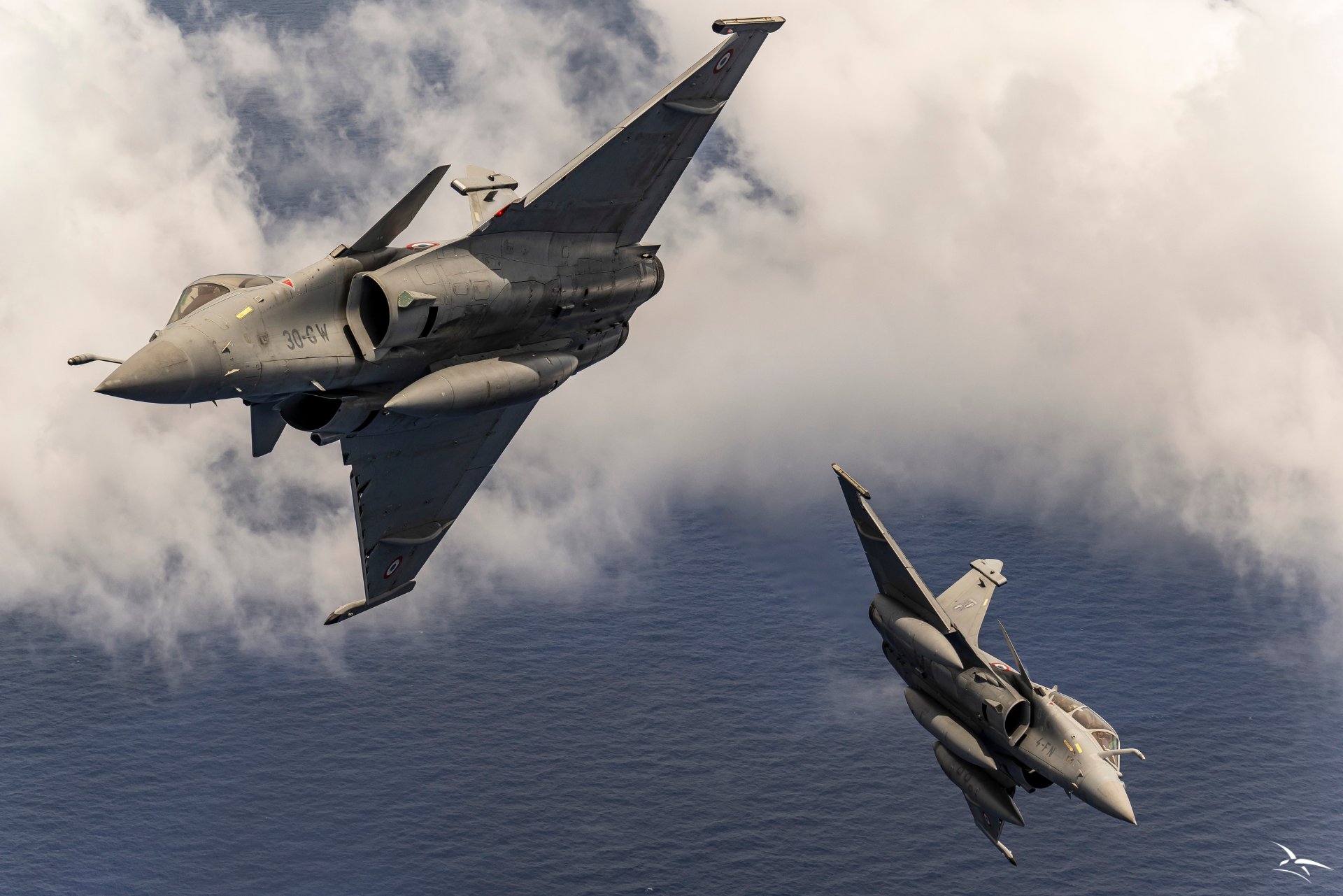
Finnish Air Force F-35A Lightning II jets have trained alongside U.S. F-22 Raptors from the Virginia Air National Guard in a rare joint stealth fighter exercise at Ebbing Air National Guard Base in Arkansas.
Two Virginia Air National Guard F-22 Raptors from the 192nd Fighter Wing of the 149th Fighter Squadron arrived at Ebbing Air National Guard Base on June 16 to take part in a combined training exercise with F-35 Lightning II aircraft from the Finnish Air Force, the Virginia Air National Guard said in a press statement.
The brief but intense two-day window underscored Ebbing’s role as a training hub for allied fifth-generation fighters, it added. Additionally, the statement emphasized that the exercise boosts the Virginia-Finland State Partnership Program, established in 2024.
“The Virginia Air National Guard’s experienced pilots and maintainers are a vital asset to this nation’s air dominance around the globe,” said Maj. Gen. James W. Ring, the adjutant general of the Virginia National Guard. “Sharing their expertise with our Finnish partners through the State Partnership Program strengthens our shared capabilities, interoperability, readiness and lethality.”
Finland ordered 64 F-35A Lightning II fighters through the HX Fighter Program to replace its aging F/A-18 Hornets. The first of these aircraft was formally delivered to Finland in December 2025, after which it completed its maiden flight and arrived at Ebbing Air National Guard Base in January 2026 for pilot training.
Notably, the two-day exercise was held days after the US Marine Corps (USMC) F-35B Lightning IIs conducted a series of unconventional operations from Finland’s highways, casting a spell over Finnish Air Force personnel. The aircraft, assigned to the 2nd Marine Aircraft Wing’s Marine Fighter Attack Squadron 224, became the first in the service to deploy to the Scandinavian nation as part of NATO-led Exercise Ramstein Flag 2026.
The USMC stated that the Finnish highway operation was designed to demonstrate combat adaptability in an increasingly contested Arctic region.
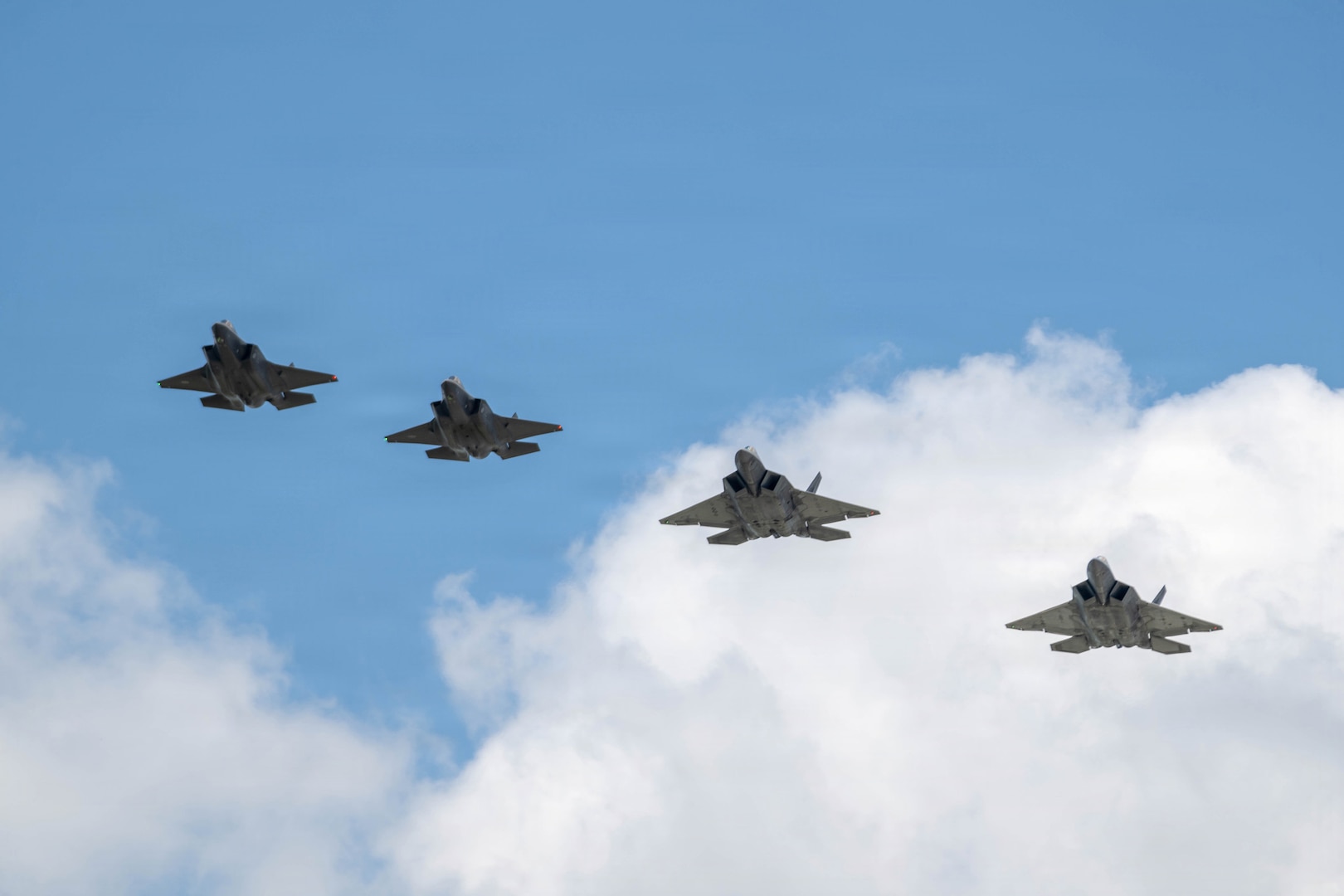
Nonetheless, training with the F-22 is a noteworthy experience, given that the Raptors are considered highly advanced fighter jets. The exercise allowed the Finnish pilots to train on two different advanced stealth fighters in realistic scenarios, accelerating the familiarity of Finnish pilots and maintainers with high-end NATO tactics and US 5th-generation doctrine early in their program.
The National Guard’s F-22 and Finnish F-35A pilots likely practiced sharing information, coordinating engagements, and executing complex missions together.
Training with Raptors could help Finland’s F-35 pilots refine tactics and gain firsthand experience of how these aircraft complement each other in a high-end conflict, which may be invaluable for Finland, a frontline NATO state that shares a long border with Russia.
It is worth highlighting that this is not the first time that the F-22 and the F-35—America’s two fifth-generation stealth fighters have come together for military drills.
For example, a pair of US Air Force F-22 Raptors engaged in a rare dogfight with South Korean F-35As over the Korean Peninsula in May 2024. The exercise, which marked the first simulated air battle between these advanced fighter jets of the two nations, featured close-range air combat maneuvers designed to test and enhance the capabilities of both sides.
The maneuvers allowed pilots to share the latest tactics and improve their skills in identifying and engaging enemy aircraft at close range, as the two sides noted at the time.
Before the 2024 drills, the US F-22s and F-35s operated alongside ROKAF F-35s and other aircraft in combined air operations as part of Vigilant ACE.
Similarly, during a one-day training exercise in 2018, two USAF F-22 Raptors faced off against two F-35s from the Royal Norwegian Air Force. At the time, a Norwegian F-35 pilot observed that training with the F-22s offered opportunities not typically available, since the F-35s frequently “overpower” traditional non-stealth aircraft.
The joint training between F-22 Raptors and F-35 Lightning II is very significant for pilots because, although both are fifth-generation combat aircraft developed by Lockheed Martin, they are very different kinds of fighters designed for different roles.
The F-22 & F-35 Must Integrate For Training
The F-22 Raptor and the F-35 Lightning II are positioned by the United States as the world’s most advanced fifth-generation stealth fighters.
The F-22 Raptor is a single-seat, twin-engine fighter that specializes in air dominance, whereas the F-35 Lightning II is a single-seat, single-engine, stealth multirole fighter jet that excels in ground attacks, air defense missions, and suppression of air defenses.
The F-22 excels in air superiority, boasting superior speed, supercruise, maneuverability, and stealth to penetrate contested airspace and clear threats, while the F-35 brings exceptional sensor fusion, data sharing, electronic warfare, and multirole strike capabilities.
Therefore, joint exercises between the two aircraft help determine optimal roles and the best way to combine their strengths, which may prove to be indispensable in combat.
The two aircraft use different datalinks and stealth-focused communications, which could potentially create challenges. But joint exercises help pilots test and refine workarounds, data-sharing protocols, and networked operations, which are critical to ensure seamless coordination between the F-22 Raptors and allied F-35s in a high-end conflict.
Regarding stealth technology, the F-22 Raptor is considered the world’s most stealthy fighter jet and reportedly boasts a cross-section even smaller than that of the F-35s.
“When it comes to sheer speed, the F-35 just can’t keep up. But it wasn’t built to. The F-35, with its air-to-ground combat design, is not designed for breakaway speed. It has a top speed of 1.60 Mach and less maneuverability than the F-22 in dogfight scenarios,” David Berke, a former Marine Corps officer and seasoned F-22 and F-35 pilot, earlier told the EurAsian Times.
“The Air Force expects that the F-35, with its stealth and sensors, will be able to fill the gaps between flights of F-22s during a large-scale engagement. The F-35 does not have the sheer speed and altitude of the Raptor, but it does have excellent sensors and stealth, which afford it decent capability against non-stealthy aircraft,” he added.

It must be noted that the F-22’s weapon bays are optimized for air-to-air missiles, such as the AIM-120, and the futuristic AIM-260 JATM (Joint Advanced Tactical Missile), and have limited air-to-ground munitions. Meanwhile, the F-35 has a more versatile payload, including a wide range of air-to-ground munitions, bombs, and standoff weapons.
On his part, Berke views the F-35 as a significant advancement in aerial combat, emphasizing its role as a battlespace sensor and adding that the Lightning II has unmatched decision-making skills both in the air and on the ground.
What makes the F-35 truly unique is its ability to fuse and share information, according to Berke. It also offers a data network linked to numerous other F-35s, making a vast array of information available to combatants, Berke told the EurAsian Times.
“The F-35’s ability to operate in hostile environments, coupled with its anti-access aerial denial, makes it a deadly stealthy machine. It can operate in places where the enemy or multiple enemies don’t want us to operate,” the former pilot stated.
It is safe to say that while the F-22 is the premier dogfighter and air-superiority king — faster, more agile, and built to clear the skies — the F-35 is the smarter, more connected multirole platform that can strike targets, gather intelligence, and operate in large numbers across services and allies. Together, they are far more powerful than the sum of their parts.
Therefore, joint exercises between these two jets are necessary to train pilots to exploit their different mission sets while operating as a single force against a common adversary.
- Contact the author at sakshi.tiwari13 (at) outlook.com
- Follow EurAsian Times on Google News