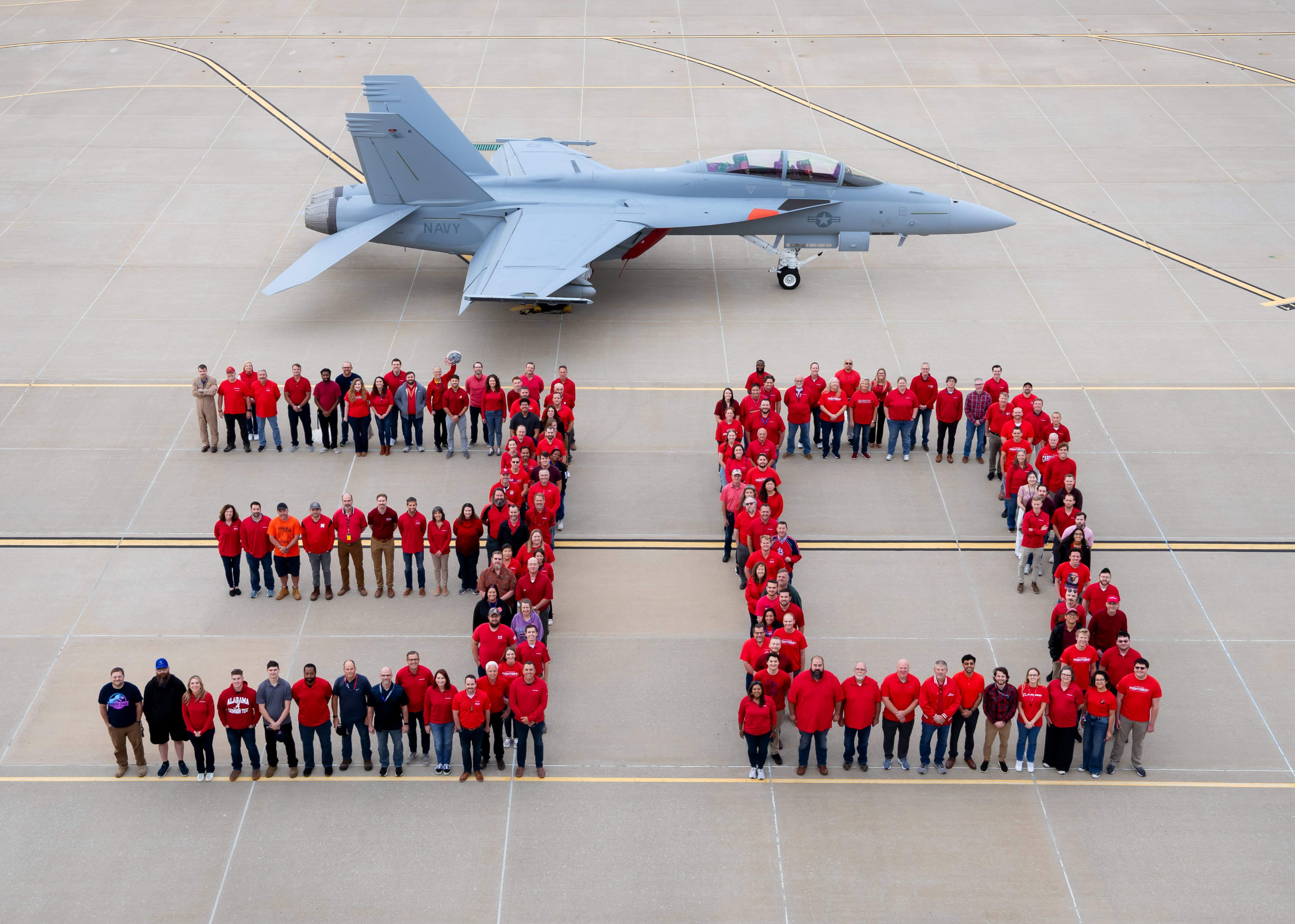
The F/A-18E/F Super Hornet, the workhorse of the US Navy that featured in the cult favourite Hollywood film, ‘Top Gun: Maverick’, is now 30 years old.
The Super Hornet took its maiden flight on November 29, 1995, and has since been central to the US Navy aviation.
“Thirty years ago, the first F/A-18 Super Hornet took to the skies for the first time. We’re thankful for the thousands of #TeamBoeing employees, partners, and suppliers who keep the Super Hornet modernized and evolving, delivering unmatched capabilities to naval aviation for decades to come,” wrote Boeing in a post on X.
Super Hornet was born out of an urgent need to fill a key capability gap in the US naval aviation at a time when the service was going through some major restructuring.
In the 1980s, the US Navy faced a looming capability gap as the A-6 Intruder fleet was aging, the F-14 Tomcat was proving increasingly expensive to maintain, and the baseline F/A-18 Hornet (from which the Super Hornet evolved) lacked the range and payload needed for deep-strike and long-endurance missions.
Since this was the era of austerity, and building a new aircraft from scratch would require a big investment, McDonnell Douglas came up with an interesting solution: a 70% larger, extensively redesigned version of the F/A-18 Hornet.
NATO Rushes 13 Sub-Hunting Frigates As Russian Submarines Prowl, Threaten North Atlantic
This plan, which was first known as “Hornet II” and then “Hornet 2000,” gave the Navy lower development risk and predictable costs while still allowing a significant capability expansion.
This proposal was selected in 1992, the first prototype flew in 1995, and the F/A-18E/F entered the US Navy fleet in 1999.
The Super Hornet was barely anything like the F/A-18 Hornet. It was essentially a new aircraft. It featured a fully new wing, was 25% larger, carried 33% more internal fuel, had a 50% longer range, and had new intakes, avionics design, and survivability measures. The aircraft came in two variants: the single-seat F/A-18E and the dual-seat F/A-18F.
The Super Hornet replaced the F-14 Tomcat in fleet defense, assumed the A-6 Intruder’s strike duty, and eventually served as the model for the EA-18G Growler, a dedicated Electronic Warfare combat aircraft that entered service with the US Navy in 2009.
“The Super Hornet is the second major model upgrade since the inception of the F/A-18 aircraft program, highly capable across the full mission spectrum: air superiority, fighter escort, reconnaissance, aerial refuelling, close air support, air defence suppression and day/night precision strike,” as per information on the official website of NAVAIR (Naval Air Systems Command).
The aircraft was upgraded to Block II standard in 2002, which included the Active Electronically Scanned Array (AESA) radar, improved sensors and avionics, increased range, and the capability to employ an arsenal of precision weapons. This aircraft then went on to become the workhorse of the US Navy’s carrier operations.
The US Navy’s F/A-18 Super Hornet fleet has faced a troubling string of incidents over the past year, including five Super Hornet crashes and two additional EA-18G Growler losses, its electronic warfare (EW) variant, as previously reported by the EurAsian Times.
The Navy lost at least three of these fighters in the waters of the Red Sea, where they were deployed aboard aircraft carriers dispatched to the West Asian region to battle the Yemen-based Houthis, a campaign that began late last year and stretched well into the summer of 2025.
More recently, a two-seater F/A-18E/F Super Hornet crashed into the South China Sea “while conducting routine operations” from the USS Nimitz in a mysterious accident on October 26. Efforts have been underway to salvage the wreckage.
Super Hornet’s Super-30 Years
The Super Hornet was first deployed for combat in 2002 in support of Operation Southern Watch. VFA-115 “Eagles” became the first squadron to deploy the Super Hornet aboard USS Abraham Lincoln.
During this campaign, the aircraft helped enforce a no-fly zone over Iraq, conduct interdiction missions, and provide aerial refuelling.
In November 2002, the Super Hornet made its combat debut with a strike against hostile targets (air defense systems and control and command bunkers) in Iraq’s no-fly zone.
By the middle of the new millennium, the Super Hornet was the most popular strike fighter on American carriers. The Super Hornet assumed a significant role of tanker, precision-strike, and ISR responsibilities.
During Operation Iraqi Freedom, which stretched from 2003 to 2011, the Super Hornet performed thousands of sorties from carriers, performing Suppression of Enemy Air Defenses (SEAD)/ Destruction of Enemy Air Defense (DEAD), close air support, deep strike, escort, air-to-air patrol, and precision strikes on strategic Iraqi infrastructure.
The Super Hornet’s APG-73 radar and sophisticated targeting pods allowed for all-weather operations, while its larger airframe allowed it to carry up to 17,750 pounds of ordnance, including laser-guided bombs (LGBs) and air-to-air missiles.
It performed SEAD missions using AGM-88 HARM anti-radiation missiles. Despite challenging desert conditions, these sorties demonstrated the Super Hornet’s reliability with a sortie generation rate of over 90%. Through Link 16 data links, its integration with joint forces improved combat coordination, making it essential in the dynamic environment of the Iraq War.
The aircraft contributed significantly to the ‘shock and awe’ campaign undertaken during Operation Iraqi Freedom. This technique attempted to decapitate the Iraqi leadership and break command structures through massive precision strikes on Baghdad and key military sites.
The first waves were flown by Super Hornets from VFA-14, VFA-41, and VFA-115, which launched JDAMs and LGBs targeting T-62 tanks, Ba’ath Party headquarters, and presidential palaces.
The Super Hornets also participated in ‘Operation Enduring Freedom’ in Afghanistan that lasted from 2001 to 2014.
The aircraft typically flew CAS (Close Air Support) for special operations and ground forces, provided armed overwatch, and supported strike coordination and reconnaissance (SCAR).
During this campaign, the Super Hornets delivered precision strikes in difficult mountainous conditions, including strikes to support coalition troops in extreme weather and low visibility.

The aircraft later went on to participate in operations against the Islamic State in Syria. It was responsible for the destruction of ISIS training camps, convoy interdiction, offensive counter-air, SCAR, and ISR, as well as maritime strike against ISIS oil shipping operations.
The aircraft secured its first and most stunning kill eight years ago when it shot down a Soviet-origin Su-22 in Syria. You can read a detailed account of this encounter in a previous EurAsian Times report.
More recently, the Super Hornet was deployed to the Middle Eastern theatre in March 2025, when US President Donald Trump launched ‘Operation Rough Rider’ against the Iran-backed Houthis.
It was regularly deployed to bomb Houthi targets inside Yemen using munitions such as Joint Direct Attack Munitions (JDAMs), AGM-154 Joint Standoff Weapons (JSOW), and GBU-53/B Stormbreaker glide bombs.
US Navy F/A-18E Super Hornet, sporting multiple Houthi drone kill marks, sitting on the deck of the USS Dwight D. Eisenhower (CVN 69) in the Red Sea. pic.twitter.com/AEXr2AqzEt
— OSINTtechnical (@Osinttechnical) March 19, 2024
Since at least 2023, the F/A-18E/F has also scored numerous aerial kills against unmanned aerial vehicles, mainly one-way attack Houthi drones, as evident by the kill markings that the aircraft now brandishes.
The Super Hornet Is Not Done Yet
The Super Hornet, which forms the backbone of the US carrier operations, has been upgraded multiple times to keep the aircraft combat-ready.
The latest Block III variant has advanced Network Infrastructure, including an improved computer (DTP-N), SATCOM, increased network throughput (TTNT), and sensor/platform integration, enabling large amounts of data to be on and off the airplane.
It also has the ability to receive targeting information from platforms such as the EA-18G and the E-2D Hawkeye.
Additionally, it also offers enhanced situational awareness through a new Advanced Cockpit System. A new 10×19-inch touchscreen display allows the pilot to see, track, and target multiple long-range targets simultaneously.
“The latest Block III upgrade extends the platform’s service life and range, and incorporates an advanced cockpit system, reduced radar cross section, and an advanced networking infrastructure,” according to NAVAIR.
The US tried to promote the aircraft in the export market, but with limited success. Only Australia and Kuwait purchased the F/A-18E/F fighters.
After India rejected the aircraft in favor of the Rafale-Marine and no foreign customer showed interest, Boeing decided to shutter production of new-build F/A-18E/F Super Hornet fighter jets at its St. Louis facility after the final deliveries.
However, the Super Hornet is not yet done and is expected to serve into the early 2040s alongside the F-35C Lightning II and the future F/A-XX.
While the F-35C Lightning II, with its stealth and advanced sensor capabilities, is also in service with the US Navy, the Super Hornet remains the backbone of the service due to its versatility, greater numbers, and operational reliability. The F-35C’s role is now growing within the US Navy, but it cannot replace the Super Hornet’s volume or range (about 500 nautical miles combat radius) in high-tempo operations like those seen in the Red Sea.
In fact, the US Navy has been bolstering the Super Hornet’s firepower, indicating that the aircraft is expected to serve as its main strike platform for years to come.
The US Navy has been steadily integrating newer, longer-range missiles into its aircraft. Last year, for instance, the aircraft was spotted with the AIM-174B missiles — the air-launched version of the SM-6 missile during the RIMPAC 2024 drills.
Earlier this year, the US Navy officially coined the term “Murder Hornet” to refer to the F/A-18E/F Super Hornets equipped with a formidable combination of five AIM-120 Advanced Medium Range Air-to-Air Missiles (AMRAAMs) and four AIM-9X Sidewinders. This powerful configuration, aimed at enhancing operational effectiveness, was among the key developments highlighted in the Navy’s 2024 year-in-review factsheet.
The Super Hornets were believed to be carrying the GBU-53/B StormBreaker glide bomb, also known as the Small Diameter Bomb II (SDB II), during the campaign against Houthis, as noted by reports earlier this year. Additionally, a set of newly released photos showing an F/A-18E Super Hornet fighter with a payload of AGM-84H/K Standoff Land Attack Missile–Expanded Response (SLAM-ER) was published this week. The images in question, posted by the US Department of Defense, were originally taken in April 2025.
The aircraft is expected to be replaced by the F/A-XX, a next-generation strike and air dominance platform. Currently, Boeing and Northrop Grumman are the final contenders in the F/A-XX competition. Lockheed Martin, despite being the primary developer of the F-35 family, has reportedly been eliminated from the program.
The rationale is that while the Super Hornet is versatile and combat-proven, its operational combat radius is limited to approximately 500–650 nautical miles under a realistic weapons load. This range limitation is increasingly viewed as a liability, particularly in potential conflict zones like the South China Sea, where China’s long-range missile systems and anti-access/area denial (A2/AD) strategies aim to keep U.S. forces at bay.
However, the Pentagon has prioritised the US Air Force F-47 sixth-generation fighter jet over the F/A-XX. Defense Secretary Pete Hegseth recently reiterated his opposition to the Navy’s plans to develop its next-generation F/A-XX fighter, arguing that it will overlap with the USAF’s jet.
For now, the F/A-XX remains a work in progress, and the Super Hornet dominates the carrier wings of nearly all 11 aircraft carriers in service with the US Navy.
- Contact the author at sakshi.tiwari13 (at) outlook.com
- Follow EurAsian Times on Google News