

The anniversary of the ‘Battle of Donetsk Airport’ is a reminder that the conflict between Russia and Ukraine did not begin on February 24, 2022, when Russian forces launched a full-scale invasion of Ukraine, but in 2014, when Moscow seized Crimea.
“Every year on this day, January 20, we remember the defenders of Donetsk Airport. People who held their position for at least 242 days, never surrendered, and endured encirclement and constant attacks,” Ukrainian President Volodymyr Zelenskyy wrote on X, commemorating the legendary battle.
“They were called Cyborgs, yet they were simply showing the very best of the Ukrainian character, the Ukrainian heart, and the Ukrainian spirit – not to give up, to fight the occupier, and to astonish the world with what Ukraine is capable of. These are exactly the people we must support. We are grateful to everyone standing with Ukraine. We thank everyone who is helping us,” the post further added.
Separately, Kyrylo Budanov, Head of the Office of the President of Ukraine, honoured the defenders of Donetsk Airport, saying, “They held the defence then, we hold it now. The 242 days of heroic defence became a symbol of the indomitable Ukrainian spirit.”
These poignant tributes to the soldiers who lost their lives come as the Ukraine war is rapidly approaching its four-year mark. In fact, large parts of the country are currently reeling with power outages due to targeted attacks on power grids in the country, as part of an intensified offensive by Russian forces.
Four years after the full-scale invasion, Russia occupied roughly 20% of Ukraine and about four thousand square kilometres of territory, including large swathes of Donetsk.
Prelude To The Battle For Donetsk Airport
The Battle for Donetsk airport was a result of the political upheaval that erupted in Ukraine when the then-Ukrainian President Viktor Yanukovych went back on the promise to sign an Association Agreement with the European Union in November 2013, and instead chose to forge closer ties with Russia.
Yanukovych’s unilateral decision triggered widespread protests in Ukraine. Russia alleged that these protests were manufactured and supported by the West.
The protests turned violent between January and February of 2014, and inadvertently led to clashes between demonstrators and security personnel, and deaths of civilians.
With the situation spiralling out of control, the Ukrainian parliament voted to remove Yanukovych from office on February 22, 2014, and later formed an interim government.
However, Russia denounced this as a “coup” orchestrated by NATO and launched a military intervention in Ukraine. By late February 2014, Russian troops entered Crimea, and by March that year, they seized control of the Ukrainian-controlled peninsula.
Ukraine lost the strategic peninsula of Crimea, the crucial port of Sevastopol, and its entire Navy.
Russian President Vladimir Putin justified the annexation as defending the rights of Russian speakers and nationals in Crimea and southeast Ukraine. At the time, the Crimeans chose to join Russia in a controversial referendum held by Moscow, following which the peninsula was formally annexed.
Nonetheless, this marked the beginning of the Russo-Ukrainian War and heightened tensions in eastern Ukraine, where large Russian-speaking populations sided with Moscow.
In fact, by April 2014, large armed groups seized administrative buildings in Donetsk and Luhansk and proclaimed the Donetsk People’s Republic (DPR) and the Luhansk People’s Republic (LPR), respectively.
In retaliation, Ukraine deployed its Anti-Terrorist Operation (ATO) military and National Guard units to reclaim control over these rebel territories.
Notably, Petro Poroshenko was elected president of Ukraine on May 25, 2014, in an election boycotted by separatists.

The next day, on May 26, 2014, the DPR militants took control of Donetsk International Airport, a vital hub on the outskirts of the city, and demanded that Ukrainian troops leave.
This led to the First Battle of Donetsk Airport, where separatists suffered severe casualties, and the Ukrainian paratroopers seized control on May 27, 2014.
The Airport remained under Ukrainian control and essentially became a symbol of government resolve amid encirclement by separatist-held territory.
The summer of 2014 saw brutal fighting.
The Ukrainian forces initially pushed the separatists back, but a counteroffensive in August, which the West alleged was carried out by regular Russian soldiers, reversed those gains.
This culminated in the devastating Battle of Ilovaisk, where hundreds of Ukrainians lost their lives, and then came the second battle of Donetsk Airport, which came to be known as the Battle of Donetsk Airport.
Battle of Donetsk Airport
In September 2014, Ukraine, Russia, the OSCE, and separatist representatives signed the first Minsk Protocol, which established a ceasefire and fixed the withdrawal lines.

However, this ceasefire did not last long enough, and hostilities resumed immediately after.
By this time, the Donetsk International Airport was the last Ukrainian-held position in the city after the surrounding area fell under occupation. It was located on the northern edge of Donetsk, eastern Ukraine’s biggest city and a key rebel stronghold, which was used as a launchpad by the militants to launch attacks on Ukrainian security forces.
The Airport became the scene of an intense showdown. The one who controlled the Airport could effortlessly airlift munitions, hardware, and manpower into the warzone.
On their part, the DPR forces backed by Russia decided to target the Airport to tear down the last fort of Ukrainian resistance and seize full control of the city.
They were, however, met with fierce resistance from Ukrainian soldiers, who were reportedly dubbed “Cyborgs” for their impressive warfighting capabilities. The term first appeared online, and then found an echo across the country, with most people seeing their fight as superhuman.
These cyborgs reportedly held out amid relentless artillery, missile barrages, tank battles, and urban combat, and this lengthy airport battle became a symbol of Ukrainian resilience.
Trapped inside the ruins as the last line of Ukrainian defence, the Cyborgs often took to social media to share their plight. “It’s cold. It’s dark. It’s dangerous all the time. All this affects how you think. You get used to shots being fired pretty quickly,” wrote Maxim Muzyka, external. “You get used to everything,” he added.
A documentary released much later showed the extent of damage that the Russian-backed forces had caused. They would attack Ukrainian tanks and armoured personnel carriers with missiles, charring them beyond recognition.
“We would be praying,” recalled a Ukrainian in the documentary. “No one wanted to be burned to death.”
After a protracted conflict surrounding the Airport and what is remembered and celebrated as an incredible spirit shown by the Cyborgs, Russian tanks and military units rolled onto the scene to support the Donetsk separatists in January 2015.
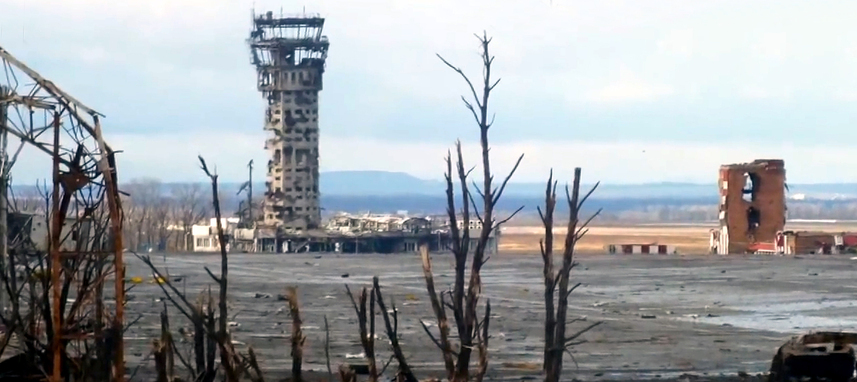
This marked the beginning of the end of the Cyborg struggle.
These reinforcements forced Ukrainians into a comparatively limited area of the bombed-out terminal after driving them from the airport tower and its outbuildings. And, towards the end, the Ukrainians had no supplies, medical attention, or help from tanks or artillery.
As per some accounts, Ukrainian tanks arrived at the scene to assist the troops lodged there, but a tipping point had been reached when they turned around and left.
“No one showed up,” one person remarked in the documentary. “We requested assistance.”
The majority of the Ukrainians were crushed to death when the Russians eventually overran the area and set off an explosion that threw the terminal’s concrete flooring onto them on January 20, 2015.
They continued to persevere, collecting their injured to stay warm as they gradually perished. But when the fighting officially ended, nearly 100 Ukrainian soldiers had died, and over 290 had been wounded.
- Contact the author at sakshi.tiwari13 (at) outlook.com
- Follow EurAsian Times on Google News


