

As the US-Iran War entered its 12th day with no signs of an early resolution, the European Council President, Antonio Costa, issued a stark warning.
“So far, there is only one winner in this war – Russia,” Costa said in a speech to European Union ambassadors in Brussels on March 10.
“It gains new resources to finance its war against Ukraine as energy prices rise. It profits from the diversion of military capabilities that could otherwise have been sent to support Ukraine. And it benefits from reduced attention to the Ukrainian front as the conflict in the Middle East takes centre stage.”
Indeed, between February 28, when the US & Israel started the Iran War, and March 10, oil prices have jumped as much as 64 percent.
On February 28, oil was priced at approximately US$72.48 per barrel. On March 10, it hit a peak of US$119.50 per barrel.
Meanwhile, the US has issued a temporary 30-day “waiver” allowing Indian refiners to buy Russian crude already at sea.
India had, in recent months, significantly cut its oil imports from Russia amid trade negotiations with the US, as Washington made it a prerequisite for scrapping its 25% additional penal tariff on New Delhi.
Notably, for most of 2025, India was the second-largest buyer of Russian fossil fuels, trailing only China.
Now, with the 30-day waiver, Indian imports of Russian oil are set to increase again, providing Russia a valuable stream of revenues to finance its war in Ukraine. For most of 2025, India’s monthly oil imports from Russia were over US$5 billion.
Meanwhile, the Ukrainian President Zelenskyy is already issuing distress warnings that a long Iran War could leave Ukraine defenseless.
If the conflict in the Middle East drags on, it “will certainly affect supplies,” Zelenskyy told reporters in a WhatsApp group message earlier this month.
“So far, everything is going as it was, but of course we know that a long war, if it is long, and the intensity of hostilities will affect the number of air defenses for us,” he said.
“Everyone understands that for us this [air defense missiles] is our life,” Zelenskyy added.
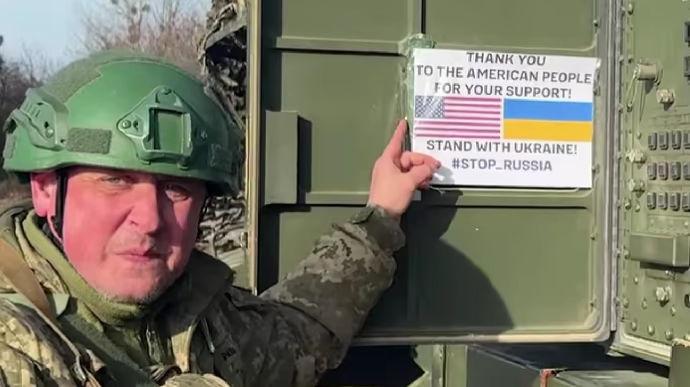
The Patriot missile interceptors are crucial for Kyiv’s air defense and for shooting down incoming Russian ballistic missiles. In fact, the Patriots have been so crucial that Zelenskyy has been repeatedly trying to buy more Patriot batteries from the US.
In April last year, Zelensky said Ukraine is ready to purchase 10 Patriot systems. “That’s $15 billion. We are ready to pay it. We will find the money and pay for it.”
In November, Zelensky said Ukraine wants to buy 25 Patriot batteries.
“Today, we want to order 25 Patriot systems from the United States,” Zelenskyy wrote on X today, saying there is a “clear budget” for the acquisition and imploring European “colleagues” to loan “their systems now and then take back ours once they arrive from the manufacturers.”
However, a prolonged war in the Middle East could mean that Ukraine might struggle to get regular interceptor supplies even for its existing Patriot batteries.
The fervent pace with which Israel, the US, and its Gulf allies are burning their air defense missile stocks; soon, there could be a crunch for Patriot interceptors globally. However, for Ukraine, even a temporary supply bottleneck could mean losing territory on the battlefield that it has heroically defended for the last four years.
According to a New York Times report, the US and its allies have expended over 800 anti-ballistic missiles from MIM-104 Patriot long-range air defense systems, worth USD 2.4 billion, during just the first five days of hostilities with Iran.
Notably, this exceeds the total estimated number of Patriot interceptors launched throughout the entire Russian-Ukrainian War, in which the Patriot has been operated for close to three years, and is estimated to have further worsened the already very severe shortage of interceptors available.

Presidential adviser Dmytro Lytvyn told The New York Times that Kyiv has received about 600 missiles for the U.S.-made Patriot air defense system since the beginning of Russia’s full-scale invasion.
The Patriot interceptors were used to defend against approximately 2,000 Iranian drones and 500 missiles targeting Israel and Gulf countries.

However, Iran still has a very large arsenal of ballistic missiles and thousands of Shahed drones. If the conflict enters a ‘war of attrition’ phase, it could further strain the already limited supply chains of Patriot interceptors.
According to the Atlantic, the U.S. military leaders may soon be forced to choose between protecting troops and civilians near Iran and maintaining U.S. combat readiness against larger, more consistent threats from Russia and China.
The US made an average of 270 advanced Patriot missiles a year from 2015 to 2024, according to the Centre for Strategic and International Studies (CSIS). However, Lockheed Martin delivered 620 PAC-3 MSE in 2025, and the current capacity for producing PAC-3 interceptors stands at around 600.
This means that the US and its allies have burned through more Patriot interceptors in just the first five days of war than the US has the capacity to produce in the next year.
However, it is not just Ukraine that is anxiously watching the Middle East conflict unfold, since the Patriot air defense systems are also used by Japan, South Korea, and Taiwan in the Indo-Pacific, and it’s not just Patriots but also THAAD that is a cause for worry.
Iran’s stockpile of ballistic missiles and drones pales when compared to China’s arsenal of ballistic missiles, ICBMs, hypersonic cruise missiles, and hypersonic glide vehicles (HGVs).
Furthermore, North Korea also maintains a formidable arsenal of ICBMs.
Amid reports that Iran has targeted multiple THAAD batteries in the Middle East, there are reports that the US has reportedly started moving parts of the system, along with other military hardware, out of South Korea for deployment in its war against Iran.

The US media has reported that the Pentagon is moving parts of a THAAD system to the Middle East, citing two officials. Currently, there are only 10 THAAD systems globally. The US operates seven of these; two were sold to the UAE, and one THAAD battery is with Saudi Arabia.
According to unconfirmed reports, Iran has targeted four different THAAD batteries.
The plans to move the THAAD system from South Korea to the Middle East have triggered doubts over Donald Trump’s security commitment to South Korea.
The hasty transfer of the THAAD system, which incidentally was deployed to South Korea despite strong protests from the local communities, has left South Korea’s liberal president, Lee Jae Myung, trying to reassure the public that the country was able to deter threats from the North, even if the US redeployed weapons and other military assets to the Middle East.
Noting that Seoul had opposed the redeployment of US artillery batteries and air-defence units, Lee told a cabinet meeting, “If asked whether that would seriously hinder our deterrence strategy against North Korea, I can say with certainty that it would not,” the Guardian reported.
However, if the Iran war drags on, the US allies in the Indo-Pacific and Europe will start getting more insecure.
Russia’s involvement in the Ukraine War meant that it was unable to protect its interests in Syria, Venezuela, Armenia, Libya, Cuba, and Iran. The Kremlin might have gained territory in Ukraine, but its global influence has waned considerably.
There are apprehensions that the US might have committed a similar mistake in Iran. It might dismantle Tehran’s ballistic missile program and its Navy, but it is leaving Ukraine and South Korea defenseless against adversaries that are far more dangerous.
- Sumit Ahlawat has over a decade of experience in news media. He has worked with Press Trust of India, Times Now, Zee News, Economic Times, and Microsoft News. He holds a Master’s Degree in International Media and Modern History from the University of Sheffield, UK.
- VIEWS PERSONAL OF THE AUTHOR.
- He can be reached at ahlawat.sumit85 (at) gmail.com


