

US defense giant General Dynamics has unveiled plans to arm the Abrams Main Battle Tanks (MBTs) with Switchblade kamikaze drones. Interestingly, both platforms have been deployed by Ukraine to counter the ‘superior’ Russian military.
General Dynamics Land Systems (GDLS), in collaboration with drone builder AeroVironment (AV), is arming the M1A2 Abrams main battle tanks with the Switchblade series of loitering munitions. This integration is achieved through a system called Precision Effects & Reconnaissance, Canister-Housed (PERCH).
PERCH was first unveiled on October 14, 2025, at the Association of the United States Army (AUSA) 2025 expo, with GDLS describing it as a non-invasive integration for beyond-line-of-sight reconnaissance and strikes.
PERCH is a modular kit that integrates Switchblade 300 and Switchblade 600 loitering munitions into M1A2 Abrams SEPv3 main battle tanks and Stryker infantry carrier vehicles for beyond-line-of-sight surveillance and lethality. It essentially replaces the Abrams loader sponson box and is bolted into position using pre-existing connection points, eliminating the need for welding or cutting.
A photograph of one of the loitering munitions being fired from a pop-up canister installed on the tank’s turret, replacing the typical loader sponson box, was also recently published by GDLS. The launcher can hold three Switchblade 300s and one 600 at a time.
GDLS announced on December 5, 2025, that the combination was tested at the US Army’s Machine-Assisted Rugged Sapper (MARS) event in Fort Hood, Texas, on October 26–30. At the time, PERCH was used at the event via a tablet interface, but according to GDLS, subsequent versions will be fully integrated with existing vehicle computer systems.
NEWS 📢: General Dynamics Land Systems and @aerovironment successfully demonstrate PERCH loitering munitions launcher
Full release: https://t.co/Ci0WhXcOdd#ThePowerToWin pic.twitter.com/kGdWEqi5ld
— General Dynamics Land Systems (@GD_LandSystems) December 5, 2025
This unique integration transforms the MBTs from standalone firepower platforms into hybrid drone carriers by employing unmanned aerial vehicles (UAVs) for target acquisition, precise hits, and monitoring.
With this, the Abrams gets over-the-horizon lethality and extended-range monitoring. This can even be expanded to beyond-line-of-sight (BLOS) in some situations, where the loitering munition is used in an autonomous, preprogrammed mode to fly a path and/or hit a fixed target.
“PERCH allows units to deploy Switchblade loitering munitions far forward on the battlefield while remaining covered and concealed themselves,” Jim Pasquarette, vice president, US strategy and business development, General Dynamics Land Systems, was quoted as saying in the official press statement. “We have seen a lot of Soldier interest in this readymade, effective concept, and we look forward to future demonstrations. With our partners at AV, we’re generating the power to win on the modern battlefield.”
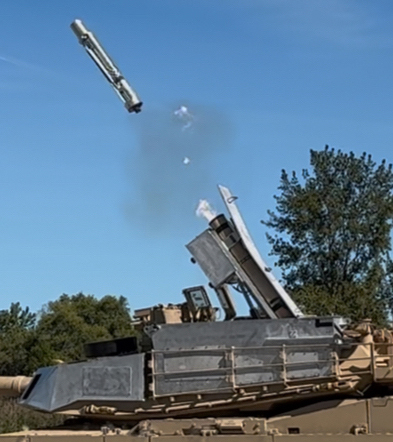
PERCH would enable Abrams to use indirect fire to deliver precise effects, such as engaging targets at long ranges from fortified positions where it cannot use its main gun.
In fact, the tank’s ability to host the Switchblade would provide it with an organic extended-range surveillance capability, allowing it to scout ahead for potential threats without relying on intelligence from other units.
This unique integration would provide enhanced situational awareness by giving the crew “eyes in the sky” and allowing them to spot threats 5-10 kilometres away. This would reduce vulnerability to ambushes and turn tanks into force multipliers, coordinating with infantry or artillery via drone data.
In urban or forested terrain, this would help mitigate line-of-sight limitations.
This approach likely aims to enhance the tank’s effective range while reducing crew exposure to threats such as hostile drones and anti-tank guided missiles. This integration is purportedly based on the lessons learnt in modern battlefields, including the Ukraine War, which has been heavily dominated by cheap drones.
Both Abrams MBTs and Switchblade kamikaze drones were deployed by Ukraine against the Russian military. While the Switchblade drones have performed admirably in urban settings, the “downgraded” M1A1 Abrams MBTs suffered few losses, mainly due to First Person View (FPV) drones and loitering munitions.
The GDLS seeks to combine the individual advantages of the two platforms into a lethal platform capable of delivering a significant blow to the enemy.
Switchblade 300 is a small kamikaze drone that can carry a 4-pound high-explosive payload and fly for about 15 minutes. It has a maximum range of just over six miles or about 10 kilometres.
Meanwhile, the Switchblade 600 is relatively larger and potentially offers long-range, higher-endurance reconnaissance and strike capabilities with a multipurpose warhead.
Therefore, the Switchblade-600 could be launched from the Abrams to demolish buildings and penetrate heavy armour, whereas the Switchblade-300 could be used to target troops and light vehicles.
Launching drones from tanks would address the persisting “drone vulnerability” conundrum faced by ground-based platforms. It would expand lethality and make tanks less of “sitting ducks” by shifting risk to disposable UAVs. This hybrid approach would interact with networked combat, minimize crew losses, and maximize ammunition utilization.
GDLS, on its part, is currently in talks with the US Army to deliver an improved version of PERCH for testing in the second part of the next year.
Speaking on the sidelines of the Maneuver Warfighter Industry Symposium in Detroit, Scott Taylor, director of business development at GDLS, informed Janes that engineers will prototype a design that makes it easier to reload the Switchblade 300 and 600 loitering bombs
Improving Abrams Has Been A Priority
Earlier this year, the US Army allocated $107 million to enhance the survivability of over 400 of its M1 Abrams MBTs, as seen in the 2026 Procurement of Weapons and Tracked Combat Vehicles (W&TCV, Army) report.

The upgrades include “belly” protection against mines and improvised explosive devices, laser attack warning receivers, top attack protection, and “stealth-enhancing” coating, all of which are intended to boost the survivability of the tanks that suffered a debacle in Ukraine.
Like most Western main battle tanks, the Abrams MBTs are designed for “tank-on-tank” combat and are equipped with substantial frontal protection. However, the Abrams proved to be extremely vulnerable to first-person view (FPV) attack drones, as well as modern anti-tank guided weapons (ATGWs) and guided artillery.
The majority of the funding, nearly $92 million, will be allocated to the GM1914 VPS Top Attack Protection (TAP) passive armour kits, designed to provide additional overhead protection for the crew compartment and hatches against shaped-charge and explosively formed projectiles (EFPs).
Although the service did not elaborate on what this top attack protection system would look like, it is widely believed to be similar to the so-called Cope Cages, based on the vague description.
TAP “is a passive add-on armour to the base vehicle configuration,” states the Army’s Fiscal Year 2026 Justification Book. “It is strategically placed over crew compartments and hatches, working in tandem with the base vehicle armour to mitigate damage from overhead threats. It is most effective against Explosively Formed Projectiles [EFPs] and Shaped Charge Jets.”
- Contact the author at sakshi.tiwari13 (at) outlook.com
- Follow EurAsian Times on Google News


