

Israeli Prime Minister Benjamin Netanyahu’s press office posted a short AI-generated video on Instagram depicting Netanyahu and US President Donald Trump piloting an aircraft that bears an uncanny resemblance to the B-2 stealth bomber that bombed Iran’s nuclear facilities in June 2025.
The opening scene of the video, posted on December 24, features an overhead view of an aircraft that appears to be a B-2 Spirit stealth bomber flying over a desolate desert landscape, likely symbolising the Middle Eastern terrain.
Notably, the Israeli Prime Minister’s Press Office (GPO) symbol subtly overlays the content in the corner, indicating the official sanction.
The footage then shows a close-up of the bomber’s cockpit, with Trump piloting the aircraft and Netanyahu as the co-pilot. Interestingly, both wear aviator-style sunglasses, which gives them a tough, dramatic look evocative of action movies. The two leaders are seen smugly glancing at one another as the camera zooms in on them.
As the video proceeds, the view pulls back slightly, showing just the cockpit canopy as the bomber continues its flight. It has no dialogue or dramatic background score except the powerful sound of the bomber’s engine.
Netanyahu’s press office shared this AI-generated video on Instagram. pic.twitter.com/0miii9wicK
— Clash Report (@clashreport) December 24, 2025
Notably, the clip lasts about 6-7 seconds. It comes six months after the US B-2 bombers escorted by the F-35 and the F-22 stealth fighters bombed Iranian nuclear facilities as part of ‘Operation Midnight Hammer’ on June 22, 2025.
The caption accompanying this video reads: “Our victory lap. #sixmonths.”
The video potentially aims to send a message of force to Iran, which has vowed to bolster its military and ramp up its missile program amid sustained security threats in the region. But more importantly, it appears to symbolise an unwavering US-Israel alliance.
B-2 Bomber In 12-Day War
The US operation against Iran, codenamed “Operation Midnight Hammer,” involved more than 125 aircraft and a deception operation that deployed bombers over the Pacific as a “decoy,” as detailed by the Chairman of the Joint Chiefs of Staff, Gen. Dan Caine.
Seven B-2 Spirit stealth bombers from Whiteman Air Force Base, Missouri, dropped 14 GBU-57 Massive Ordnance Penetrators on the deeply buried Fordow Uranium Enrichment Plant and the Natanz Nuclear Facility, whereas a comparable number of these bombers travelled to Guam as decoys.
Lockheed Martin CEO Jim Taiclet later said at an earnings call that F-22 and F-35 stealth fighters led the mission, adding that these fighters provided air dominance and defence suppression required for the bombers to reach Iran’s hardened nuclear sites.
“Our platforms operated essentially undetected in highly defended and contested airspace, underscoring the value of advanced stealth, superior electronic warfare, and broadband communications capability,” he asserted.
The assertion was confirmed when the USAF announced F-35’s role in carrying out SEAD (Suppression of Enemy Air Defences) during the mission.
Additionally, a US Navy submarine launched “more than two dozen Tomahawk land attack cruise missiles against key surface infrastructure targets at Isfahan nuclear facility.”
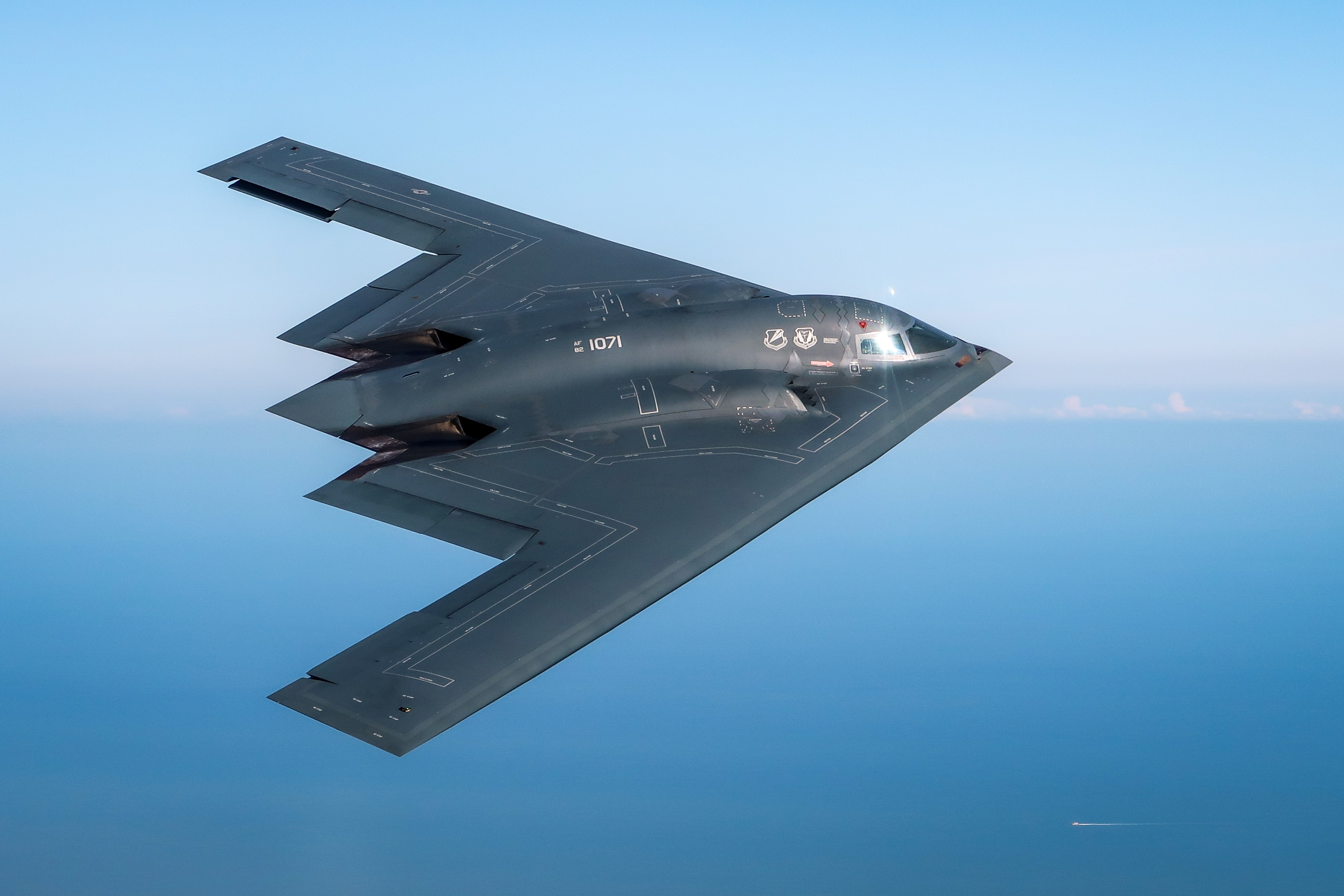
The US B-2 bombing of Iran’s nuclear facilities essentially ended the 12-Day War between Israel and Iran that had begun on June 12 when the Israel Defence Forces (IDF) launched ‘Operation Rising Lion’ with massive airstrikes on Iranian nuclear sites, military infrastructure, IRGC leaders, and nuclear scientists.
As he launched the operations, Netanyahu predicted that the war, which involved strikes on multiple targets and assassinations of top leaders of the Iranian Revolutionary Guards Corps (IRGC), would bring Tehran to its knees and end immediately.
However, Iran managed to absorb the Israeli attack. It retaliated with multiple barrages of missiles and drones at Israel, some of which got through the coveted Israeli air defence network to reach their designated targets.
This created a stalemate-like situation, which ended only when the US President ordered that the B-2s drop the MOP on Iranian facilities.
Following the strikes, on the evening of June 23, 2025, Trump announced a ceasefire between Israel and Iran, stating that both sides had accepted a US and Qatar-mediated proposal. The ceasefire took effect on the morning of June 24, despite initial violations, but it ultimately held under US pressure.
Iran launched a retaliatory strike at a US base in Qatar, but it appeared to be more symbolic and was reportedly communicated to Washington beforehand. The Iranian ballistic missile strike caused very little damage to infrastructure, and there were no casualties.
Notably, Israel justified its attack on Iran because Tehran was pursuing the development of a nuclear weapon. It said that the attacks against Iran’s top military officials, nuclear scientists, uranium enrichment facilities, and ballistic missile program were necessary to prevent Iran from attacking (pledge of destroying) the Jewish state.
The Combat Aircraft Link Between US & Israel
The AI-video has been framed as a “message to Iran” in some interpretations, amid reports of US or allied strikes using similar aircraft.
However, it may also bear a reminder that the US has relentlessly assisted Israel in assembling a dominant air force with state-of-the-art fighter jets.
The current combat fighter inventory of the Israel Air Force (IAF) consists exclusively of American-designed and primarily U.S.-manufactured aircraft, many of which are customised for Israeli requirements.
This includes the F-35I Adir, the most powerful export variant of the aircraft in the world that features unique electronic warfare and systems integration; and the F-16 and F-15 that have been repeatedly used in all of Israel’s recent military campaigns, including against Iran, Gaza, Hezbollah, and Hamas.

Israeli fighter jets played a central role in Operation Rising Lion, the surprise air campaign that initiated the conflict on June 13, 2025. Over 200 jets participated in the opening waves, striking about 100 targets across Iran with more than 330 munitions.
The F-35 led initial penetrations due to its stealth capabilities, suppressing/degrading Iranian air defences and enabling follow-on strikes, which helped it achieve air superiority over Iran. However, the bulk of precision strikes against missile launchers, production facilities, and infrastructure were conducted by F-15s and F-16s.
Israel was the first operator of F-35 outside the US, and the first country in the world to use it in combat. Additionally, Israel has already placed an order for the F-15EX—the latest variant of the F-15 Eagle—becoming the only export customer of the aircraft.
Therefore, it is safe to say that the AI-generated video on a symbolic “victory lap” serves as a bold reminder of the unbreakable US-Israeli alliance that decisively tipped the scales in the 12-Day War.
- Contact the author at sakshi.tiwari13 (at) outlook.com
- Follow EurAsian Times on Google News


