

A chilling new video released by Iranian media captures the moment a missile — identified by experts as a U.S. Tomahawk — struck an IRGC naval base adjacent to Shajareh Tayyebeh girls’ elementary school in Minab, which killed at least 165 children.
As previously reported by the EurAsian Times, the United States and Israel launched a coordinated military operation against Iran on February 28, 2026.
Framed by US President Donald Trump as a preemptive strike to dismantle Iran’s nuclear program, ballistic missile arsenal, and military leadership, the joint US-Israel attacks began with hundreds of strikes using Tomahawk missiles, fighter jets, B-2 bombers, suicide drones, and other support assets.
On the first day, Shajareh Tayyebeh girls’ elementary school in Minab, in southern Iran, may have been erroneously struck by a missile. The strike, described as one of the deadliest single incidents against children in recent memory, killed more than 165 girl students aged between 7 and 12 years.
The incident sparked global outrage, drew condemnations from international organisations, such as the United Nations, and was considered a grave violation of international humanitarian law.
Iran accused the US and Israel of deliberately targeting the school as a war crime—a charge that has been denied by both countries. On the contrary, US President Donald Trump denied US involvement in the strike and instead blamed Iran for the attack.
“In my opinion, based on what I’ve seen, that was done by Iran,” he told reporters when questioned about the US military’s role in the devastating strike over the weekend.
While the incident is still under investigation, evidence points to alleged US involvement. The latest footage published by the Iranian Mehr News shows a US airstrike targeting a building at the Islamic Revolutionary Guard Corps naval base on February 28, next to the affected elementary school in Minab.
Recorded from a nearby construction site, the footage shows a missile resembling a Tomahawk Land Attack Missile (TLAM) right before it strikes the Iranian naval base.
As it proceeds and the camera moves to the right, a massive cloud of smoke is visible coming from the Shajareh Tayyebeh school. Subsequently, it shows dozens of people fleeing the strikes.

Geolocating the clip, Bellingcat stated: “The red cone superimposed over this image shows the estimated area of impact of the missile visible in the footage. The graphic also shows the position of a clinic, the school, and other damaged buildings.”
“Planet Labs satellite imagery shows that only two structures within this red cone were damaged, including a clinic. The other structure appears to be an earth-covered magazine or bunker,” it added.
Notably, only the United States uses the Tomahawk missile, which is not known to have been delivered to Israel.
“From the video and satellite images, the damage looks most like ‘(2) misidentification” to me, but an investigation is necessary,” Dr. Jeffery Lewis, Distinguished Scholar of Global Security at Middlebury College, wrote on X.
Analysing the video, he said: “The camera looks like it has a pretty narrow field of view, ~30°. As best I can work out, this is a strike on one of the other buildings at the IRGC compound — the school should be to the visual right of the palm tree.”
Interestingly, the White House had earlier stated that “While the Department of War is currently investigating this matter, the Iranian regime targets civilians and children, not the United States of America.”
Which Tomahawk Missile Hit The School?
The precision strike conducted on the IRGC facility and the girls’ school is consistent with a Tomahawk missile strike, as the missile appears consistent with standard Tomahawk designs in flight profile, terminal dive, as well as the visual characteristics.
There are 2 reasons it’s most probably the Tomahawk. One, the US generally uses this lethal, combat-proven munition in opening salvos of a strike on a hostile country; Two, the missile’s shape (wing and structure) and the massive impact it causes.
The Tomahawk Land Attack Missile (TLAM) is a staple of the US’s precision-strike capabilities. In June 2025, the US Navy lobbed 30 Tomahawks at Iran’s nuclear facilities from an Ohio-class guided-missile nuclear submarine as part of Operation Midnight Hammer, which ended the 12-Day War between Iran and Israel.
Tomahawks are typically launched from ships, which program the missile before launch with target coordinates, routing, flight profile, and digital terrain maps.
Although the variant of the missile used in the strike on Iran’s girls’ school has not been definitively established, CNN states the munition used in the strike seems consistent with an American BGM or UGM-109 Tomahawk Land Attack Missile (TLAM).
Notably, BGM-109 Tomahawk and UGM-109 Tomahawk are designations for the same family of Tomahawk cruise missiles, with the distinctive prefix indicating the launch platform.
For instance, BGM-109 denotes all ground-launched missiles, whereas UGM-109 denotes a submarine-launched TLAM. BGM-109 is an older or broader prefix, while UGM-109 is the specific submarine version used by the US Navy.
The Tomahawk cruise missile is a versatile, long-range, subsonic weapon designed for precision strikes against ground targets. It is an intermediate-range, subsonic cruise missile that is launched from US Navy ships and submarines using standardised canisters.
The missile is about 20 feet long with an 8.5-foot wingspan, and weighs about 1,510 kilograms, and can carry a payload of 454 kilograms—making it a massive weapon. Tomahawk missiles have the potential to demolish structures and leave blast craters up to 20 feet in diameter.
The missile is designed to fly at subsonic speed while maintaining a low altitude, making it difficult to detect. It uses tailored guidance systems to manoeuvre at such low altitudes.
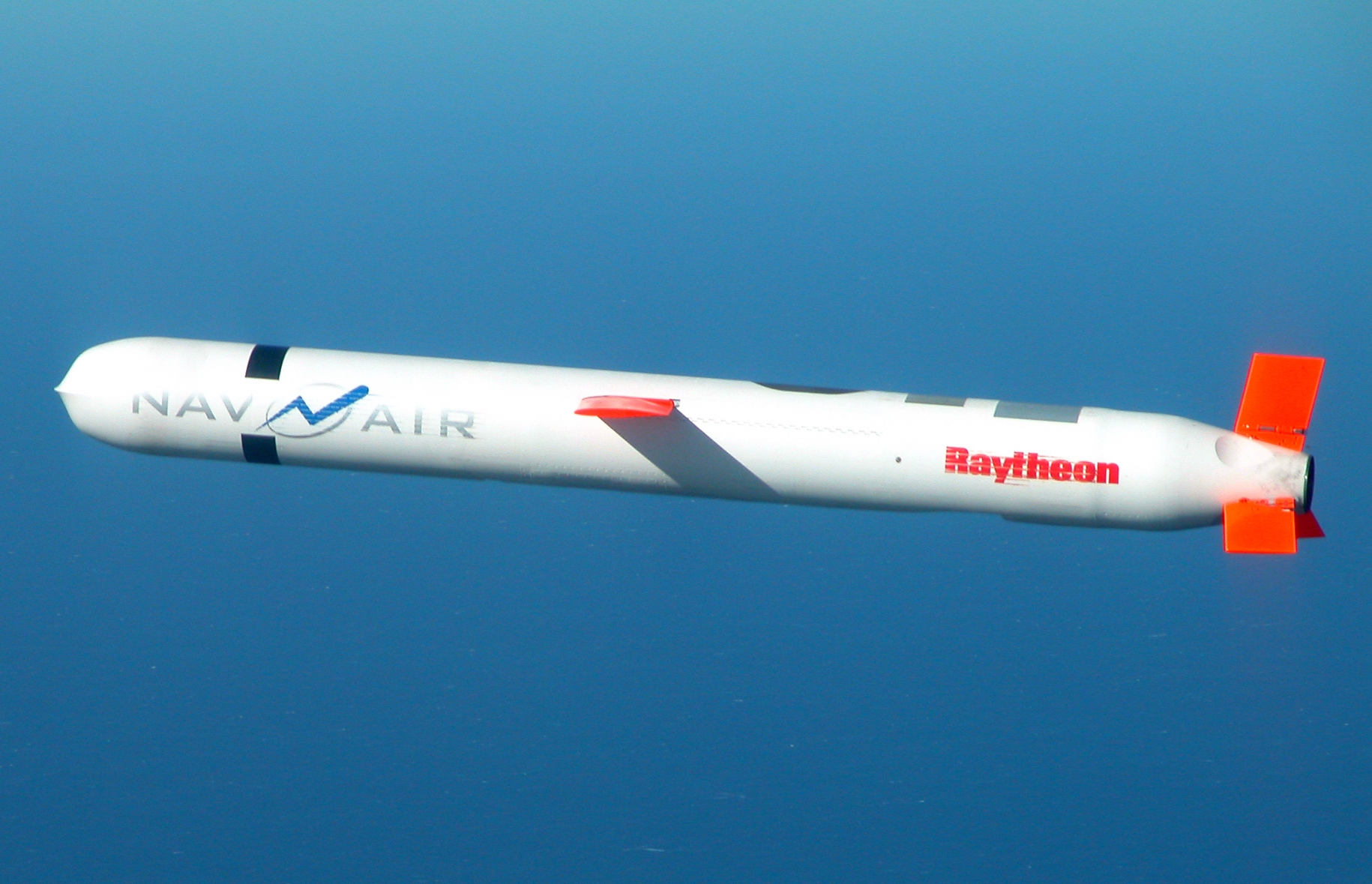
Thanks to its modular architecture, the Tomahawk can be used with various warheads, such as high-explosive submunitions and bunker-busters. The missiles use several guidance technologies, such as GPS, inertial navigation, and terrain contour matching. A satellite data link can also direct Tomahawks to strike another target in midair or hover over it.
While we don’t know which missile was used in the strike, we do know that the Block IV variant of the Tomahawk has a datalink embedded into it that allows switching targets while the missile is in flight and can loiter for a “prolonged duration.”
In contrast, the Block V variant features next-generation technology that enables the weapon to attack moving ships at sea while flying at very low altitudes.
The Tomahawk missiles were widely used in Libya, Syria, and Iraq. They were last used in Iran during the war with Israel when the US bombed Tehran’s nuclear facilities.
- Contact the author at sakshi.tiwari9555 (at) gmail.com
- Follow EurAsian Times on Google News


