

Pakistan has finalized a landmark defense agreement with Libya’s eastern Libyan National Army (LNA) to export 16 JF-17 Thunder multi-role fighters, co-developed with China.
This aligns with China’s broader push to expand its influence in the MENA (Middle East North Africa) region by selling cost-effective, low-restriction military hardware.
Pakistan and the Libyan National Army (LNA), a group headed by Khalifa Haftar that controls eastern Libya, concluded a significant arms contract valued at more than $4 billion last week.
The agreement, billed as the largest-ever arms sale by Pakistan, includes the sale of 16 JF-17 Thunder multi-role fighters, 12 Super Mushak trainer aircraft, equipment for land, sea, and air forces, and provisions for joint training and military manufacturing.
Without giving specifics, the LNA’s official media channel confirmed the agreement, stating that it encompasses collaborative training, military production, and the sale of weaponry.
“We announce the launch of a new phase of strategic military cooperation with Pakistan,” Haftar reportedly told the local media.
This marks the fourth export order for the JF-17, which has also been purchased by Myanmar, Nigeria, and Azerbaijan.
However, the agreement has already come under the scanner for circumventing a United Nations-imposed arms embargo on the strife-torn North African country.
Pakistan and the LNA have reportedly agreed a $4.6bn arms deal despite the UNSEC arms embargo on Libya.
The deal is covering the purchase of 16 JF-17 fighter jets, 12 Super Mushak trainers, 44 Haider main battle tanks, infantry mortars, and a multi-purpose naval vessel. https://t.co/M0mXzDFn4Z pic.twitter.com/KxKe2BT55Q
— Libya OSINT (@Libya24_7OSINT) December 23, 2025
Libya is effectively split into two main rival administrations—the UN-recognized Government of National Unity (GNU), led by Prime Minister Abdul Hamid Dbeibah, which controls Tripoli and parts of western Libya.
In contrast, the Government of National Stability, backed by the Libyan National Army (LNA) under Field Marshal Khalifa Haftar (aged 82), dominates Benghazi, much of the south and east, and key oil-producing regions.
The UN arms embargo was imposed in 2011 and forbids the direct or indirect supply, sale, or transfer of weapons and related materials to or from Libya without UN approval. The embargo seeks to prevent the crisis in the divided nation from getting worse.
While some analysts have criticised the deal as brazenly bypassing the United Nations’ authority, others have pointed to the military support the UN-backed government has received in recent years to support the Pakistan-LNA agreement.
Turkey has supplied Bayraktar TB2 drones to the UN-backed government in Tripoli since 2019, which proved decisive in repelling Haftar’s 2019-2020 offensive on Tripoli by destroying LNA supply lines and air defenses. Additionally, reports indicate that Libya’s Government of National Unity (GNU) has also acquired the Akinci drone and Hurkus-C turboprop trainer and ground-attack aircraft from Turkey.
Some officials from Pakistan contended that sending weapons to the LNA was not expressly forbidden and that there were no direct sanctions against any persons, including Haftar. In fact, even the LNA had earlier received the Chinese Wing Loong II drones, allegedly supplied through the UAE.
JF-17 vs Indian Air Force
Libya’s purchase of the J-17 comes just months after Pakistan deployed the aircraft in an aerial battle with the Indian Air Force (IAF) fighters during the high-voltage May 2025 conflict.
IAF chief Air Marshal A.P. Singh disclosed in October 2025 that the service had managed to destroy 9-10 Pakistani fighter jets, including US-supplied F-16s and Chinese JF-17s.
Pakistan has not acknowledged these claims, and the ambiguity surrounding combat losses, on both sides, continues.
However, for a country like Libya, which has long relied on outdated Soviet-era aircraft like MiG-23s, MiG-29s, and Su-24s, many of which are aging or grounded due to maintenance issues, the fourth-generation JF-17 multi-role aircraft could be a major upgrade.
The JF-17 Thunder is a single-engine, lightweight, multi-role combat aircraft developed jointly by Chengdu Aircraft Corporation and the Pakistan Aeronautical Complex.
With a maximum speed of approximately 1,200 mph and a service ceiling of 50,000 feet, the JF-17 can carry out a variety of tasks, including ground assault and aerial intercept.
The aircraft has seven hard points and can hold over 7,000 pounds of ammo in its twin-barrel 23 mm auto-cannon. It is designed to carry Chinese weaponry on its seven hardpoints, including the LS-6 GPS-guided glide bombs, the PL-5 short-range air-to-air missile, and the YJ-12 supersonic and YJ-83 subsonic anti-shipping missiles. Although not directly integrated, the JF-17 can also be equipped with external pods carrying self-defense jammers and electro-optical/infrared sensors.
While there is no information on which variant of J-17 the LNA has chosen, we know the aircraft has been upgraded multiple times since its inception. For instance, the latest Block III variant features advanced avionics, active electronically scanned array (AESA) radars, and compatibility with long-range missiles.
This JF-17 Block III can be used in a host of combat scenarios. It is capable of carrying a variety of weapons, including air-to-air and air-to-surface weapons, guided and unguided bombs, and anti-ship missiles. It has also been equipped with a PL-15 Beyond-Visual-Range (BVR) missile, which has a range of 300 kilometers.
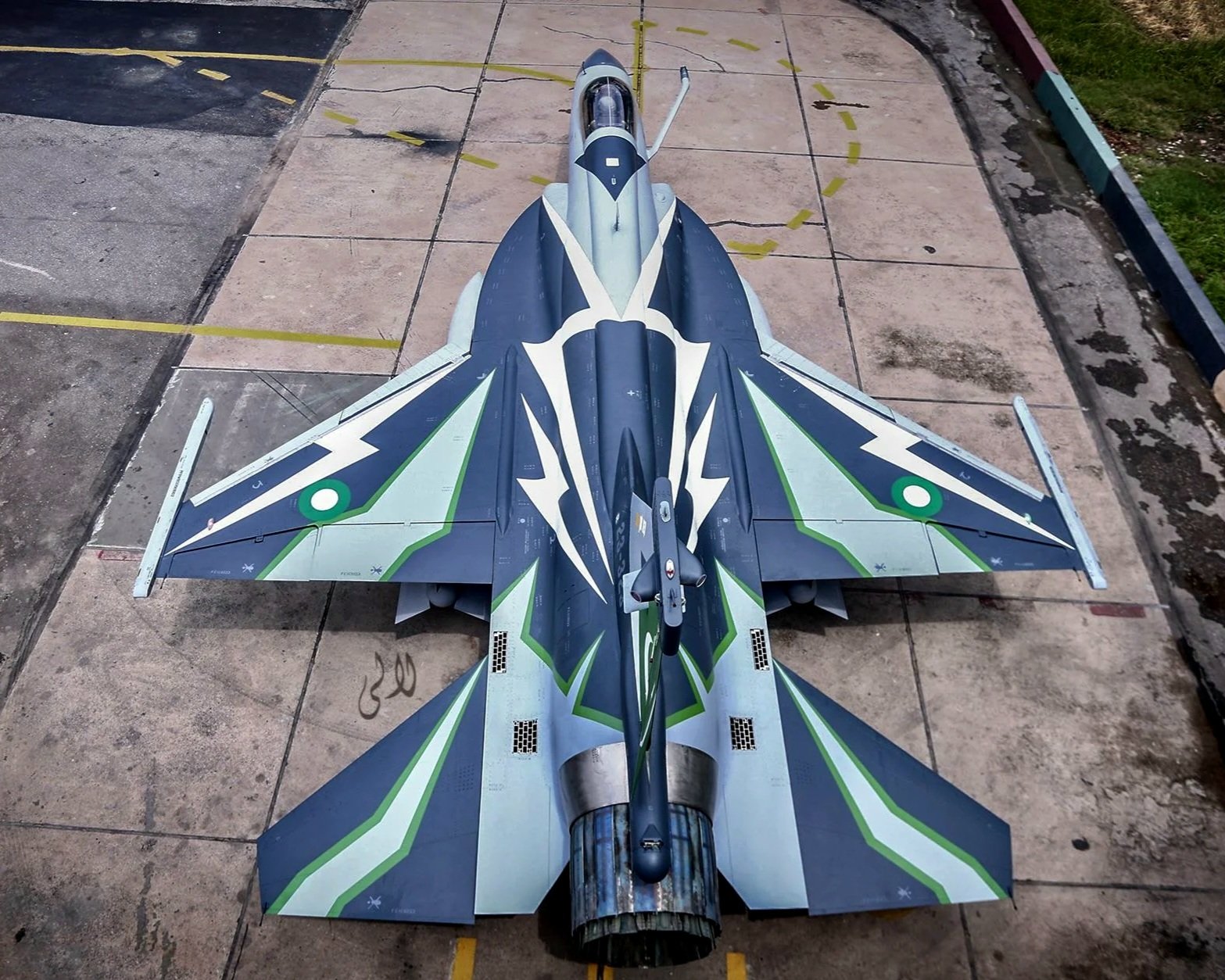
Due to its lower radar cross-section, the JF-17 Block III has better stealth characteristics. The aircraft uses more composites and has better avionics than its predecessors, and it boasts an active electronically scanned array (AESA) radar.
Reports state that the aircraft is equipped with the KLJ-7A airborne active electronically scanned array (AESA) fire-control radar. Additionally, the JF-17 Block III has several notable improvements, including Missile Approach Warning Systems (MAWS), an integrated electronic warfare (EW) suite, a Wide Angle Smart HUD, and additional hard points.
As a lightweight, single-engine fighter, the JF-17 is designed to keep operational and maintenance costs low, making it suitable for resource-constrained environments such as Libya.
It enables rapid response operations, such as armed overwatch for ground forces, quick interdiction strikes, and extended patrols—capabilities that could help secure vast territories and respond to threats from militias or insurgent groups.
A Win For China’s MENA Objectives
The latest deal comes as China expands its military footprint in the MENA region and is attracting customers who may be looking to buy arms from a reliable supplier other than Russia and the United States.
Exploiting the shrinking appeal of Russian equipment caused by the ongoing Ukraine War, China has positioned itself as an alternative supplier, offering cost-effective, advanced jets that can be manufactured and delivered promptly.

It seeks to attract customers on the premise that they would not face US sanctions, i.e., CAATSA (Countering America’s Adversaries Through Sanctions Act). Additionally, Beijing offers flexible payment options.
Amine Ayoub, a Middle East forum fellow based in Morocco, said in a blog on Times of Israel: “The transaction highlights a growing trend in global defense economics: the rise of alternative supply chains that bypass traditional Western and Russian monopolies. This deal is characterized by a “South-South” cooperation model, where a nuclear-armed South Asian power supplies a North African non-state actor (or quasi-state entity) without the political preconditions typically attached to Western arms sales.”
The trend is evident, with countries such as Egypt, Saudi Arabia, and the UAE expressing interest in the Chinese FC-31 stealth aircraft, as noted in a recent Pentagon report on China’s military. Moreover, Beijing has also apparently pitched its J-10C to Egypt and Iran, positioning the aircraft as a better alternative to the US F-16, the European Eurofighter Typhoon, and the French Rafale.
As the Pentagon report stated, “Arms transfers are a component of China’s foreign policy and complement assistance and initiatives that are part of the Belt and Road Initiative.”
In fact, analysts believe that Beijing is trying to effectively replace Russia and challenge the US as the main arms supplier to the MENA region and expand its military footprint.
It’s not only about foreign sales; it’s also a validation of Chinese weapon systems, which have long been dismissed as “untested” or “copycat” technology. The JF-17s were used in the clash with India and stood their ground against superior, combat-tested jets such as the Su-30 MKI and Rafale. The argument that Chinese jets are not combat-tested or have never seen real action would no longer hold water, said defense analyst and editor of EurAsian Times Nitin J Ticku.
The sale of JF-17 to Libya also comes as a major boost to Pakistan’s defense exports, generating revenue, jobs, and validation for the JF-17 program. It effectively positions Pakistan (along with China) as a non-Western supplier offering affordable, no-strings-attached options, expanding influence in North Africa, and aligning with Gulf partners.
- Contact the author at sakshi.tiwari13 (at) outlook.com
- Follow EurAsian Times on Google News


