

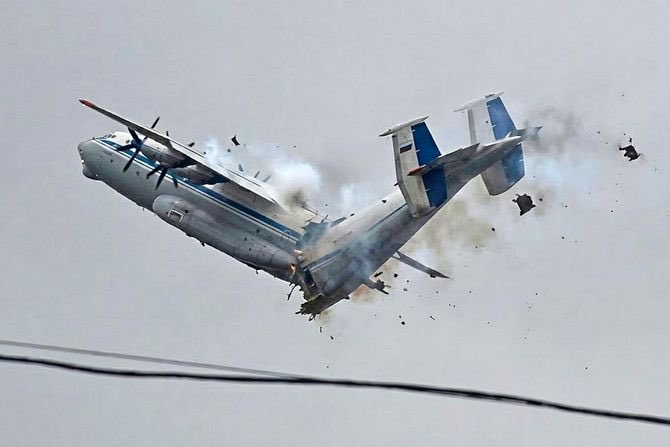
A Russian Aerospace Forces Antonov An-22, the world’s largest turboprop-powered transport aircraft, crashed during a post-maintenance test flight. The footage of the tragic accident has appeared on social media, with analysts lambasting the dismal state of Russian military aviation.
The crash occurred in Russia’s Ivanovo region, near the Uvodskoye Reservoir, on December 9, 2025. Footage of the incident was published by the Russian Telegram channel Mash on December 14, showing the last moments before the aircraft went down, killing all seven crew members onboard.
Notably, the An-22 broke apart mid-air before crashing into the Uvodskoye Reservoir. Video footage clearly shows the fuselage splitting into two main sections, with the tail detaching as the aircraft rapidly descended in an uncontrolled spiral.
The visible structural failure during the steep dive strongly points to a catastrophic in-flight breakup, leaving little chance for recovery.
According to some observers, some crew members onboard the aircraft tried unsuccessfully to escape their fate. “It is possible that at least 2 Russian crew members (load masters) likely attempted to parachute from the plane. Both appear to have suffered malfunctions. On the right, one became totally entangled in his ‘chute (called a horseshoe malfunction)– this is a non-recoverable malfunction. And the other, on the left, apparently suffered a ‘line over’ malfunction, where some shroud lines become entangled above the canopy,” Chuck Pfarrer, a former SEAL and correspondent with Kyiv Post, wrote on social media site X.
The Antonov An-22 “Antei” is a Soviet-designed heavy military transport aircraft, notable for being the largest turboprop-powered airplane ever built. It entered service in 1967 as a strategic and tactical airlift aircraft.
It was designed to carry extremely heavy and bulky cargo that other aircraft of its era could not, and was capable of operating from short, rough, or unprepared runways, including dirt and grass.
This set the An-22 apart, making it a truly special aircraft back in the day. However, it was gradually replaced by jet-powered aircraft like the Il-76 and An-124.
A video appeared in Russian media allegedly showing the crash of the Russian An-22 aircraft. It started falling apart in the air.
The aircraft was newly renovated and was on a test flight. https://t.co/wwNIr3WOBR pic.twitter.com/w91JA7FBcg
— Anton Gerashchenko (@Gerashchenko_en) December 14, 2025
Reports stated that the An-22 involved in the crash was the last operational aircraft of the type. Unverified reports in August 2024 claimed that Russia had ceased operations of its An-22 fleet.
The final example, registered number RF-09309, was reportedly flown on August 16, 2024, from its home base of Migalovo in the Tver area of western Russia to Yekaterinburg in the Ural Federal District.
The aircraft was expected to be permanently displayed at Verkhnyaya Pyshma’s military museum, but it never arrived.
Some observers surmised that Russia may have decided to restore the An-22 despite its retirement, to fill the gap created by the loss of multiple Il-76 aircraft during the ongoing conflict, adding that the incident serves as a grim reminder of the dismal state of Russian airlift capabilities.
Although Russian officials are still conducting an investigation to determine the precise cause of the crash, sources cited in Russian media and aviation outlets have attributed it to a “technical malfunction.”
In fact, a preliminary report from the Russian Telegram channel Mash suggests that the failure of control actuators is likely due to poor servicing during maintenance.
Some experts said the crash could have been caused by long-term metal fatigue in aging Soviet-era airframes, compounded by challenges sourcing parts from the original Ukrainian Antonov bureau due to the ongoing war. Meanwhile, others conjectured that the recent maintenance or repairs may have contributed to the aircraft’s structural failure.
It is pertinent to note that even though the mid-air disintegration of the aircraft has cast doubt on the state of Russian military aviation, this is not the first time we have seen an aging aircraft split in two.
Many Such Cases In The Past
Several notable incidents involving military aircraft have resulted in mid-air structural breakups, in which the plane splits into pieces due to failure rather than an explosion or collision.
These are often caused by metal fatigue, excessive stress, age-related degradation, or maintenance issues, much like the latest An-22 disintegration.
These events often result in total loss of the aircraft and high fatalities, as the breakup leaves little chance for controlled recovery.
In November 2025, for instance, a 57-year-old Turkish C-130E broke apart mid-air at around 24,000 feet while en route from Azerbaijan to Turkey, before crashing near the Georgia-Azerbaijan border.

A video of the incident showed both the front section, housing the flight deck, and the entire tail end of the aircraft being severed. All 20 military personnel onboard were killed in the accident, which was attributed to factors like structural fatigue, propeller failure, or age-related issues in Turkey’s aging C-130 fleet.
More visuals of the disintegrated debris of Turkish Air Force Hercules C130 (68-01609) falling from the sky.#aircraft #accident https://t.co/p7cDrP7gQW pic.twitter.com/kpGnb485ut
— FL360aero (@fl360aero) November 11, 2025
In July 2017, a KC-130 belonging to the US Marine Corps (USMC) similarly crashed after being disintegrated mid-air over Mississippi during a routine flight.
It was later revealed that a corroded propeller blade detached in flight, slicing through the fuselage and causing rapid structural failure. The wing box separated, and the aircraft disintegrated. All 16 personnel were killed.
A decade before this incident, a US Air Force (USAF) F-15C air superiority fighter broke apart mid-flight in November 2007, during a training flight over Missouri. It was later determined that a failure of the upper right longeron, a critical support structure in the F-15C Eagle, led to the incident.
“According to the Air Combat Command Accident Investigation Board report released Jan. 10, a technical analysis of the recovered F-15C wreckage determined that the longeron didn’t meet blueprint specifications. This defect led to a series of fatigue cracks in the right upper longeron. These cracks expanded under life cycle stress, causing the longeron to fail, which initiated a catastrophic failure of the remaining support structures and led to the aircraft breaking apart in flight,” stated the accident report.
In January 1961, a B-52 Stratofortress strategic bomber carrying two 3.8-megaton Mark 39 nuclear bombs disintegrated mid-air due to a fuel leak, which caused it to drop its nuclear payload.
This may be an incomplete list of similar incidents that split mid-air before they crashed, sometimes killing all crew on board, and some with survivors. While many of these incidents could be blamed on structural failures, others have been attributed to mid-air collisions and other accidents.
- Contact the author at sakshi.tiwari13 (at) outlook.com
- Follow EurAsian Times on Google News


