

Russia has transformed Iran’s “notorious” Shahed-136 kamikaze drone into a MANPAD (Man Portable Air Defense System) carrier, continuing the spate of innovation in drone warfare in the Ukraine War.
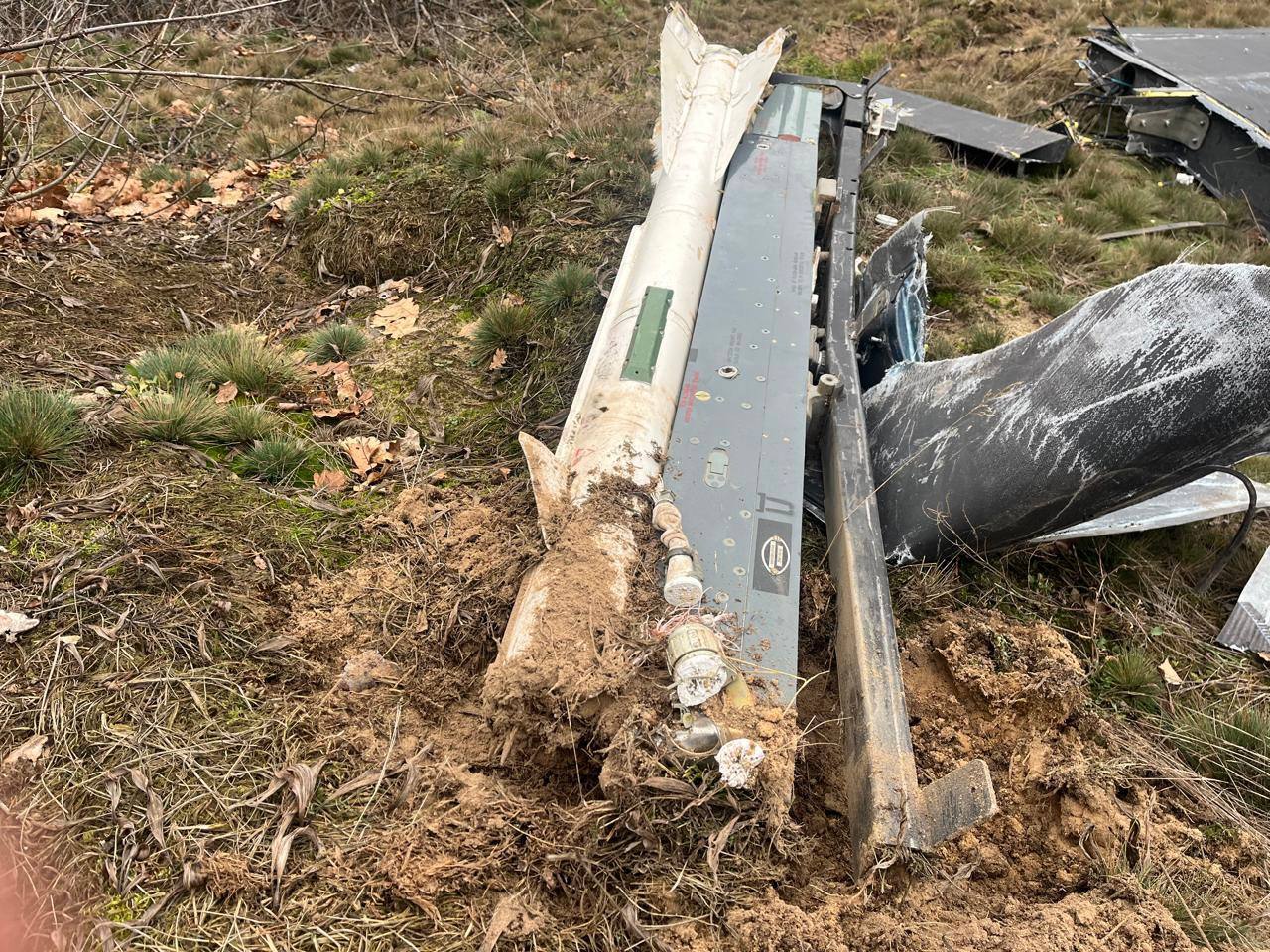
The discovery was made when the wreckage of a Shahed-136, produced and fielded under the name ‘Geran-2’ by Moscow, was recovered in a nearly intact state in the Chernihiv region, after being downed by Ukraine’s Darknode battalion of the 412th Nemesis Brigade.
The images of the drone first appeared on the Telegram channel of Ukrainian radio and electronic warfare expert Serhii “Flash” Beskrestnov, and show the drone lying upright in the snow, with only the propeller of its four-cylinder piston engine seen broken.
The MANPADS installed on the drone has been identified as the Verba system based on markings on the transport-launch container (9K333/9P521) and visual distinctions from older Igla-series tubes, as reported by a prominent Ukrainian military website.
Developed to replace the popular Igla, Verba is a fourth-generation Russian MANPAD designed for short-range anti-aircraft defense.
Since 2015, it has been delivered to multiple Russian units, including motorized rifle brigades, tank brigades, and airborne troops (VDV). The system has seen extensive combat use in the ongoing Ukraine War, where it has been employed against aircraft, helicopters, drones, and cruise missiles so far.
For the first time, Shahed equipped with a MANPADS has been detected.
This Shahed was equipped with a camera, radio modem and is remotely controlled from Russia. pic.twitter.com/uSvIdMCa7y
— Special Kherson Cat 🐈🇺🇦 (@bayraktar_1love) January 4, 2026
At the heart of Verba’s lethality is the 9M336 missile, which features a multispectral optical seeker employing three sensors—the ultraviolet (UV), near-infrared (NIR), and mid-infrared (MIR).
This tri-spectral setup enables cross-verification of targets, significantly improving discrimination between actual threats and decoys or countermeasures such as flares and lasers, and providing up to 10 times greater resistance to jamming than predecessors.
Notably, the drone has been equipped with a forward- or rear-facing camera and a mesh radio modem for real-time control from operators on Russian territory.

The operator likely maneuvers the slow-flying drone to allow the Verba’s multispectral seeker to lock onto a target, followed by a remote launch.
By deploying Shahed-136 armed with MANPADS, Russia seeks to directly threaten high-value, slow-moving targets such as Mi-8 and Mi-24 helicopters and potentially even fixed-wing aircraft, which have allegedly been forced to fly at lower altitudes due to the threat of long-range attacks from Russian Su-35s.
Detailed look on a Russian Shahed with an installed 9K333 Verba MANPADS. https://t.co/v4NWR6JEC8 pic.twitter.com/aS4R5KPO0N
— Special Kherson Cat 🐈🇺🇦 (@bayraktar_1love) January 4, 2026
As consistently seen in the ongoing war, small kamikaze drones pose a serious threat to slower-moving, lower-flying helicopters. The addition of a heat-seeking missile should further amplify the threat.
This follows a similar but distinct experiment in late 2025, where Geran-2 drones carried Soviet-era R-60 (AA-8) air-to-air missiles on pylons, as previously reported by the EurAsian Times.
At the time, experts reckoned that the R-60 was lighter than most anti-tank missiles (44 kilograms in weight and 2.1 meters in length) and could be carried by almost anything that flies, explaining its easy integration with the Shahed-136.
It is pertinent to mention here that integrating Verba with the Shahed is much easier, with some analysts referring to it as “garage level.”
This is primarily because the MANPAD could be fastened onto the drone using its standard launch tube, rather than a launch rail adaptor required to integrate the R-60. Additionally, the MANPAD arrangement is lighter and might better suit the Shahed’s limited payload than the heavier R-60 missiles.
This does not, however, mean that the R-60s would be replaced with MANPADS going forward. In fact, Moscow might field a combination of both as part of its sustained combat innovation, particularly concerning low-cost drones.
A Shahed/Geran equipped with an R-60 or a MANPADS might be able to operate the missile using beyond-line-of-sight capabilities. And even if Russia doesn’t arm all its Shahed-136 drones, the uncertainty would essentially force Ukrainian pilots to adopt more cautious tactics, such as maintaining greater distances or relying more on ground-based or drone interceptors, such as the STING.
Shaheds Have Their Own Blinding Lights
Earlier this week, a Shahed drone was spotted in Ukraine equipped with a rear-facing infrared LED “flashlight” intended to confuse helicopter pilots wearing night-vision goggles.
Ukrainian expert Serhiy Beskrestnov posted a photo of the drone on Telegram along with a message that read, “This is the first time I’ve seen this in Shahed. This is an IR (infrared) searchlight to blind anti-aircraft drones and aircraft. The enemy continues to work on countermeasures.”
During a press conference in September 2025, Oleksandr Syrskyi, the Commander-in-Chief of the Armed Forces of Ukraine, reportedly said that up to 40% of the drones in their operational regions are shot down by Ukrainian helicopters. These new LED flashlights are meant to evade that threat.
An infrared searchlight installed by Russians on the Shahed in an attempt to blind interceptor drones https://t.co/MK4oBT7YhZ pic.twitter.com/gpcBmIJGKp
— Special Kherson Cat 🐈🇺🇦 (@bayraktar_1love) January 2, 2026
Additionally, it could even blind Ukrainian interceptor drones equipped with basic infrared sensors for nighttime interception, as noted by Indian Air Force veteran and military commentator Vijainder K. Thakur.
Interceptor drones often ram into Geran-2 drones in midair using infrared sensor guidance, while others are equipped with small arms. These low-cost interceptor drones are guided to their targets either visually or using radar tracks after launch.
Thakur said, “The rear-facing Geran IR flashlight would not be effective against interceptor drones equipped with high-quality thermal imagers.” However, he added, “such drones would be significantly more expensive, adversely impacting the cost-benefit ratio.”
Designed by Iran and mass-produced under license by Russia with substantial modifications, the Shahed-136 suicide drones have emerged as Moscow’s weapon of choice in the Ukraine War.
Russia also uses these drones to launch scores of decoys in an attempt to overwhelm and deceive Ukrainian air defense systems.
The Shahed-136 drone operates autonomously, meaning it does not require real-time human control after launch. However, certain upgrades, such as arming the drone with MANPADS or air-to-air missiles, have brought the human role back into operations.
Last year, the drone was reportedly upgraded and equipped with electro-optical sensors. At the time, analysts said the Russians were equipping the kamikaze drones with cameras for visual reconnaissance.

The interceptor version of the Geran drone operates in a swarm with other Geran drones configured for decoy operations, electronic warfare, photo reconnaissance, ELINT, and communication relay.
Additionally, reports suggest that the drones are now more resistant to electronic warfare (EW) thanks to Chinese-developed CRPA (Controlled Reception Pattern Antennas) antennas installed within their fuselage.
Compared to FPV drones or loitering munitions like the Lancet, they have a significantly bigger warhead. Additionally, they are more effective as they fly at higher altitudes, staying out of the effective range of MANPADS and air defense guns.
Russian forces have reportedly fielded a jet-powered variant of the Shahed-136 or Geran-2, known as the Shahed-236.
More recently, a Shahed-107 reconnaissance and strike drone designed for targeted strikes on high-value assets, such as military equipment or infrastructure, was also spotted.
The Shahed kamikaze drones provide Russia with an expendable and cost-effective alternative to its expensive cruise and ballistic missiles.
- Contact the author at sakshi.tiwari13 (at) outlook.com
- Follow EurAsian Times on Google News


